

Resources Categories
INDUSTRY FACT FILE · AGRICULTURE & AGRITECH
Threat Landscape: Top Cyber Threats Facing Agriculture and Agritech
The 18 most relevant cyber threats, attacks and industry challenges for agribusinesses, seed and agri-input companies, farm IoT providers, marketplaces, warehousing and agri-credit platforms, FPOs and cooperatives, and the impact each has.
|
In this document 1. The threat picture in numbers 2. Top 18 threats, attacks and challenges 3. Threat relevance by agriculture and agritech segment 4. Five priority threats in depth 5. Impact on agriculture and agritech businesses and the farmers they serve 6. How regulation turns incidents into business events 7. Questions every leadership team should ask |
1. The threat picture in numbers
|
~5.5 lakh Ineligible PM-KISAN payees added via misused logins (TN, 2020) |
US$11 m Ransom JBS paid to end its 2021 attack |
US$5.9 m Ransom demanded from NEW Cooperative (2021) |
6 hours To report incidents to CERT-In |
Agriculture and agritech businesses face attackers with different aims. Criminal groups use ransomware against cooperatives, processors, input firms and platforms because downtime during sowing, harvest or a payout window creates pressure to pay, and the FBI warned in April 2022 that attacks on agricultural cooperatives may be timed to those seasons. Fraudsters target payment flows, subsidies, loans and warehouse receipts, often by misusing the credentials of officials, field agents, dealers or traders rather than by breaking encryption. Opportunistic attackers scan the internet for exposed gateways, controllers, management interfaces and storage buckets. Competitors and insiders seek breeding data, trial results and pricing. Researchers find flaws in devices and apps, which become public quickly, and vendors and integrators deep in the chain can introduce weaknesses without anyone noticing.
Public reporting shows how these risks have played out. In August 2020 Tamil Nadu reported that officials' login credentials had been misused to register about 5.5 lakh ineligible PM-KISAN beneficiaries in 13 districts, with more than ₹110 crore transferred before the surge was noticed. JBS paid US$11 million in June 2021 to end a ransomware attack that disrupted meat production in North America and Australia. In September 2021 BlackMatter ransomware hit the Iowa grain cooperative NEW Cooperative, with a reported demand of US$5.9 million, and Minnesota's Crystal Valley cooperative was hit days later, both during harvest. At DEF CON in 2021, researchers reported vulnerabilities in web systems of major farm equipment makers, later fixed. As Indian farming moves onto AgriStack, e-NAM, DBT and digital credit, the same patterns of credential misuse, platform flaws and seasonal ransomware apply.
2. Top 18 threats, attacks and challenges
The list below is a practical assessment framework, not a statistical ranking. Priority varies by business model, technology exposure and existing controls.
|
# |
Threat / attack / challenge |
Typical scenario |
Most exposed |
Potential impact |
|
1 |
Farm IoT device and gateway compromise |
Attackers reach sensors, gateways or irrigation controllers through default passwords, open ports or unsigned firmware |
Farm IoT providers, irrigation and greenhouse operators |
False readings, unwanted commands, crop stress |
|
2 |
Machinery telematics and agri-drone platform abuse |
Takeover of telematics, drone fleet or ground control accounts and their APIs |
Machinery, drone and custom hiring services |
Fleet misuse, data leaks, safety risk |
|
3 |
Marketplace and trading platform API flaws |
Broken authorisation in trading, bidding and order APIs exposes or alters others' trades |
Agritech marketplaces, commodity platforms |
Manipulated trades, data exposure, lost partners |
|
4 |
Payment integration and settlement fraud |
Unverified payment callbacks or flawed settlement logic release money for unpaid trades |
Marketplaces, input e-commerce, FPO platforms |
Direct financial loss, partner disputes |
|
5 |
Farmer, trader and dealer account takeover |
Credential stuffing, SIM swap or OTP phishing against farmer, trader and dealer accounts |
Marketplaces, dealer portals, farmer apps |
Diverted payouts, fraudulent orders |
|
6 |
Farmer data exposure and consent failures |
Farmer identity, land, crop and bank data collected without clear consent or leaked |
All platforms holding farmer data |
DPDP exposure, loss of farmer trust |
|
7 |
Misuse of public platform and scheme credentials |
Misuse of official, operator or integrator logins to public scheme and registry portals |
Integrators, service centres, cooperatives |
Ineligible payments, fake records, recoveries |
|
8 |
Agri-loan, subsidy and warehouse receipt fraud |
Forged land, crop or receipt documents and fake beneficiaries in loans and subsidies |
Agri-credit platforms, lenders, warehouses |
Credit losses, lender and regulatory action |
|
9 |
Warehouse, cold store and processing OT tampering |
Intrusion into weighbridge, dryer, cold room, sensor and camera networks |
Agribusiness, warehouses, cold stores |
Spoilt stock, false weights, shutdowns |
|
10 |
Ransomware timed to sowing and harvest seasons |
Encryption of procurement, ERP, grading and payment systems in peak season |
Cooperatives, processors, input firms |
Halted procurement, delayed farmer payments |
|
11 |
Cloud misconfiguration and exposed data stores |
Public storage buckets, open databases and weak cloud identity |
Agritech start-ups, IoT and lending platforms |
Mass data exposure, platform takeover |
|
12 |
Counterfeit input codes and dealer portal fraud |
Cloned traceability codes and abuse of dealer incentive and stock portals |
Seed and agri-input companies |
Counterfeit sales, incentive fraud, brand harm |
|
13 |
Theft of breeding data, trait IP and R&D |
Exfiltration of breeding, trait, trial and formulation data by outsiders or leavers |
Seed and crop protection companies |
Lost competitive advantage, litigation |
|
14 |
Phishing and payment diversion in commodity trade |
Spoofed emails and changed bank details in commodity, input and export deals |
Agribusiness, traders, exporters |
Misdirected payments, disputes |
|
15 |
Field agent mobile app and device risks |
Phished, shared or lost field agent tablets and apps storing farmer data offline |
Agri-credit, input and FPO platforms |
Fraudulent applications, data leaks |
|
16 |
AI advisory, analytics and model data risks |
Manipulated inputs, prompt abuse or leakage of farmer data through AI advisory tools |
Advisory, analytics and marketplace platforms |
Wrong advice, data leaks, liability |
|
17 |
Vendor, integrator and SaaS supplier risk |
Weak security at device makers, cloud vendors, integrators and service centres |
All segments, especially lean platforms |
Inherited breaches, supply chain intrusion |
|
18 |
Weak logs, monitoring and 6-hour reporting |
No device, platform, payment and cloud logging or 24x7 monitoring |
Start-ups, FPO platforms, smaller cooperatives |
Missed reporting, unprovable timelines |
3. Threat relevance by agriculture and agritech segment
The matrix is a qualitative guide for prioritising the first round of security reviews.
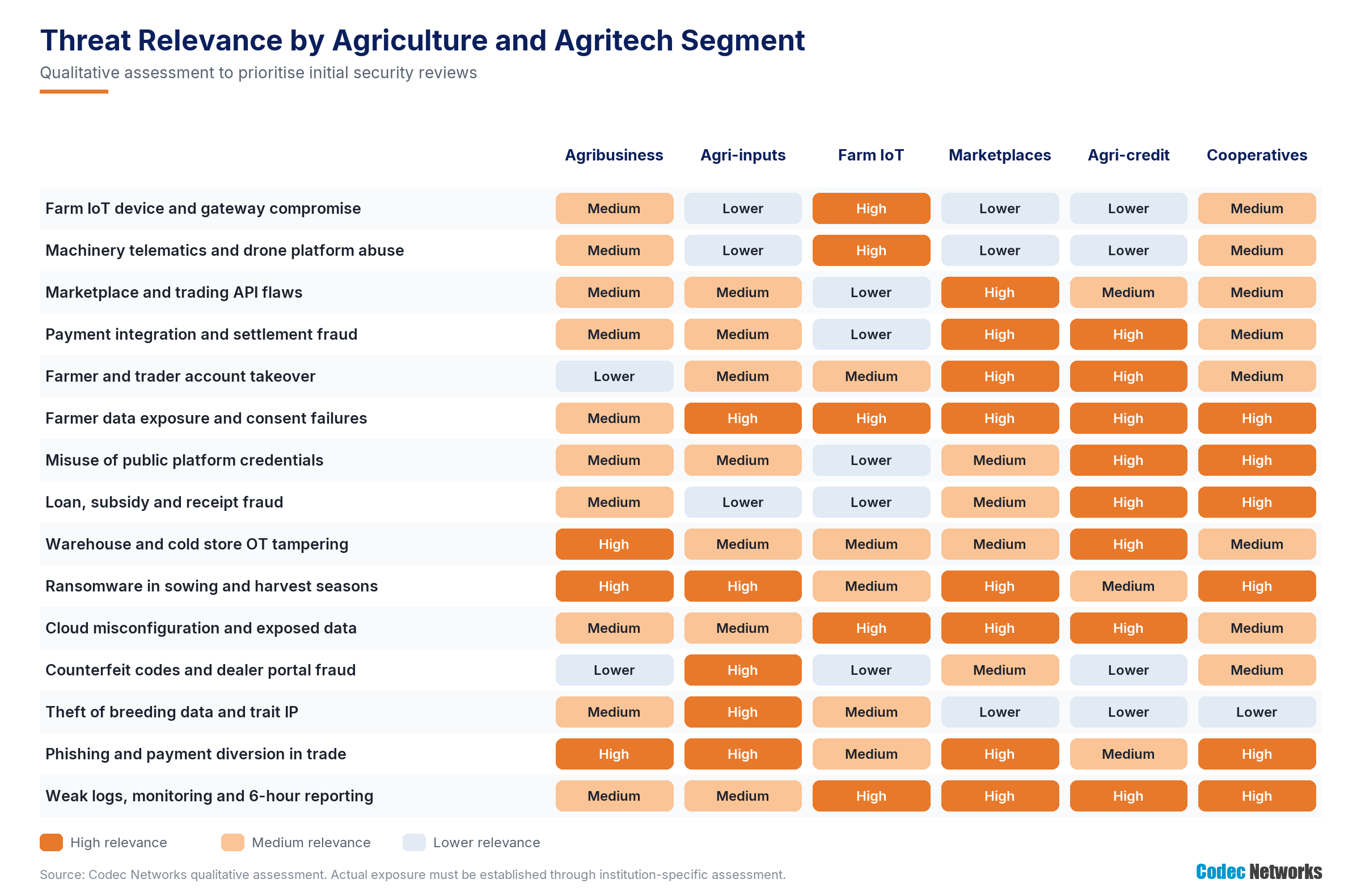
Figure 5: Qualitative threat relevance by agriculture and agritech segment (Codec Networks assessment).
4. Five priority threats in depth
4.1 Farm devices, gateways and the cloud broker
Precision farming platforms connect thousands of low-cost sensors, gateways and controllers to one cloud message broker. Default or shared passwords, open management ports, unsigned firmware and brokers that let any device publish to any topic mean that one weakness can expose every farm on the platform. False readings can drive wrong irrigation or spraying decisions, and remote commands can switch pumps and valves. Devices sit in remote fields for years, so weaknesses persist.
- Questions to test: Does every device have unique credentials? Are management ports closed? Is firmware signed and are updates verified? Can one device or farm reach another's data or commands on the broker? Are command rates and ranges limited? Would we notice abnormal readings or commands?
- Relevant services: IoT device and firmware testing, broker and cloud architecture review, device identity design, authorised testing scheduled around field operations and SOC use cases for device anomalies.
4.2 Payment integrations and settlement
Marketplaces, input e-commerce and FPO platforms collect and pay out money through gateways, UPI, bank APIs and DBT-linked flows. The most damaging flaws are logical: trusting a payment callback without checking its signature and amount, processing the same message twice, or releasing payouts before reconciliation. Fraudsters probe these flows quickly, and losses can mount for days before finance teams notice.
- Questions to test: Do we verify the signature, amount and order of every callback? Are duplicate and replayed messages rejected? Do payouts wait for server-side reconciliation? Are bank detail changes verified out of band? Would we notice unusual payout patterns?
- Relevant services: payment integration testing, settlement logic and API VAPT, reconciliation and fraud control reviews, and monitoring of payout anomalies.
4.3 Credentials to public platforms, lenders and partners
Agritech firms, integrators, service centres and cooperatives increasingly hold logins and API keys to scheme portals, registries, lenders and insurers. The 2020 PM-KISAN case in Tamil Nadu showed how misused official credentials can add lakhs of ineligible beneficiaries before anyone notices. Shared accounts, no MFA, weak key storage and no monitoring of who registers or changes records make such abuse easy.
- Questions to test: Who holds logins and API keys to public and partner platforms? Are they named, MFA-protected and reviewed? Are keys stored in a vault? Are unusual volumes of registrations or changes flagged? Do consent records match each data request?
- Relevant services: integration and access control reviews, privileged access management, API key handling reviews, monitoring of registration and change volumes and DPDP consent reviews.
4.4 Agri-credit, field agents and document fraud
Agri-credit platforms originate loans through field agents' tablets and farmer apps, using land records, crop data and warehouse receipts. A phished agent account, an app that stores data on lost devices or a workflow that accepts uploaded documents without checking them at source can turn into fraudulent loans to mule accounts. Lenders and RBI's digital lending rules hold the regulated entity responsible for its partners.
- Questions to test: Do agent accounts use MFA and device binding? Are land, crop and receipt data verified at source rather than from uploads? Are velocity and anomaly rules in place? Is data on agent devices encrypted and wiped when lost? Can we give the lender a complete audit trail?
- Relevant services: mobile app and loan API testing, access and device management review, fraud control reviews, DPDP programmes and incident response for loan fraud.
4.5 Seasonal ransomware at procurement, storage and plants
Cooperatives, agribusinesses and input firms run procurement centres, warehouses, dryers, cold stores and plants whose IT and OT are often flat, reachable through remote access and backed up to shares attackers can reach. The FBI's 2022 warning and the 2021 attacks on US grain cooperatives show that attackers know harvest is when downtime hurts most. Recovery must be possible within days, not weeks.
- Questions to test: Are office, weighbridge, dryer and plant networks segmented? Is all remote access MFA-protected? Are backups offline and tested? Can we buy, weigh, store and pay manually for a week? Is monitoring strengthened during sowing and harvest?
- Relevant services: OT and network assessments, ransomware readiness and backup testing, managed SOC with harvest-season monitoring, tabletop exercises and an incident response retainer.
5. Impact on agriculture and agritech businesses and the farmers they serve
|
Player type |
Threats to prioritise |
Main impact |
|
Agribusiness and cooperatives |
Seasonal ransomware, OT tampering, payment diversion |
Halted procurement, spoilt stock, delayed farmer payments |
|
Seed and agri-input companies |
Counterfeit codes, dealer fraud, IP theft, ransomware |
Revenue loss, brand damage, lost R&D advantage |
|
Precision farming and farm IoT |
Device and broker compromise, cloud exposure |
Crop losses, client churn, liability claims |
|
Marketplaces and commodity platforms |
Payment fraud, API flaws, account takeover |
Financial loss, partner exits, DPDP exposure |
|
Warehousing and agri-credit platforms |
Loan and receipt fraud, agent compromise, data leaks |
Credit losses, lender and regulatory action |
|
Farmers and FPOs |
Diverted payments, exposed identity and land data |
Lost income, fraud risk, loss of trust in digital services |
6. How regulation turns incidents into business events
- CERT-In: incidents reported within six hours of noticing them; logs kept for 180 days in India and available for investigation; CERT-In may issue directions and advisories.
- RBI and lending partners: incidents at lending service providers and loan apps draw in the regulated entity, which may suspend the partnership, demand audits and report fraud under its own obligations.
- Scheme and AgriStack owners: misuse of integrations or credentials can lead to suspended access, recoveries and investigations by state and central authorities.
- WDRA and lenders: incidents affecting warehouse receipts or stock records raise questions under accreditation conditions and pledge agreements.
- DPDP Act: breach intimation and safeguards for farmer and borrower data once provisions commence; SEBI LODR disclosure for listed firms.
- Buyers and partners: processors, exporters, insurers and investors can suspend contracts, demand audits or exercise security clauses after incidents.
|
Insight The most damaging agriculture incidents have not needed sophisticated attacks. They begin with a default device password, an unverified payment callback, a shared official login, a phished field agent or an open cloud bucket, and end as false commands, paid-out losses, fraudulent loans, exposed farmers or a harvest without systems. Testing devices, platforms, payments, access and cloud together is the best defence. |
7. Questions every leadership team should ask
- If ransomware struck in harvest week, could we still buy, weigh, store and pay for crops?
- Does every device on our platform have unique credentials and verified firmware?
- Do we verify every payment callback and reconcile before money leaves?
- Who holds logins and API keys to public, lender and partner platforms, and are they protected and monitored?
- Where is our farmer, land and borrower data, and who can reach it today?
- Could we detect, contain and report an incident within six hours, including at night and in peak season?
Talk to Codec Networks
|
Contact Codec Networks Pvt. Ltd. New Delhi: 507, 5th Floor, New Delhi House, Barakhamba Road, Connaught Place, New Delhi – 110001 Gurugram: 707, 7th Floor, Silverton Tower, Golf Course Extension Road, Sector 50, Gurugram – 122018, Haryana Landline: 011 430 496 96 | 011 437 522 99 Mobile: +91 99716 76124 | +91 88007 88220 | +91 88003 31124 Email: mktg@codecnetworks.com Web: www.codecnetworks.com |
Note: Threat descriptions and relevance ratings are general guidance, not findings about any specific organisation, platform or scheme. Public incident references are summarised from official statements and widely reported events. Attack techniques are described only at the level needed to explain defences, and testing of devices, drones and payment systems is described only as authorised testing in agreed windows and controlled conditions.