

Resources Categories
INDUSTRY FACT FILE · BANKING
Main Products and Services in the Banking Sector
What banks offer their customers, the systems that deliver each product, and where those systems create cybersecurity and compliance exposure.
|
In this document 1. How banks earn their money 2. Products and services by customer segment 3. Deposits, lending and payments in detail 4. Transaction banking, treasury and distribution 5. Digital banking and partner ecosystems 6. The systems behind the products 7. Product trends that change the attack surface 8. Mapping products to Codec Networks engagements |
1. How banks earn their money
A bank's business model rests on four pillars: taking deposits, lending, moving money and earning fees for services. Every pillar now depends on technology, and each creates a distinct type of cyber exposure.
|
Revenue stream |
How it works |
Security relevance |
|
Net interest income |
Interest earned on loans and investments minus interest paid on deposits |
Loan origination, core banking and treasury systems must be trustworthy and available |
|
Fee and commission income |
Cards, payments, transaction banking, account services, lockers, forex |
Card switches, payment gateways and digital channels are prime fraud targets |
|
Treasury and markets income |
Trading in government securities, forex and money markets |
Dealing systems, SWIFT and settlement interfaces need strict access control |
|
Distribution income |
Selling insurance, mutual funds and other third-party products |
Customer data shared with partners must be protected and minimised |
|
Government business |
Tax collection, pension disbursement, welfare transfers, agency business |
High-volume, high-visibility services with zero tolerance for outage or error |
2. Products and services by customer segment
|
Customer segment |
Main products |
Main services |
|
Retail customers |
Savings and current accounts, fixed and recurring deposits, home, vehicle, personal, education and gold loans, credit and debit cards |
Internet and mobile banking, UPI, bill payments, lockers, wealth and insurance distribution, NRI services |
|
MSMEs |
Working-capital loans, term loans, overdrafts, trade finance, merchant acquiring |
Cash management, GST and tax payments, POS and QR acceptance, supply-chain finance, TReDS |
|
Corporates |
Term loans, working capital, structured finance, bank guarantees, letters of credit |
Transaction banking, payroll, liquidity management, host-to-host and API banking, forex and derivatives |
|
Government and PSUs |
Government accounts, deposits, project and infrastructure finance |
Tax and fee collection, pension and subsidy disbursement, Direct Benefit Transfer, treasury services |
|
Rural and agricultural customers |
Kisan Credit Card, crop and farm loans, SHG and microfinance lending |
Business correspondent services, Aadhaar-enabled payments, government scheme accounts |
|
Financial institutions and fintechs |
Correspondent and sponsor-bank services, co-lending, escrow and nodal accounts |
Sponsor-bank services for UPI and payment aggregators, banking-as-a-service, settlement |
3. Deposits, lending and payments in detail
3.1 Deposits
Savings, current, fixed and recurring deposits are the foundation of the bank's balance sheet and its customer relationship. Account opening increasingly happens through video-based KYC (V-CIP) and digital onboarding, which makes identity verification controls and device security central to fraud prevention.
3.2 Lending
Banks lend to retail, MSME, corporate, agricultural and government customers. Retail lending is now heavily digital, with loan origination systems integrated with credit bureaus, Account Aggregators, lending service providers and co-lending NBFC partners. Each integration carries customer data and credit decisions across organisational boundaries.
3.3 Payments
Banks operate or participate in every major payment rail: UPI and IMPS through NPCI, NEFT and RTGS through RBI, card networks, NACH mandates, Bharat Bill Payment System, Aadhaar-enabled payments and SWIFT for cross-border transfers. Banks also act as sponsor banks for UPI apps and as escrow banks for payment aggregators.
|
Authentication is changing From 1 April 2026, RBI's Authentication Directions require domestic digital payment transactions to use at least two factors of authentication, with at least one dynamic factor, while allowing banks to adopt alternatives to SMS OTP such as biometrics and device-bound tokens. |
4. Transaction banking, treasury and distribution
- Transaction banking: cash management, collections, payables, payroll, liquidity and escrow services, increasingly delivered through host-to-host connections and APIs integrated with corporate ERP systems.
- Trade finance: letters of credit, bank guarantees, export and import finance, often relying on SWIFT messaging and document-handling platforms.
- Treasury and markets: management of liquidity, investments, forex and derivatives, connected to market infrastructure such as CCIL.
- Third-party distribution: insurance, mutual funds and other investment products sold through branches and digital channels, requiring secure data sharing with partners.
- Digital rupee: banks participate in RBI's e-rupee (CBDC) pilots for retail and wholesale use, adding new wallet and settlement systems.
5. Digital banking and partner ecosystems
Most banking interactions now happen outside the branch: internet and mobile banking, UPI apps, WhatsApp and chat-based banking, API banking and partner platforms. Banks increasingly provide services through partners—fintechs, NBFCs, business correspondents and banking-as-a-service platforms—so the bank's security perimeter extends into its partners' systems.
- Open and API banking: APIs for corporate customers, fintech partners and Account Aggregator data sharing, where the bank acts as a Financial Information Provider.
- Co-lending and partnerships: joint lending with NBFCs and digital lending partners governed by RBI's co-lending and digital lending directions.
- Business correspondents: agent networks that extend banking into rural areas using micro-ATMs and handheld devices.
- Sponsor-bank services: banks connect UPI apps, payment aggregators and co-operative banks to national payment systems.
6. The systems behind the products
Mapping products to systems is the first step in scoping any security assessment. It shows which applications, interfaces and suppliers carry the most business risk.
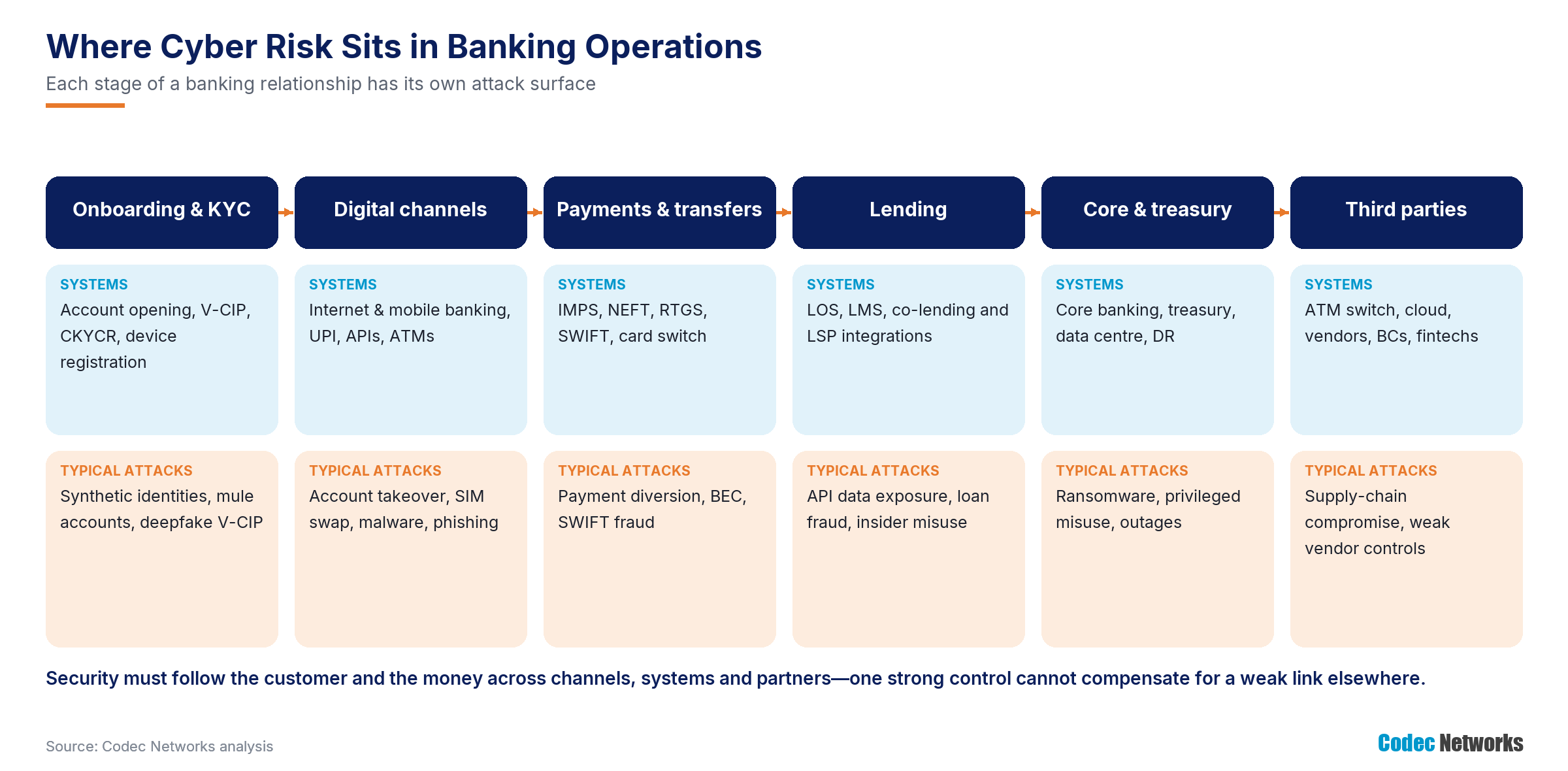
Figure 2: Where cyber risk sits in banking operations — systems at each stage and the attacks that typically target them.
|
Product / service |
Systems that deliver it |
Key cyber and compliance touchpoints |
|
Accounts and deposits |
Core banking, CRM, V-CIP and KYC platforms, CKYCR interface |
Identity assurance, data protection, privileged access |
|
Internet and mobile banking |
Web and mobile apps, API gateway, authentication server, fraud engine |
Application security testing, authentication rules, anti-phishing and rogue-app monitoring |
|
UPI and IMPS |
UPI switch, NPCI interfaces, PSP and TPAP integrations |
API security, transaction monitoring, mule detection |
|
Cards and ATMs |
Card management system, card switch, ATM switch (often a shared service provider), HSMs |
PCI DSS, baseline controls for ATM switch providers, limit-change monitoring |
|
RTGS, NEFT and SWIFT |
Payment hub, SWIFT interface, treasury systems |
SWIFT CSP, privileged access, maker-checker, segregation |
|
Retail and MSME lending |
LOS, LMS, bureau and AA connectors, LSP and co-lending APIs |
API data minimisation, partner assurance, DPDP |
|
Transaction banking |
Corporate portals, host-to-host and API channels, ERP connectors |
Integration security, file integrity, customer authentication |
|
Data centre and recovery |
Primary and DR data centres, backup systems, cloud workloads |
Half-yearly DR drills, backup isolation, cloud security |
7. Product trends that change the attack surface
|
Trend |
What is changing |
Security implication |
|
Credit on UPI and digital lending |
Credit lines and RuPay credit cards on UPI; instant digital loans |
Account takeover now exposes credit limits, not only balances |
|
New authentication factors |
Biometrics, device binding and tokens supplement SMS OTP from April 2026 |
Authentication and recovery flows must be retested |
|
Cloud and core modernisation |
Workloads move to cloud and modern core platforms |
Misconfiguration and shared-responsibility gaps; migration risk |
|
Open APIs and partnerships |
More fintech, co-lending and BaaS integrations |
Partner APIs can overshare data or become entry points |
|
AI in operations and service |
AI-driven fraud detection, chatbots and underwriting |
Prompt injection, data leakage and model manipulation risks |
|
Deepfakes and voice cloning |
Synthetic voices and video used against KYC and staff |
Call-back and verification controls must assume impersonation |
8. Mapping products to Codec Networks engagements
|
If the bank offers… |
Recommended starting engagement |
|
Internet and mobile banking |
Mobile and web application testing, authentication review, anti-phishing and rogue-app monitoring |
|
UPI, IMPS and sponsor-bank services |
API security testing, transaction-monitoring review, mule-detection use cases in the CSOC |
|
Cards and ATMs |
PCI DSS readiness, ATM switch provider assessment, card-switch privileged-access review |
|
SWIFT and treasury |
SWIFT CSP independent assessment support, privileged-access and segregation review |
|
Digital lending and co-lending |
Partner API testing, DPDP privacy review, third-party risk assessment |
|
Transaction banking |
Host-to-host and API integration testing, file-integrity controls review |
|
Data centre, DR and cloud |
DR drill observation, backup security testing, cloud posture assessment |
Talk to Codec Networks
|
Contact Codec Networks Pvt. Ltd. New Delhi: 507, 5th Floor, New Delhi House, Barakhamba Road, Connaught Place, New Delhi – 110001 Gurugram: 707, 7th Floor, Silverton Tower, Golf Course Extension Road, Sector 50, Gurugram – 122018, Haryana Landline: 011 430 496 96 | 011 437 522 99 Mobile: +91 99716 76124 | +91 88007 88220 | +91 88003 31124 Email: mktg@codecnetworks.com Web: www.codecnetworks.com |
Note: Product descriptions are general and based on public information available as of October 2026. Product rules are governed by RBI directions and NPCI and card network rules, which change frequently. Confirm current requirements against official circulars.