

Resources Categories
INDUSTRY FACT FILE · CAPITAL MARKETS
Main Products and Services in Capital Markets and Securities
What market infrastructure institutions and intermediaries provide, the systems behind each service, and where those systems create cybersecurity and compliance exposure.
|
In this document 1. How market participants earn their money 2. Products and services by participant 3. Trading, clearing and settlement 4. Depository, custody and registry services 5. The systems behind the products 6. Product trends that change the attack surface 7. Mapping products to Codec Networks engagements |
1. How market participants earn their money
|
Revenue stream |
How it works |
Security relevance |
|
Transaction charges |
Exchange and clearing fees on trades |
Platform availability during market hours is directly revenue-critical |
|
Brokerage and subscription fees |
Per-trade or subscription pricing on trading platforms |
App and API security protects client trust and revenue |
|
Depository and DP charges |
Account maintenance and transaction charges |
Integrity of holdings and transfers is the core promise |
|
Interest and margin funding |
Margin trading facilities and interest on client funds |
Risk systems and fund-flow integrity must be protected |
|
Registry and data services |
Corporate actions, investor services and market data |
Investor records and data feeds are high-value targets |
2. Products and services by participant
|
Participant |
Main products |
Main services |
|
Stock exchanges |
Equity, derivatives, currency, commodity and debt trading platforms; indices; market data |
Listing, trading, surveillance, investor protection, Market SOC (NSE and BSE) |
|
Clearing corporations |
Clearing and settlement services, collateral management |
Risk management, margining, settlement guarantee |
|
Depositories |
Demat accounts, e-voting, pledge and corporate action systems |
Holding and transfer of securities, investor services |
|
Stock brokers |
Trading apps, web platforms, APIs, algo and smart-order tools, margin trading |
Order execution, research, client onboarding, fund and securities settlement |
|
Depository participants |
Demat account services, pledge and transfer processing |
KYC, account servicing, investor support |
|
Custodians |
Custody and fund accounting for institutions and FPIs |
Settlement, corporate actions, reporting |
|
KRAs and RTAs |
Central KYC records; investor registers |
KYC validation, corporate actions, investor services |
3. Trading, clearing and settlement
Investors place orders through broker apps, websites and APIs; orders flow through the broker's order and risk management systems to the exchange, where they are matched. Clearing corporations then determine obligations and settle funds and securities, with depositories crediting holdings to investors' demat accounts. India's move to shorter settlement cycles has compressed the time available to detect and correct errors or fraud.
|
Speed raises the stakes Faster settlement and app-based trading mean that unauthorised trades or transfers can complete before an investor notices. Detection and response must be measured in minutes, not days. |
4. Depository, custody and registry services
Depositories and their participants hold investors' securities, process transfers and pledges, and support corporate actions and e-voting. Custodians provide institutional custody, and RTAs maintain issuers' investor records. These services concentrate investor identity and holdings data, making them attractive targets for data theft and unauthorised-transfer fraud.
5. The systems behind the products
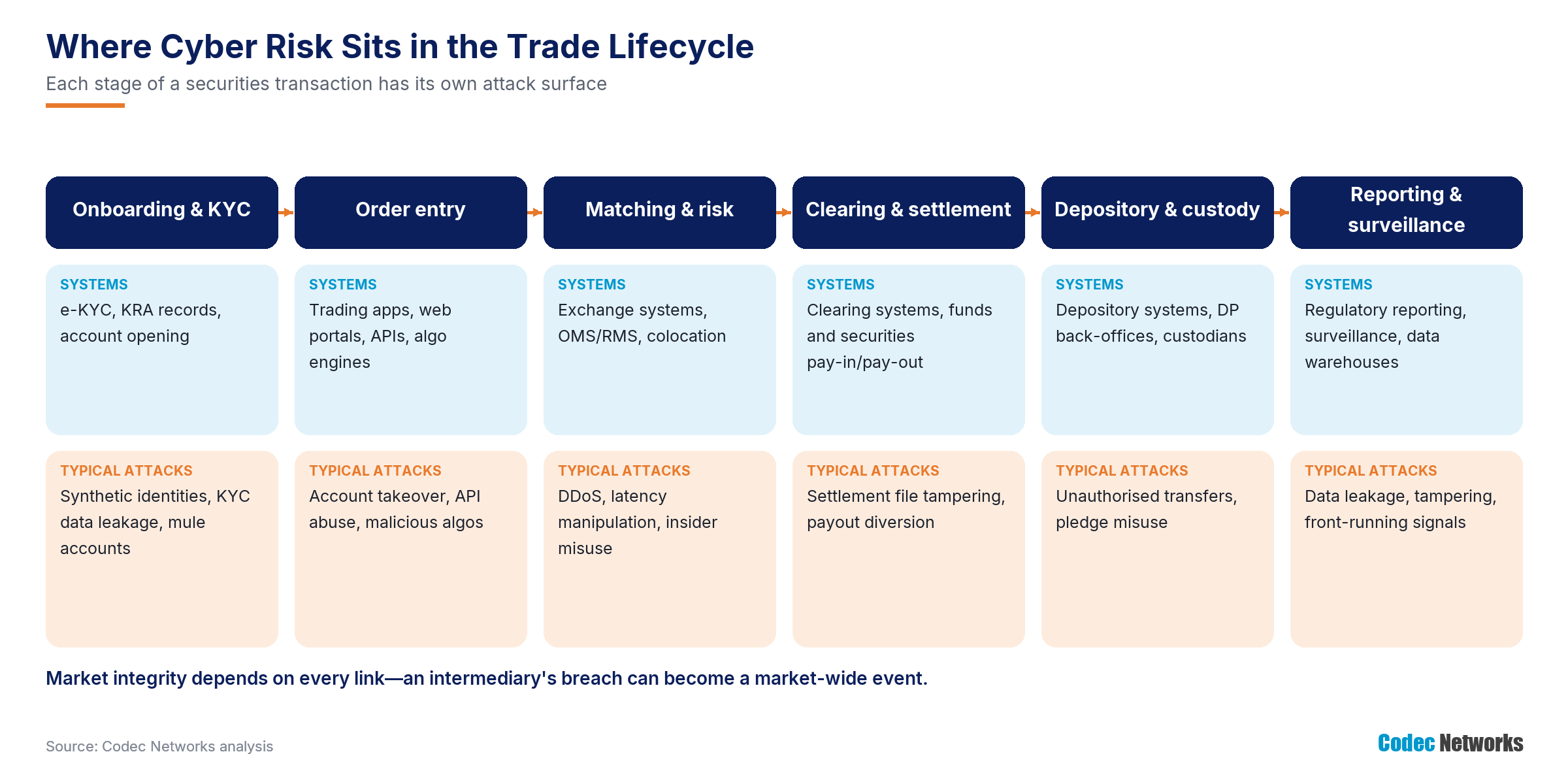
Figure 2: Where cyber risk sits in the trade lifecycle — systems at each stage and the attacks that typically target them.
|
Product / service |
Systems that deliver it |
Key cyber and compliance touchpoints |
|
Retail trading |
Mobile and web apps, API gateways, OMS/RMS, exchange connectivity |
CSCRF controls, app and API testing, DDoS resilience |
|
Algorithmic trading |
Algo engines, vendor strategies, colocation, risk checks |
Change control, risk limits, kill switches, vendor assurance |
|
Exchange and clearing |
Matching engines, surveillance, clearing and settlement systems |
MII-level CSCRF controls, resilience and RTO/RPO testing |
|
Depository services |
Depository systems, DP back-offices, pledge and transfer modules |
Privileged access, maker-checker, investor alerts |
|
KYC and onboarding |
e-KYC, KRA interfaces, document storage |
Identity assurance, data protection, cloud security |
|
Registry services |
Investor databases, corporate action systems |
Segmentation, backups, data protection |
6. Product trends that change the attack surface
|
Trend |
What is changing |
Security implication |
|
App-first retail trading |
Most new investors trade only through apps |
Account takeover and fake apps become primary threats |
|
APIs and algo access |
Programmatic trading for retail and institutional users |
API abuse and faulty algos can affect markets quickly |
|
Cloud adoption |
Back-office and analytics workloads move to cloud under SEBI's framework |
Shared responsibility, misconfiguration and exit readiness |
|
Shorter settlement cycles |
Less time between trade and settlement |
Faster detection and reconciliation are required |
|
AI in surveillance and advice |
AI models for surveillance, research and support |
Model abuse, data leakage and new AI vulnerabilities |
7. Mapping products to Codec Networks engagements
|
If the entity offers… |
Recommended starting engagement |
|
Retail trading apps and APIs |
Trading app and API testing, anti-phishing and fake-app monitoring, CSCRF audit |
|
Algo trading |
Algo platform change-control and risk-limit review, vendor code review |
|
Exchange or clearing services |
Resilience and red team testing, SOC efficacy, RTO/RPO validation |
|
Depository or DP services |
Back-office access and maker-checker testing, transfer-alert review |
|
Registry or KYC services |
Segmentation and backup testing, data protection and cloud review |
|
Cloud-hosted services |
Assessment against SEBI's cloud framework |
Talk to Codec Networks
|
Contact Codec Networks Pvt. Ltd. New Delhi: 507, 5th Floor, New Delhi House, Barakhamba Road, Connaught Place, New Delhi – 110001 Gurugram: 707, 7th Floor, Silverton Tower, Golf Course Extension Road, Sector 50, Gurugram – 122018, Haryana Landline: 011 430 496 96 | 011 437 522 99 Mobile: +91 99716 76124 | +91 88007 88220 | +91 88003 31124 Email: mktg@codecnetworks.com Web: www.codecnetworks.com |
Note: Descriptions are general and based on public information available as of October 2026. Market rules are governed by SEBI regulations and circulars, which change frequently.