

Resources Categories

INDUSTRY FACT FILE · DEFENCE & STRATEGIC INDUSTRIES
Market Landscape and the Drivers of Cybersecurity Demand in Defence
The business, technology, regulatory, legal and statutory forces that create assurance, testing, monitoring and investigation work for defence PSUs, private manufacturers, suppliers, research organisations and start-ups.
|
In this document 1. Market landscape 2. Business drivers 3. Technology drivers 4. Regulatory drivers: SMLDI, CERT-In, NCIIPC, acquisition and partner requirements 5. Legal and statutory drivers 6. How the drivers differ by organisation type 7. What this means for buyers and for Codec Networks |
1. Market landscape
India's defence market is driven by a policy of self-reliance. The Defence Acquisition Procedure 2020 gives the highest priority to the Buy (Indian-IDDM) category for indigenously designed, developed and manufactured equipment; positive indigenisation lists restrict hundreds of platforms and thousands of components to Indian sources; FDI up to 74% has been allowed through the automatic route for companies seeking new industrial licences since September 2020; and the iDEX programme, with its ADITI scheme offering grants of up to ₹25 crore per project, brings start-ups and MSMEs into defence problem statements. More than 33,000 items had been offered for indigenisation on the SRIJAN portal by mid-2026. The result is record output: ₹1.78 lakh crore of defence production in 2025-26 and ₹38,424 crore of exports, with the private sector's share of production rising to about 24%.
Cybersecurity demand follows five pressures. Threats: state-linked espionage groups target designs and officials, and security vendors have repeatedly reported defence-themed campaigns against Indian organisations, while ransomware hits manufacturers worldwide. Licence conditions: SMLDI 2025 makes cyber controls, a CISO and, for some companies, log integration with the MoD's cyber security operations centre part of licensed production. Supply chains: indigenisation spreads controlled data to MSMEs and start-ups that have rarely been assessed. Partners: foreign primes and export customers ask for evidence, and suppliers to US primes face DFARS and CMMC requirements. Reporting and audit: CERT-In's six-hour reporting rule and its 2025 audit policy apply across the sector. Most organisations outside the largest DPSUs and primes rely on external auditors, SOC providers and investigators for depth.
|
₹7.85 lakh crore MoD allocation in the Union Budget 2026-27 |
₹38,424 crore Record defence exports in FY 2025-26 |
509 Items on the five DMA positive indigenisation lists |
Jul 2025 SMLDI 2025 issued, replacing the 2014 manual |
|
Market segment |
Landscape and buying behaviour |
Cybersecurity opportunity |
|
Defence PSUs |
Large, programme-driven estates with design, plant and isolated networks; tender-based buying |
SMLDI audits, restricted environment reviews, threat hunting, forensics |
|
Private defence primes |
Fast-growing, often listed, with JV and export partners |
SMLDI and CERT-In audits, OT segmentation, NIST 800-171, SOC |
|
MSME suppliers |
Thousands of small firms with limited IT teams and budgets |
Supplier gap reviews, MFA and EDR, managed SOC, awareness |
|
R&D and strategic organisations |
Research networks, test ranges and partner ecosystems |
Isolated-network reviews, media controls, compromise assessments |
|
Defence start-ups |
iDEX and ADITI-funded, cloud-native, software-heavy |
Secure SDLC, cloud reviews, code and firmware assurance |
|
Space and strategic electronics |
Liberalised FDI for satellites and components; firmware-heavy products |
Firmware and component assurance, ground segment VAPT |
2. Business drivers
|
Business driver |
Buying trigger |
Relevant services |
|
Meeting licence conditions |
SMLDI 2025 compliance required before production of licensed items |
SMLDI gap assessments, policies, CISO support |
|
Winning and keeping programmes |
Customers and primes ask for security evidence from suppliers |
Supplier assessments, ISO 27001, audit reports |
|
Protecting designs and IP |
Designs and code are prime espionage targets |
Restricted environment reviews, secure SDLC, monitoring |
|
Keeping lines running |
Delivery milestones and penalties depend on production |
OT assessments, segmentation, backup testing, SOC |
|
Exporting and partnering |
Foreign customers and primes set security requirements |
NIST SP 800-171 readiness, data segregation, audits |
|
Scaling start-ups and MSMEs |
New entrants need security programmes quickly |
Packaged assessments, managed SOC, awareness |
|
Responding to leaks |
Suspected espionage or leaks need fast, careful investigation |
Forensics, compromise assessment, insider investigations |
3. Technology drivers
|
Technology driver |
Exposure created |
Codec Networks opportunity |
|
Digital engineering and PLM |
Designs shared across many parties and systems |
PLM access reviews, secure exchange, data classification |
|
Embedded software and firmware |
Code theft, tampering, vulnerable components |
Secure SDLC, firmware review, code signing, SBOM |
|
Smart factories and OT |
IT-to-OT spread, vendor remote access |
OT assessments, IEC 62443 gap analysis, monitoring |
|
Isolated and restricted networks |
Removable media, cross-domain transfers, insiders |
Air-gap and media control reviews under clearance |
|
Cloud and SaaS in smaller firms |
Exposed storage, weak identity, shadow IT |
Cloud configuration and identity reviews |
|
Drones, space and connected systems |
Ground segment, data links, mobile apps |
Ground segment and app VAPT, firmware assurance |
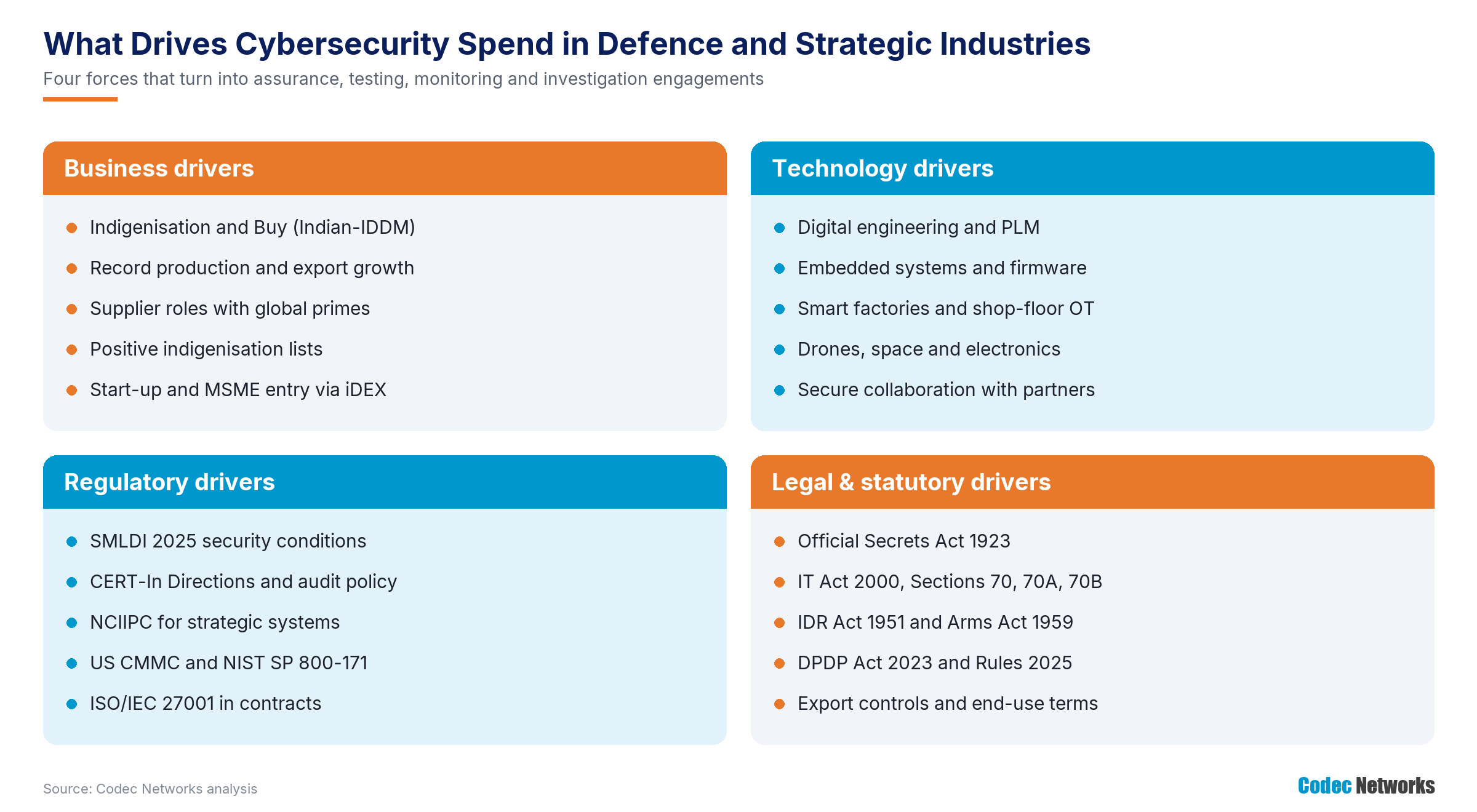
Figure 3: The four groups of drivers behind cybersecurity spending in defence and strategic industries.
4. Regulatory drivers: SMLDI, CERT-In, NCIIPC, acquisition and partner requirements
|
Instrument |
Key requirements |
|
Security Manual for Licensed Defence Industries (2025) |
Cyber, personnel, physical and document security for licensed companies and DPSUs; CISO above ₹250 crore turnover; vetted security officers; air-gapped official work; SIEM, IDS/IPS and privileged account management; logs integrated with the MoD CSOC where specified; compliance before production under DPIIT Press Note 3 of 2025 |
|
CERT-In Directions (2022) and audit guidelines (2025) |
Six-hour incident reporting; 180-day ICT logs in India; risk-based independent audits covering infrastructure, applications, cloud and OT |
|
IT Act Sections 70 and 70A; NCIIPC |
Notified protected systems in strategic and public enterprises receive NCIIPC guidance and controls |
|
Defence Acquisition Procedure 2020 and draft DAP 2026 |
Acquisition categories and procedures; contract terms that carry security conditions; DAP 2026 released in draft in February 2026 and not yet in force as of October 2026 |
|
US DFARS 252.204-7012 and CMMC |
NIST SP 800-171 controls and incident reporting for covered defence information; CMMC Phase 1 self-assessments from November 2025; Phase 2 third-party certification suspended in July 2026 pending a programme review |
|
ISO/IEC 27001 and partner requirements |
The management-system standard most often requested by primes, export customers and foreign partners |
|
Confirm applicability Obligations depend on your industrial licence and product category, whether you are a DPSU, any NCIIPC notification, listing status and the contracts you hold with Indian and foreign customers. Confirm against the official instruments, your licence and your contracts. |
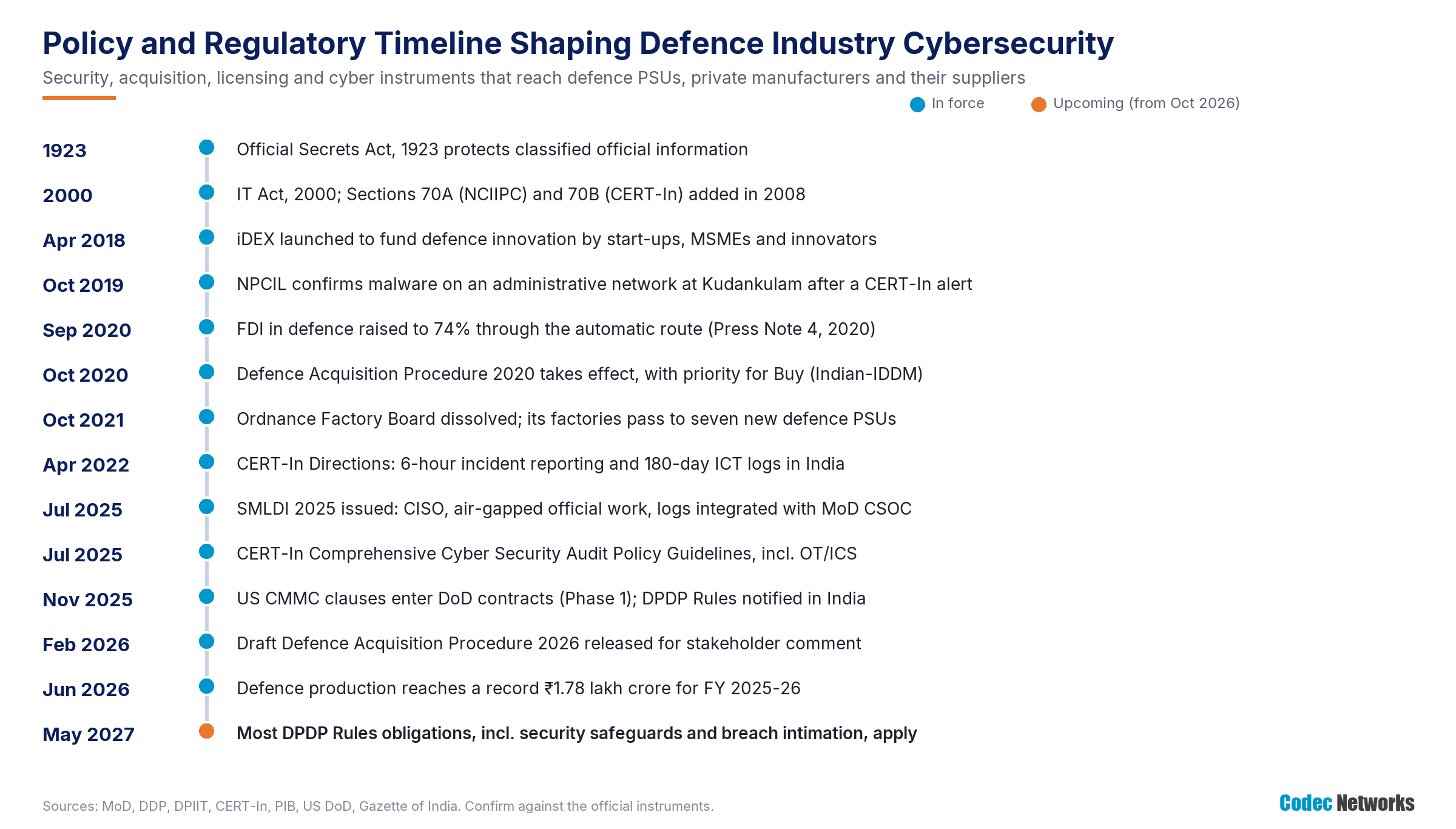
Figure 4: Policy and regulatory timeline shaping defence industry cybersecurity, as of October 2026.
5. Legal and statutory drivers
|
Law or obligation |
Relevance |
Demand created |
|
Official Secrets Act, 1923 |
Protection of classified official information and places |
Need-to-know access, insider controls, leak investigations |
|
IT Act, 2000 and CERT-In Directions |
Incident reporting, logging and offences against computer systems |
SOC, logging, audits and incident response |
|
IT Act Sections 70, 70A and 70B |
Protected systems, NCIIPC and CERT-In's statutory powers |
Protected-system controls, audits, monitoring |
|
IDR Act, 1951 and Arms Act, 1959 |
Industrial and arms licences for defence items, with security conditions |
SMLDI compliance programmes and audits |
|
DPDP Act, 2023 and Rules, 2025 |
Personal data of employees, vetted staff, visitors and partners |
Privacy programmes, data maps, safeguards |
|
Export controls and end-use commitments |
Controlled technology and end-user obligations; India joined the Wassenaar Arrangement in 2017 |
Controlled-data segregation, access control, audit trails |
|
Companies Act, 2013 and SEBI LODR (listed firms) |
Board risk responsibility; quarterly cyber incident disclosure |
Board reporting, incident records |
6. How the drivers differ by organisation type
|
Organisation type |
Dominant business drivers |
Dominant technology drivers |
Principal regulatory drivers |
|
Defence PSUs |
Programme delivery, national trust |
PLM, isolated networks, plant OT |
SMLDI, CERT-In, NCIIPC if notified, SEBI LODR |
|
Private defence primes |
Growth, exports, partner trust |
PLM, MES, partner portals |
SMLDI, CERT-In, DFARS/CMMC via partners |
|
MSME suppliers |
Winning and keeping orders |
Email, file servers, CNC |
Contract clauses, SMLDI if licensed, CERT-In |
|
R&D and strategic organisations |
Protecting research and trials |
Research networks, test ranges |
Official Secrets Act, ministry instructions, CERT-In |
|
Defence start-ups |
Contracts, funding, scale |
Cloud, code, firmware |
iDEX terms, CERT-In, DPDP |
|
Space and strategic electronics |
Export and partner growth |
Firmware, ground segment |
IN-SPACe, export controls, CERT-In |
7. What this means for buyers and for Codec Networks
|
Customer buying need |
Recommended offering |
Natural recurring engagement |
|
“We need to show SMLDI 2025 compliance before our next licensed production run.” |
SMLDI 2025 cyber gap assessment with policies and remediation plan |
Annual SMLDI and CERT-In audit cycle |
|
“Our prime has sent us a supplier security questionnaire.” |
Supplier readiness review with evidence pack |
Annual supplier reassessment |
|
“Our drawings go to two hundred suppliers by email.” |
Tiered supplier assessment and secure exchange design |
TPRM retainer and monitoring |
|
“We think someone has been inside our design network.” |
Compromise assessment and forensics under clearance procedures |
Threat hunting and IR retainer |
|
“Our US partner wants NIST SP 800-171 evidence.” |
NIST SP 800-171 readiness assessment and data segregation review |
Continuous compliance support |
|
“Our factory runs ERP, MES and CNC on one network.” |
OT assessment and IT–OT segmentation review |
Managed SOC with OT monitoring |
|
“Our start-up's firmware is built in the cloud.” |
Secure SDLC, build pipeline and code-signing review |
Release-by-release assurance |
Talk to Codec Networks
|
Contact Codec Networks Pvt. Ltd. New Delhi: 507, 5th Floor, New Delhi House, Barakhamba Road, Connaught Place, New Delhi – 110001 Gurugram: 707, 7th Floor, Silverton Tower, Golf Course Extension Road, Sector 50, Gurugram – 122018, Haryana Landline: 011 430 496 96 | 011 437 522 99 Mobile: +91 99716 76124 | +91 88007 88220 | +91 88003 31124 Email: mktg@codecnetworks.com Web: www.codecnetworks.com |
Note: This document is general industry guidance based on public information available as of October 2026. It is not legal, regulatory or security-clearance advice. Obligations differ by type of entity, industrial licence conditions, product category, any NCIIPC notification, programme and contract terms and the information each organisation handles; confirm them against the official Ministry of Defence, DDP, DPIIT, CERT-In, NCIIPC and Data Protection Board instruments, your licence and your contracts. Assessments of classified or restricted environments are conducted only under the customer's security clearance procedures.