

Resources Categories

INDUSTRY FACT FILE · FINTECH
Main Products and Services in Fintech and Digital Financial Services
What fintech companies sell, how their platforms deliver it, and where those platforms create cybersecurity and compliance exposure.
|
In this document 1. How fintechs earn their money 2. Products and services by fintech model 3. Lending technology in detail 4. Account Aggregators and financial data 5. Embedded finance and banking-as-a-service 6. The systems behind the products 7. Product trends that change the attack surface 8. Mapping products to Codec Networks engagements |
1. How fintechs earn their money
|
Revenue stream |
How it works |
Security relevance |
|
Sourcing and servicing fees |
Fees from banks and NBFCs for originating, servicing or collecting loans |
Partner data and loan decisions flow through the fintech's platform |
|
Platform and API usage fees |
Per-call or subscription pricing for KYC, data and banking APIs |
API availability and tenant isolation protect revenue and clients |
|
SaaS subscriptions |
Licence fees for LOS, collections, analytics and risk platforms |
A breach can affect every client simultaneously |
|
Data and consent services |
AA fees per data fetch or consent |
Consent integrity and encryption are core to the licence |
|
Distribution commissions |
Commissions on loans, insurance and investments distributed |
Customer data shared with partners must be minimised |
2. Products and services by fintech model
|
Fintech model |
Main products |
Main services |
|
Lending technology and LSPs |
Instant personal loans, BNPL-style credit lines from regulated lenders, MSME and merchant loans, multi-lender marketplaces |
Customer acquisition, underwriting support, KYC, servicing and collections for regulated lenders |
|
Account Aggregators |
Consent manager platform for financial information sharing |
Consent collection, encrypted data flow between FIPs and FIUs, consent lifecycle management |
|
Embedded finance platforms |
Checkout credit, supplier finance, insurance and payments embedded in apps |
Partner integration, eligibility checks, customer servicing |
|
Financial API and BaaS providers |
KYC, bank-statement, credit-data, account and card-issuing APIs |
Onboarding, data enrichment, risk scoring, programme management |
|
P2P lending platforms |
Marketplace for individual lenders and borrowers |
Borrower assessment, lender matching, escrow-based fund flows |
|
KYC and identity providers |
e-KYC, V-CIP, document and face verification, fraud checks |
Managed onboarding, liveness and verification services |
|
Fintech SaaS |
LOS, LMS, collections, analytics and fraud platforms |
Implementation, hosting, support and model services |
3. Lending technology in detail
Under the RBI (Digital Lending) Directions, 2025, banks and NBFCs remain responsible for lending service providers and digital lending apps. Lenders must report the DLAs they use on RBI's CIMS portal (from 15 June 2025), multi-lender LSPs must show all matching offers transparently (from 1 November 2025), and the framework restricts how borrower data is collected, stored and shared. For lending technology firms, this means their security and data practices are audited by every lender they serve.
4. Account Aggregators and financial data
Account Aggregators are RBI-licensed NBFCs that enable consent-based sharing of financial information between Financial Information Providers (such as banks, mutual funds and insurers) and Financial Information Users (such as lenders and wealth managers). Technical standards are published by ReBIT. According to Sahamati, by September 2026 the ecosystem had fulfilled more than 500 million consents, with over 1,100 regulated entities live and more than 310 million accounts linked by customers.
|
Why AA security matters AAs are 'data-blind' by design—data moves encrypted between FIP and FIU—but consent integrity, key management, API security and the FIU's handling of received data remain critical. A weakness at any point undermines trust in the whole ecosystem. |
5. Embedded finance and banking-as-a-service
Embedded finance places credit, payments and insurance inside non-financial platforms, while banking-as-a-service lets technology companies offer accounts, cards or loans with a regulated partner. Both models rely on APIs and shared responsibility: the platform owns the customer experience and data capture, while the regulated partner owns the licence and the regulatory obligations.
6. The systems behind the products
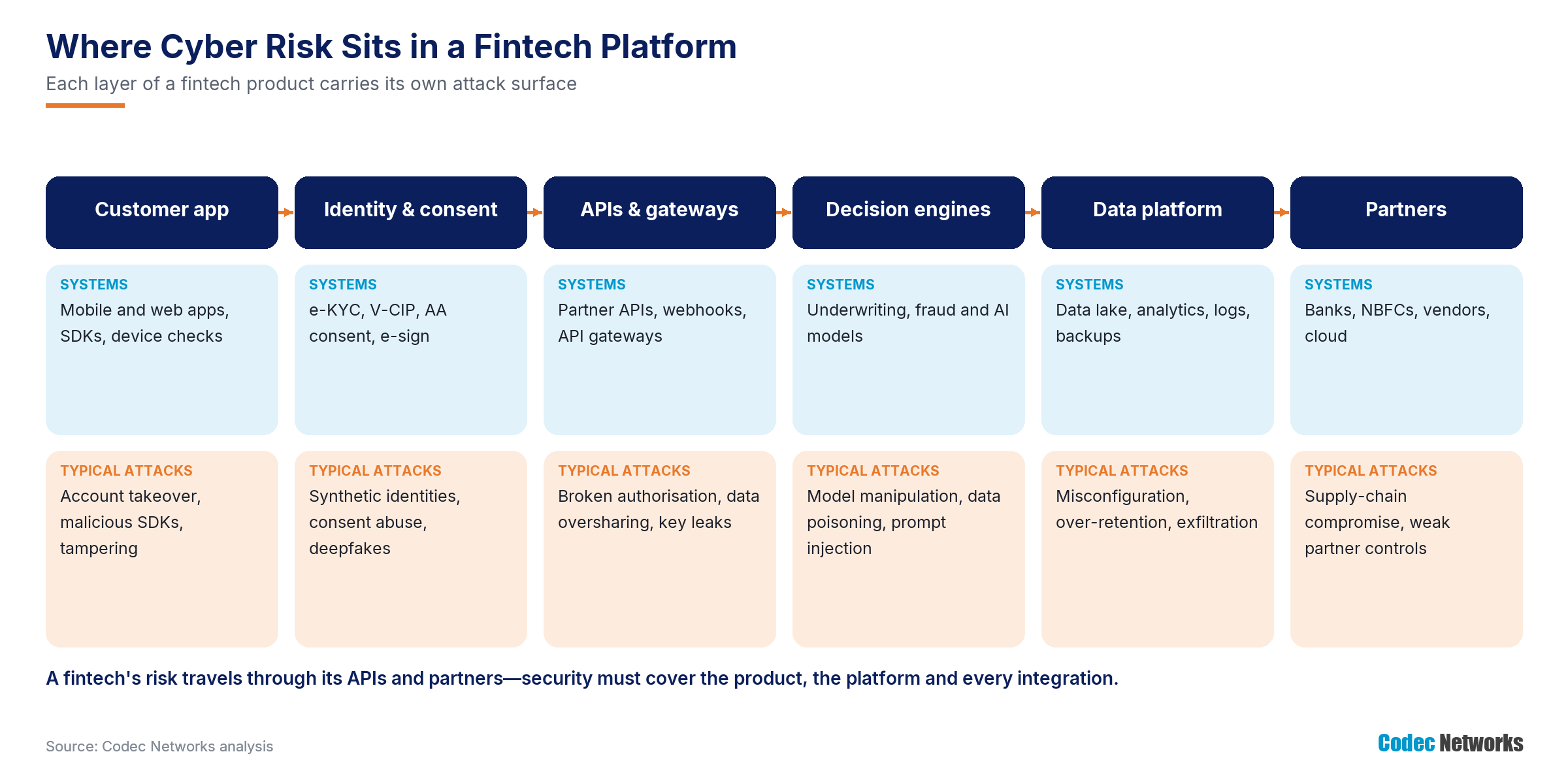
Figure 2: Where cyber risk sits in a fintech platform — layers, systems and typical attacks.
|
Product / service |
Systems that deliver it |
Key cyber and compliance touchpoints |
|
Digital loans via LSP |
Customer app, onboarding stack, decision engine, lender APIs, webhooks |
Digital Lending Directions, API authorisation, consent and data minimisation |
|
AA consent and data flows |
Consent manager, FIP/FIU gateways, encryption and key services |
Consent integrity, cryptography, API security, NBFC-AA cyber requirements |
|
Embedded checkout credit |
Merchant app SDK, eligibility APIs, lender integration |
SDK security, account takeover, data sharing |
|
KYC and verification APIs |
Document, face and liveness services, CKYCR and DigiLocker connectors |
Deepfake resistance, data retention, tenant isolation |
|
BaaS and card programmes |
Programme manager platform, issuer processor, partner bank APIs |
PCI DSS where applicable, partner oversight, fraud controls |
|
P2P marketplace |
Lender and borrower portals, escrow integrations, risk models |
Fund-flow integrity, data protection, NBFC-P2P cyber requirements |
|
Fintech SaaS |
Multi-tenant cloud platform, CI/CD, support access |
Tenant isolation, secure SDLC, client audit rights |
7. Product trends that change the attack surface
|
Trend |
What is changing |
Security implication |
|
AI-driven underwriting and agents |
LLM assistants, AI decisioning and autonomous agents |
Prompt injection, data leakage and excessive agent permissions |
|
AA-based credit everywhere |
Consented data replaces document uploads |
Consent design and FIU data handling become audit focus areas |
|
Credit on UPI and embedded credit |
Credit lines accessed through payment apps |
Account takeover now exposes credit, not just balances |
|
Deepfake-capable fraud |
Injected and synthetic video against V-CIP |
Liveness, device attestation and analytics must assume deepfakes |
|
Open-source and SDK dependence |
Hundreds of third-party components per app |
Supply-chain compromise and vulnerable dependencies |
|
Multi-cloud and microservices |
Kubernetes, serverless and managed services |
Misconfiguration and secrets sprawl |
8. Mapping products to Codec Networks engagements
|
If the fintech offers… |
Recommended starting engagement |
|
Lending technology or LSP services |
API and business-logic testing, fraud simulations, lender-ready evidence pack |
|
AA services (or acts as FIU) |
Consent-flow and API testing, cryptography and key-management review, applicability assessment |
|
Embedded finance |
App and SDK testing, data-sharing review, partner assurance |
|
Financial APIs or BaaS |
Tenant-isolation testing, SOC 2 / ISO 27001 readiness, continuous cloud assurance |
|
P2P lending |
Platform VAPT, fund-flow review, applicability assessment against the 2026 NBFC Directions |
|
Fintech SaaS |
Secure SDLC review, SBOM, penetration testing and client assurance pack |
Talk to Codec Networks
|
Contact Codec Networks Pvt. Ltd. New Delhi: 507, 5th Floor, New Delhi House, Barakhamba Road, Connaught Place, New Delhi – 110001 Gurugram: 707, 7th Floor, Silverton Tower, Golf Course Extension Road, Sector 50, Gurugram – 122018, Haryana Landline: 011 430 496 96 | 011 437 522 99 Mobile: +91 99716 76124 | +91 88007 88220 | +91 88003 31124 Email: mktg@codecnetworks.com Web: www.codecnetworks.com |
Note: Product descriptions are general and based on public information available as of October 2026. Product rules depend on the licence of the fintech or its regulated partner; confirm current requirements against official instruments.