

Resources Categories
INDUSTRY FACT FILE · METALS, MINING & CEMENT
Threat Landscape: Top Cyber Threats Facing Metals, Mining and Cement
The 18 most relevant cyber threats, attacks and industry challenges for mining groups, steel and aluminium producers, smelters, foundries and cement manufacturers, and the impact each one has on sites, safety, revenue and buyers.
|
In this document 1. The threat picture in numbers 2. Top 18 threats, attacks and challenges 3. Threat relevance by metals, mining and cement segment 4. Five priority threats in depth 5. Impact on producers, their contractors and their buyers 6. How regulation turns incidents into business events 7. Questions every leadership team should ask |
1. The threat picture in numbers
|
2019 Norsk Hydro ran aluminium plants manually after LockerGoga ransomware |
May 2025 Nucor halted production at several sites after a cyber incident |
Aug 2024 Evolution Mining disclosed ransomware on its IT systems |
6 hours To report incidents to CERT-In |
Metals, mining and cement companies attract ransomware groups because every hour of stopped dispatch or production is measured in lost tonnes and contractual penalties, which makes victims more likely to pay; they attract fraudsters because dispatch, royalty and procurement flows move large sums through many hands; and they attract state actors because coal, steel and critical minerals are strategic. The attack surface is unusually wide and remote: DCS and PLCs that cannot be patched, remote operations centres linked across sites, weighbridges and e-permit portals, captive power plants, and OEMs, MDOs and contractors connected from outside.
Public incidents show the pattern. Norsk Hydro ran aluminium plants on manual procedures for weeks after LockerGoga ransomware in 2019, estimating the first-half cost at NOK 550–650 million; Nucor temporarily halted certain production operations at various locations after unauthorised access to its IT systems in May 2025; Evolution Mining disclosed ransomware in August 2024; and Northern Minerals saw stolen data published by the BianLian group after refusing to pay. Globally, IBM X-Force ranks manufacturing the most attacked industry for the fifth consecutive year and Dragos reports that manufacturers were more than half of industrial ransomware victims in 2024. Indian producers share the same technology, the same vendors and the same exposure.
2. Top 18 threats, attacks and challenges
The list below is a practical assessment framework, not a statistical ranking. Priority varies by business model, technology exposure and existing controls.
|
# |
Threat / attack / challenge |
Typical scenario |
Most exposed |
Potential impact |
|
1 |
Ransomware halting plants and mines |
ERP, dispatch or plant systems encrypted; output stops or runs manually |
All producers |
Lost output, missed deliveries, penalties |
|
2 |
Contractor and logistics partner compromise |
An MDO, EPC contractor or transporter's incident reaches owner systems or stops dispatch |
Mining groups, cement |
Outage without being attacked directly |
|
3 |
OEM and integrator remote access abuse |
Standing vendor VPNs into DCS, fleet or kiln networks hijacked |
Automated plants and mines |
Logic changes, damage, downtime |
|
4 |
Flat networks between IT, plant and mine |
No separation between office IT, control systems and site links |
Most sites |
Office malware reaching DCS and fleets |
|
5 |
Legacy DCS, PLCs and HMIs |
Unpatched controllers and operator stations in furnaces, kilns and mills |
All plants |
Easy exploitation, no vendor fixes |
|
6 |
ERP, dispatch and weighbridge compromise |
Attackers alter orders, weights or permits, or encrypt the systems |
All producers |
Dispatch stops; revenue and royalty loss |
|
7 |
Remote operations and fleet compromise |
Fleet management, tele-remote or autonomy systems hijacked over site links |
Mining groups |
Fleet halts, safety risk |
|
8 |
Theft of geological, process and bid data |
Exploration models, auction bids, process recipes and pricing copied out |
Miners, specialty producers |
Lost bids and competitive advantage |
|
9 |
Nation-state espionage |
Persistent intrusions into coal, steel and critical mineral PSUs |
PSUs, strategic producers |
Long-term strategic loss |
|
10 |
Phishing and credential theft |
Staff, engineers, contractors and OEM accounts targeted |
All producers |
Initial access |
|
11 |
Business email compromise |
Fraudulent supplier, transporter or scrap vendor bank-account changes |
All producers |
Direct financial loss |
|
12 |
Insider and contractor misuse |
Large contract workforces with system access abuse it |
Mines, dispatch yards |
Theft, fraud, sabotage |
|
13 |
Safety and environmental system tampering |
Changes to safety PLCs, gas monitoring, interlocks or emissions monitoring |
Mines, smelters, cement |
Injury risk, statutory exposure |
|
14 |
IIoT, drones and connected fleet exposure |
Internet-facing gateways, telematics and drone systems with default credentials |
Mining groups, smart plants |
Bridge from internet to OT |
|
15 |
Captive power and utility compromise |
Power plant DCS or substations reached from corporate IT |
Smelters, steel, cement |
Power trips damaging potlines and kilns |
|
16 |
Cloud, SaaS and trading platform misconfiguration |
Exposed tenants, weak identity on group ERP, e-auction and trading platforms |
Cloud-first groups |
Data exposure, outage, fraud |
|
17 |
Weak OT detection and response at remote sites |
No visibility into plant, mine or remote-ops networks |
Most sites |
Long dwell time; missed 6-hour reporting |
|
18 |
Backup and recovery failure |
Backups encrypted, untested or missing DCS and fleet configurations |
All producers |
Weeks of downtime |
3. Threat relevance by metals, mining and cement segment
The matrix is a qualitative guide for prioritising the first round of security reviews.
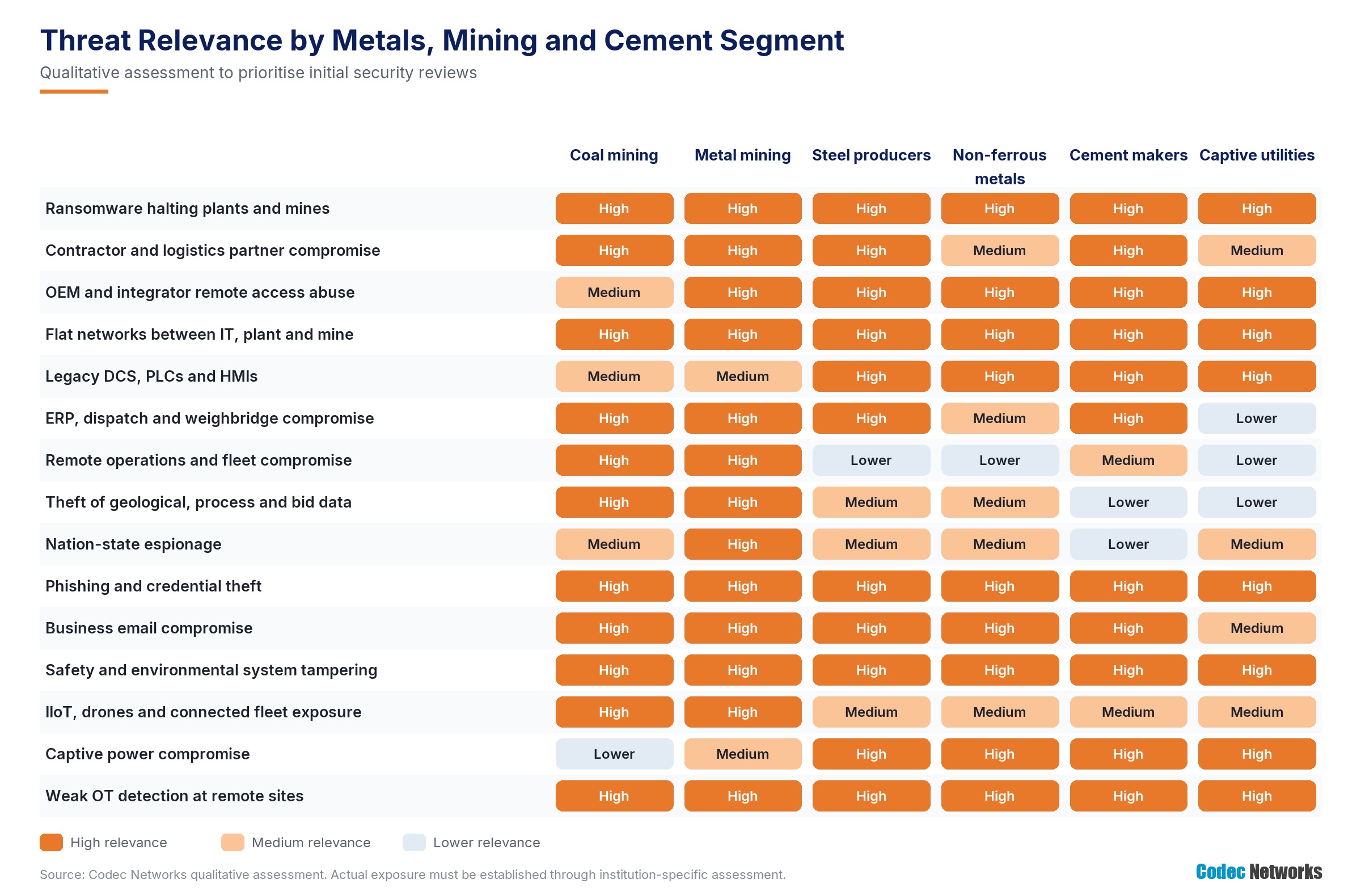
Figure 5: Qualitative threat relevance by metals, mining and cement segment (Codec Networks assessment).
4. Five priority threats in depth
4.1 Ransomware and the dispatch dependency
Attackers rarely need to touch a DCS to stop a producer. Encrypting ERP, dispatch and weighbridge servers removes the ability to issue permits, gate passes and invoices; kilns and furnaces keep producing into full silos and yards until they are cut back, as Norsk Hydro and Nucor's experiences illustrate.
- Questions to test: Which dispatch, permit and billing processes depend on ERP and weighbridge systems? Can we dispatch manually and lawfully for a week? Are backups immutable and restores tested? Would EDR and the SOC catch the intrusion before encryption?
- Relevant services: dependency mapping, segmentation, backup and recovery testing, EDR validation, crisis exercises.
4.2 Remote operations, fleets and contractors
Remote operations centres concentrate control of fleets, drills and dispatch across sites and connect MDOs, OEMs and contractors through site links that were built for availability, not security. A shared or phished contractor account becomes a path to fleet and dispatch servers.
- Questions to test: Which contractors and OEMs can reach our remote-ops and fleet systems? Are accounts named, MFA-protected and time-bound? Are site links segmented and monitored? Do contracts require security and notification?
- Relevant services: remote-ops architecture review, fleet system testing, brokered access, supply chain assessments.
4.3 Vendor devices and furnace automation
Furnace, kiln and mill automation is maintained by OEM engineers who bring laptops and media from other customer sites, often connecting directly to Level 2 networks during shutdowns and turnarounds. Malware on one laptop can spread across HMIs and engineering stations.
- Questions to test: Do we check and control vendor devices before connection? Is furnace automation segmented into zones with conduits? Do we monitor engineering activity and configuration changes? Is there a clean restart procedure for HMIs?
- Relevant services: vendor device controls, zone-and-conduit design, OT monitoring, change control, vendor recertification.
4.4 Dispatch, permit and compliance data integrity
Weights, e-permit quantities, royalty returns and emissions readings are statutory data. Excessive privileges, missing audit trails and unreviewed edits enable diversion fraud and expose producers to penalties and disputes with state departments, regulators and EU buyers.
- Questions to test: Who can edit weighbridge, permit or emissions data after the fact? Are logs tamper-evident and reconciled? Do analytics flag anomalies? Could we reconstruct records for an audit or dispute?
- Relevant services: dispatch system testing, segregation of duties, integrity logging, analytics, forensic readiness.
4.5 Captive power, safety and the 6-hour clock
Captive power plants and safety systems are frequently reachable from corporate IT, and remote sites are rarely monitored. An intrusion that trips power to a potline or alters gas monitoring is a safety event and a CERT-In report within six hours, with SEBI disclosure for listed companies.
- Questions to test: Are captive power DCS and safety PLCs segmented from corporate IT? Are plant and mine networks monitored 24x7? Is there a playbook covering containment, safe operation, DGMS and CERT-In reporting and disclosure?
- Relevant services: utility OT assessment, safety system reviews, IT/OT SOC, playbooks, joint drills.
5. Impact on producers, their contractors and their buyers
|
Player type |
Threats to prioritise |
Main impact |
|
Public-sector coal, mineral and steel undertakings |
Ransomware across sites, espionage, notified-system obligations |
National supply disruption, strategic loss, NCIIPC coordination |
|
Listed steel, aluminium, zinc and cement groups |
Dispatch outages, captive power compromise, disclosure |
Multi-plant stoppage, lender and insurer scrutiny, market disclosure |
|
Commercial miners and MDOs |
Remote-ops and fleet compromise, contract breaches |
Contract penalties, safety incidents, lost owner trust |
|
Foundries and secondary producers |
Ransomware, BEC, being the weak supplier |
Lost customer contracts, financial loss |
|
Buyers, lenders and the state |
Supplier outages, manipulated data |
Supply shortfalls, royalty loss, CBAM reporting failures |
6. How regulation turns incidents into business events
- CERT-In: incidents reported within six hours of noticing them; logs available for investigation.
- SEBI LODR: listed producers disclose cyber incidents and data loss in the quarterly corporate governance report.
- NCIIPC: incidents affecting notified protected systems require coordination, which can include public-sector coal, steel and mineral undertakings.
- DGMS and state departments: incidents that affect safety systems, mine records or statutory dispatch data engage mine safety and royalty obligations.
- DPDP: incidents involving employee, contractor or dealer personal data trigger breach intimation once provisions commence in May 2027.
- Buyers, lenders and insurers: contracts require incident notification; EU importers need reliable CBAM data; insurers require evidence that warranted controls were in place.
|
Insight The most damaging metals, mining and cement incidents cross boundaries—from a contractor into the remote operations centre, from ERP into dispatch, from a vendor's laptop into furnace automation, from corporate IT into captive power. Strong boundaries, tested recovery, data integrity and site-wide visibility are the best defence. |
7. Questions every leadership team should ask
- If ERP and dispatch went dark tonight, could trucks and rakes leave tomorrow—and lawfully?
- Which contractor, OEM or MDO could reach our fleet, DCS or remote operations, and is every session recorded?
- Could anyone alter weights, permits or emissions data without a reconciled, tamper-evident log?
- Is our captive power plant separated from corporate IT, and have we tested the boundary?
- Do we have offline backups of DCS, fleet and dispatch configurations and a tested restart plan?
- Could we detect, contain and report an incident within six hours while keeping every site safe?
Talk to Codec Networks
|
Contact Codec Networks Pvt. Ltd. New Delhi: 507, 5th Floor, New Delhi House, Barakhamba Road, Connaught Place, New Delhi – 110001 Gurugram: 707, 7th Floor, Silverton Tower, Golf Course Extension Road, Sector 50, Gurugram – 122018, Haryana Landline: 011 430 496 96 | 011 437 522 99 Mobile: +91 99716 76124 | +91 88007 88220 | +91 88003 31124 Email: mktg@codecnetworks.com Web: www.codecnetworks.com |
Note: Threat descriptions and relevance ratings are general guidance, not findings about any specific organisation. Public incident references are summarised from widely reported events and company disclosures.