

Resources Categories
INDUSTRY FACT FILE · NBFCS & LENDING
Threat Landscape: Top Cyber Threats Facing NBFCs and Lenders
The 18 most relevant cyber threats, attacks and industry challenges for NBFCs in India, and the impact each one has on lenders, borrowers and partners.
|
In this document 1. The threat picture in numbers 2. Top 18 threats, attacks and challenges 3. Threat relevance by NBFC segment 4. Five priority threats in depth 5. Impact on NBFCs and their stakeholders 6. How regulation turns incidents into business events 7. Questions every leadership team should ask |
1. The threat picture in numbers
|
₹19,813 cr Reported cyber-fraud losses in 2025, all channels (I4C data) |
8,640 Advances-related fraud cases reported in FY26 (RBI) |
17 NBFCs in RBI's 2026-27 Upper Layer list |
6 hours To report cyber incidents to RBI (NHB for HFCs) |
Lending fraud and cyber fraud increasingly overlap. RBI's Annual Report for 2025-26 shows that advances-related frauds were the largest category by value among frauds reported by banks and financial institutions, and reports based on Indian Cybercrime Coordination Centre (I4C) data put cyber-fraud losses across all channels at about ₹19,813 crore in 2025.
For NBFCs, the risk is amplified by partner-led origination, field forces using mobile devices and the rapid growth of digital lending apps—each of which handles borrower identity documents, bank details and loan decisions.
2. Top 18 threats, attacks and challenges
The list below is a practical assessment framework, not a statistical ranking. Priority varies by business model, technology exposure and existing controls.
|
# |
Threat / attack / challenge |
Typical scenario |
Lenders most exposed |
Potential impact |
|
1 |
Synthetic identity and document fraud |
Forged KYC, income and property documents; fictitious borrowers created with stolen or synthetic identities |
Housing, vehicle and consumer lenders |
Credit losses, fraud classification and reporting, KYC findings |
|
2 |
Dealer, DSA and agent collusion |
Partners and insiders collude to push fictitious or inflated loans |
Vehicle finance, housing finance, MSME lenders |
Clustered defaults, partner disputes, forensic costs |
|
3 |
Fake lending apps and brand abuse |
Look-alike apps and sites collect fees and data while impersonating the NBFC |
Consumer and digital lenders |
Borrower harm, complaints, regulatory and media attention |
|
4 |
Lending app and API data exposure |
Broken authorisation or excessive data in apps and partner APIs |
Digital lenders and LSP-led NBFCs |
Mass borrower data exposure, DPDP liability |
|
5 |
Account takeover and payout diversion |
Compromised borrower or staff accounts redirect disbursements or refunds |
Consumer, MSME and gold-loan lenders |
Direct losses and customer disputes |
|
6 |
Phishing and business email compromise |
Impersonation of executives, banks or vendors to redirect payments or steal credentials |
All NBFCs, especially treasury and finance teams |
Fraudulent transfers and credential theft |
|
7 |
Ransomware and data extortion |
Encryption of LOS, LMS and branch systems, often timed for month-end |
All NBFCs; branch-heavy lenders |
Disbursement and collection outages, data exposure |
|
8 |
Insider and field-agent misuse |
Agents or staff export borrower data, misuse collections or manipulate records |
Microfinance, vehicle and gold-loan lenders |
Data leakage, conduct complaints, fraud |
|
9 |
Third-party and LSP compromise |
A lending service provider, DSA platform or SaaS vendor is breached |
Digital and partner-led lenders |
Downstream data exposure, outsourcing findings |
|
10 |
Cloud and SaaS misconfiguration |
Public storage of KYC documents, over-privileged roles, exposed keys |
Cloud-native NBFCs and fintech-led lenders |
Large-scale data exposure |
|
11 |
Field device and app compromise |
Lost or compromised tablets and phones holding offline borrower data |
Microfinance and vehicle finance |
Data leakage and impersonation of agents |
|
12 |
Loan data manipulation |
Unauthorised changes to loan terms, collateral or repayment records |
All lenders |
Financial loss and audit findings |
|
13 |
Co-lending and partner data tampering |
Altered loan files or interception of data exchanged with bank partners |
NBFCs in co-lending arrangements |
Partner disputes, losses, regulatory scrutiny |
|
14 |
Data leakage and privacy failures |
Over-collection, weak retention and sharing of borrower data |
All NBFCs |
DPDP obligations from May 2027, complaints |
|
15 |
Weak detection and slow response |
Missing logs, untuned alerts and unclear escalation |
Base and Middle Layer NBFCs with lean teams |
Missed 6-hour reporting, wider impact |
|
16 |
Deepfake-assisted fraud |
Synthetic video defeats V-CIP; cloned voices target staff |
Digital lenders and treasury teams |
Fraudulent onboarding and approvals |
|
17 |
Backup and recovery failure |
Backups reachable by attackers or never restored |
All NBFCs |
Extended downtime and data loss |
|
18 |
Mule accounts in disbursement and repayment |
Loan proceeds or repayments routed through mule accounts |
Consumer and digital lenders |
Fraud losses and AML exposure |
3. Threat relevance by NBFC segment
The matrix is a qualitative guide for prioritising the first round of security reviews.
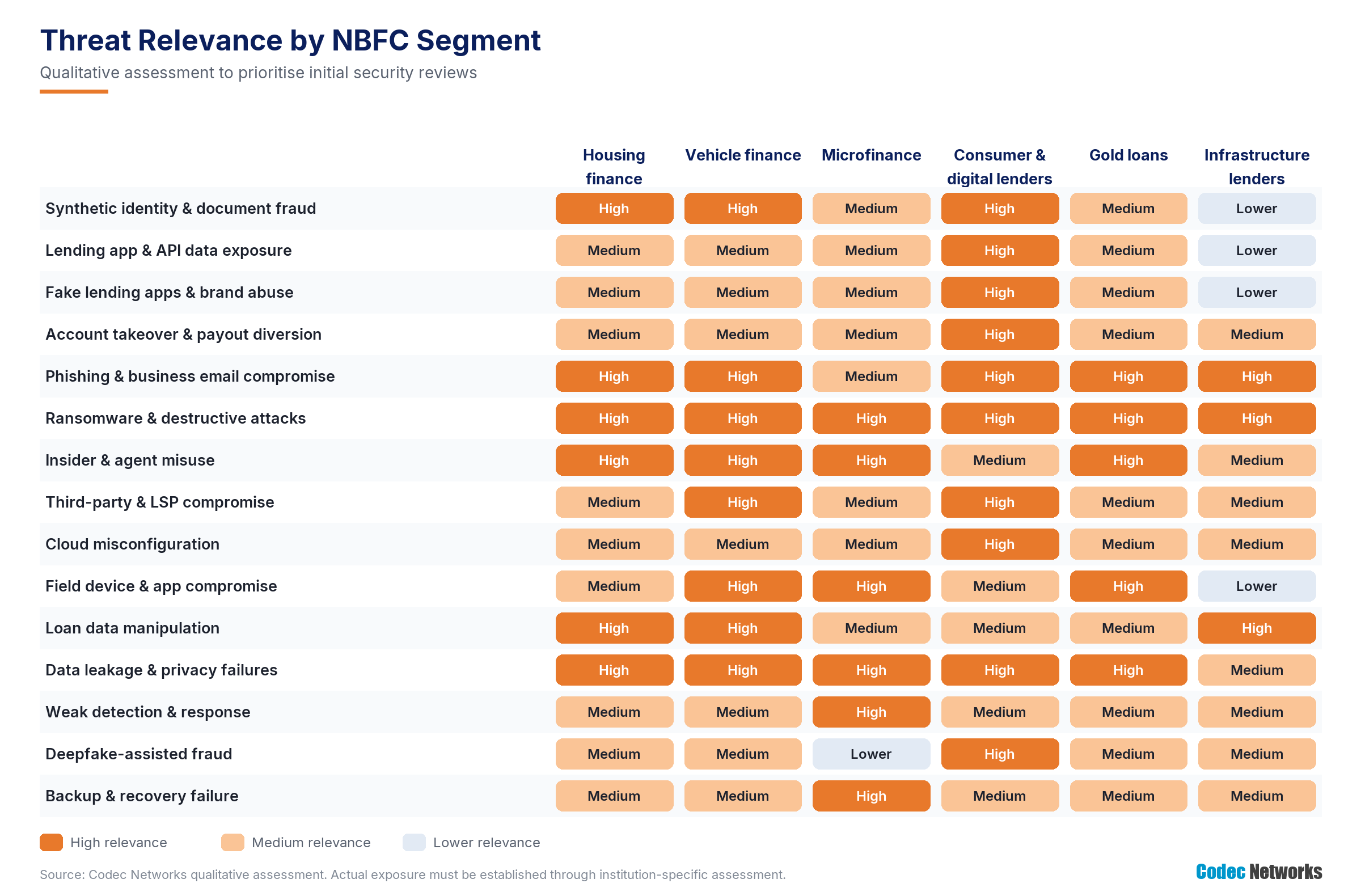
Figure 5: Qualitative threat relevance by NBFC segment (Codec Networks assessment).
4. Five priority threats in depth
4.1 Synthetic identity, document fraud and partner collusion
Fraud in NBFC lending often combines forged documents, synthetic or borrowed identities and collusion by dealers, DSAs or insiders. RBI's Master Directions on Fraud Risk Management in NBFCs (July 2024) require Upper and Middle Layer NBFCs to operate an early warning signal framework and red-flagging of accounts, supported by data analytics and market intelligence.
- Questions to test: Do onboarding checks go beyond OCR to verify identity, income and collateral? Are dealers, agents, devices and bank accounts linked analytically? Do early warning signals trigger red-flagging and forensic audit in time?
- Relevant services: onboarding and V-CIP controls review, fraud analytics, EWS framework review, forensic audit.
4.2 Fake lending apps and brand abuse
Rogue apps and websites impersonating legitimate lenders harvest borrower data and collect bogus fees, harming customers and the real NBFC's reputation. RBI's Digital Lending Directions require transparency about the digital lending apps a lender uses, including reporting them on RBI's CIMS portal.
- Questions to test: Is the NBFC monitoring app stores and the web for impersonation? How quickly can fake apps be taken down? Do borrowers know which apps are genuine?
- Relevant services: brand and rogue-app monitoring, anti-phishing and takedown support, DMARC review, customer communication.
4.3 Lending app, API and partner data exposure
Digital lending runs on APIs between apps, LSPs, bureaus, Account Aggregators and lenders. Broken authorisation or excessive data in responses can expose borrower files at scale. The 2026 Directions require VA at least six-monthly and PT at least annually for critical and customer-facing systems for Middle Layer NBFCs and above.
- Questions to test: Is every API tested for object-level authorisation and data minimisation in each release? Are LSP integrations assessed, not just contracted?
- Relevant services: application and API security testing, secure code review, LSP and partner assurance.
4.4 Ransomware and month-end disruption
Ransomware is most damaging when timed for disbursement or collection peaks. Middle Layer NBFCs and above must run DR drills for critical systems at least half-yearly, with DR operating for at least a full working day, and test BCP at least annually.
- Questions to test: Are backups isolated and restorable? Is EDR monitored around the clock? Has a ransomware scenario been rehearsed with the 6-hour reporting step?
- Relevant services: ransomware simulation, backup and DR testing, managed SOC, incident response retainer.
4.5 Field-agent devices and insider misuse
Microfinance and vehicle-finance field forces carry borrower data on tablets and phones, often offline. Lost devices, unrestricted exports and misuse by agents create data leakage and conduct risk.
- Questions to test: Are field apps hardened and data encrypted? Can devices be remotely wiped? Are bulk exports and unusual access by agents detected?
- Relevant services: mobile app security testing, device management and DLP review, insider threat simulation, SOC monitoring.
5. Impact on NBFCs and their stakeholders
|
Lender type |
Threats to prioritise |
Main impact |
|
Housing finance |
Document fraud, ransomware, data leakage |
Credit losses, NHB scrutiny, borrower trust |
|
Vehicle finance |
Dealer collusion, field-device risk, payout diversion |
Clustered defaults, partner disputes |
|
Microfinance |
Agent misuse, device loss, collection fraud |
Borrower harm, conduct complaints, data leakage |
|
Consumer and digital lenders |
Fake apps, API exposure, LSP compromise |
Mass data exposure, regulatory and media attention |
|
Gold loans |
Ransomware across branches, insider misuse |
Branch outages, vault and valuation fraud |
|
Infrastructure lenders |
BEC, targeted phishing, data theft |
Large-value fraud and reputational damage |
6. How regulation turns incidents into business events
- Reporting clocks: cyber incidents to RBI on DAKSH within six hours of detection (HFCs to NHB) under the 2026 Directions; specified incidents to CERT-In within six hours.
- Fraud reporting: fraud classification, reporting and red-flagging obligations under RBI's fraud risk management directions for NBFCs.
- Evidence: ICT logs retained for 180 days in India under CERT-In's Directions.
- Privacy: once DPDP breach provisions commence in May 2027, personal data breaches must be intimated to the Data Protection Board, with a detailed report within 72 hours.
- Partners: bank co-lenders and funders may suspend arrangements or call for audits after a material incident.
|
Insight NBFC incidents are rarely single failures: a weak partner control lets a fraudulent file in, weak analytics lets the cluster grow, and slow response turns losses into supervisory findings. Assessments should test origination, partners and back-end systems together. |
7. Questions every leadership team should ask
- Which chapter of RBI's 2026 NBFC Directions applies to us, and where are our gaps?
- Could we detect, triage and report a material incident to RBI or NHB within six hours?
- Which partners—LSPs, DSAs, dealers, co-lenders—could hurt us most, and when were their controls last tested?
- Would our analytics spot a cluster of loans linked to the same dealer, device or account?
- Are fake apps or sites impersonating us right now?
- Is borrower data on field devices encrypted, minimised and remotely wipeable?
Talk to Codec Networks
|
Contact Codec Networks Pvt. Ltd. New Delhi: 507, 5th Floor, New Delhi House, Barakhamba Road, Connaught Place, New Delhi – 110001 Gurugram: 707, 7th Floor, Silverton Tower, Golf Course Extension Road, Sector 50, Gurugram – 122018, Haryana Landline: 011 430 496 96 | 011 437 522 99 Mobile: +91 99716 76124 | +91 88007 88220 | +91 88003 31124 Email: mktg@codecnetworks.com Web: www.codecnetworks.com |
Note: Threat descriptions and relevance ratings are general guidance, not findings about any specific NBFC. RBI fraud figures relate to frauds of ₹1 lakh and above reported by banks and FIs in 2025-26; I4C figures cover all channels. Confirm regulatory obligations against official instruments.