

Resources Categories
INDUSTRY FACT FILE · OIL, GAS & PETROCHEMICALS
Threat Landscape: Top Cyber Threats Facing Oil, Gas and Petrochemicals
The 18 most relevant cyber threats, attacks and industry challenges for exploration companies, pipelines, refineries, terminals and fuel distributors.
|
In this document 1. The threat picture in numbers 2. Top 18 threats, attacks and challenges 3. Threat relevance by oil and gas segment 4. Five priority threats in depth 5. Impact on oil and gas companies and consumers 6. How regulation turns incidents into business events 7. Questions every leadership team should ask |
1. The threat picture in numbers
|
2012 Shamoon wiped ~30,000 workstations at a Gulf oil company |
2017 TRITON targeted a petrochemical plant's safety system |
May 2021 IT ransomware led to a precautionary US pipeline shutdown |
6 hours To report incidents to CERT-In |
Oil and gas attracts criminals seeking ransom from operations that cannot stop, state-backed actors seeking intelligence or disruptive capability, and destructive attacks designed to cause maximum damage. Contractors, vendors and remote sites widen the attack surface.
Landmark incidents—Shamoon (2012), TRITON's targeting of safety systems (2017), the precautionary shutdown of a major US pipeline after IT ransomware (2021) and a reported ransomware attack on an Indian oil company in 2022—show the range of impact.
2. Top 18 threats, attacks and challenges
The list below is a practical assessment framework, not a statistical ranking. Priority varies by business model, technology exposure and existing controls.
|
# |
Threat / attack / challenge |
Typical scenario |
Most exposed |
Potential impact |
|
1 |
Ransomware with operational impact |
IT encryption forcing OT shutdowns |
Pipelines, refineries, terminals |
Supply disruption |
|
2 |
Safety instrumented system tampering |
Malicious changes to SIS logic |
Refineries, petrochemicals, terminals |
Safety hazards |
|
3 |
Pipeline SCADA compromise |
Unauthorised control of pumps and valves |
Pipelines and CGD |
Supply and safety impact |
|
4 |
Insecure third-party and contractor access |
Vendor tunnels and contractor laptops |
All operators |
Initial access to OT |
|
5 |
Destructive wiper malware |
Mass wiping of workstations and servers |
E&P and refiners |
Long recovery |
|
6 |
Nation-state espionage |
Theft of exploration and process data |
E&P and refiners |
Strategic and commercial loss |
|
7 |
Phishing and credential theft |
Staff and engineers targeted |
All operators |
Initial access |
|
8 |
Legacy and unpatched OT |
Outdated DCS, HMI and RTU platforms |
All operators |
Easy exploitation |
|
9 |
Flat IT/OT networks |
No separation between IT and OT |
Refineries and terminals |
Rapid spread |
|
10 |
Remote and offshore connectivity risks |
Satellite and radio links to remote sites |
E&P and pipelines |
Exposure and disruption |
|
11 |
Retail automation and payment fraud |
Manipulated station systems or payments |
Fuel retail |
Revenue loss |
|
12 |
Inventory and measurement manipulation |
Altered tank or flow data |
Terminals, pipelines, retail |
Financial loss and disputes |
|
13 |
Supply-chain and vendor compromise |
Compromised OEM software or updates |
All operators |
Persistent compromise |
|
14 |
Business email compromise |
Fraudulent payments to suppliers |
All operators |
Financial loss |
|
15 |
Removable media malware |
USB drives in plant environments |
Refineries and plants |
OT infection |
|
16 |
Insider misuse |
Employees or contractors abuse access |
All operators |
Sabotage or fraud |
|
17 |
Weak OT detection and response |
No OT monitoring |
Most operators |
Missed 6-hour reporting |
|
18 |
OT recovery failure |
No tested OT backups or restart plans |
All operators |
Extended shutdowns |
3. Threat relevance by oil and gas segment
The matrix is a qualitative guide for prioritising the first round of security reviews.
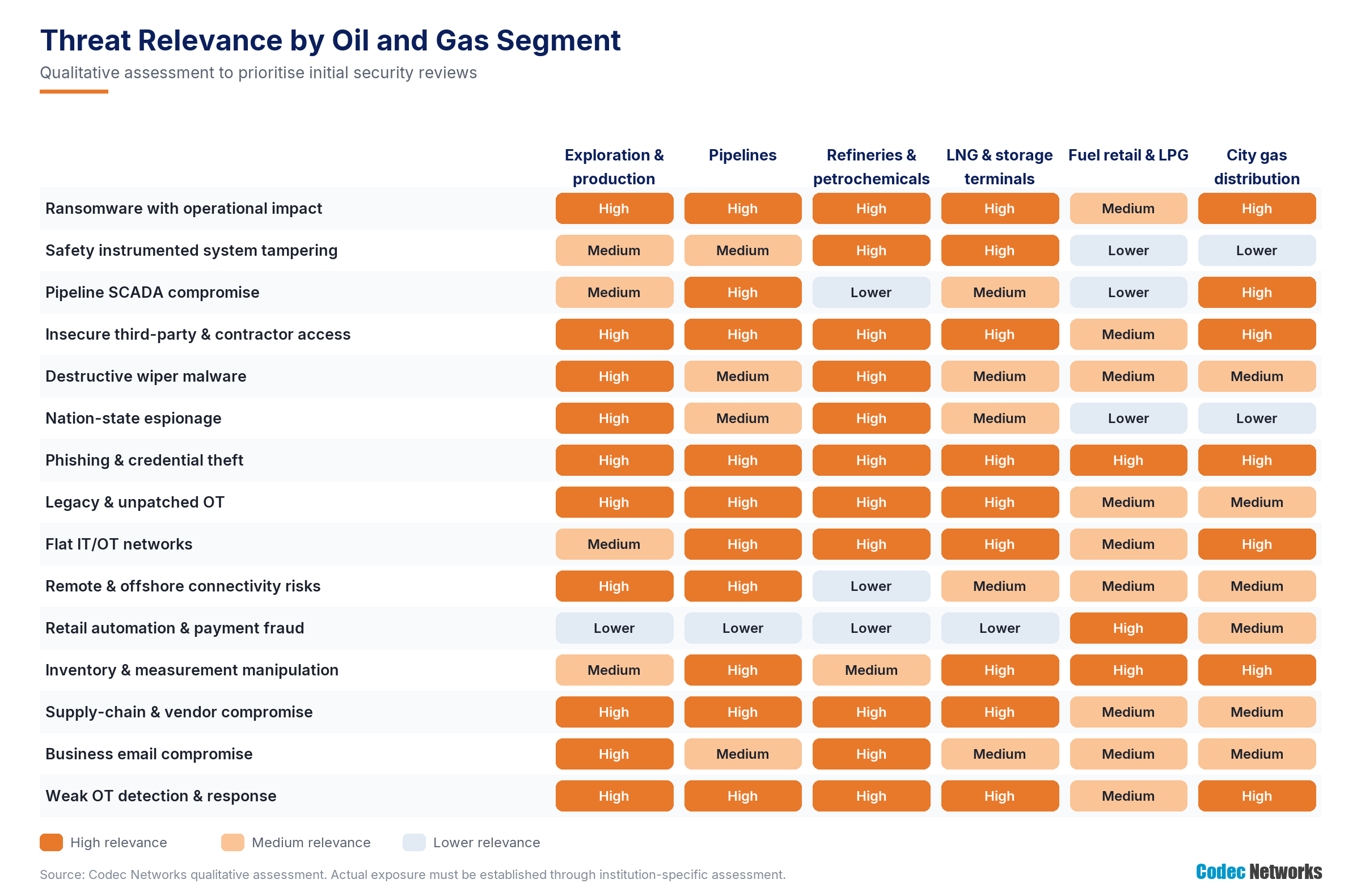
Figure 5: Qualitative threat relevance by oil and gas segment (Codec Networks assessment).
4. Five priority threats in depth
4.1 Ransomware and IT-dependent shutdowns
Even when OT is untouched, operators may shut down because billing, scheduling or custody-transfer systems on IT are unavailable or trust is lost.
- Questions to test: Which operational processes depend on IT? Can OT run safely and commercially without IT for a period? Are backups immutable and tested?
- Relevant services: dependency mapping, segmentation, backup and recovery testing, crisis exercises.
4.2 Safety instrumented systems
Attacks on SIS aim to disable the last layer of protection. Engineering workstations with access to safety controllers are the critical path.
- Questions to test: Are SIS networks isolated? Are controllers in run mode with physical key control? Are engineering workstation actions monitored?
- Relevant services: SIS security review, engineering workstation controls, OT monitoring.
4.3 Contractors and vendors
Turnarounds bring hundreds of contractors and laptops into plants, and vendors often hold permanent remote access to control systems.
- Questions to test: Are contractor devices scanned and segmented? Is vendor access brokered and recorded? Are accounts removed after work?
- Relevant services: third-party access programme, scanning kiosks, remote access review.
4.4 Destructive malware and espionage
Wipers and state-backed intrusions target corporate networks and valuable exploration and process data.
- Questions to test: Is privileged access tiered and protected? Are critical datasets backed up offline? Is there threat hunting?
- Relevant services: PAM review, offline backups, EDR, SOC and hunting.
4.5 Detection and the 6-hour clock
CERT-In requires reporting within six hours of noticing an incident. OT environments are often unmonitored, delaying detection.
- Questions to test: Are IT and OT monitored 24x7? Is there a playbook combining safety, operations and reporting decisions?
- Relevant services: IT/OT SOC, playbooks, joint drills with operations and safety teams.
5. Impact on oil and gas companies and consumers
|
Player type |
Threats to prioritise |
Main impact |
|
E&P companies |
Wipers, espionage, remote access |
Lost data and production disruption |
|
Pipelines and CGD |
SCADA compromise, IT-dependent shutdowns |
Regional supply disruption |
|
Refineries and petrochemicals |
SIS tampering, contractor access |
Safety and production impact |
|
Terminals |
Automation and measurement manipulation |
Overfill risk and inventory loss |
|
Retail and consumers |
Retail fraud, outages at pumps |
Revenue loss and consumer impact |
6. How regulation turns incidents into business events
- CERT-In: incidents reported within six hours of noticing them.
- NCIIPC: incidents affecting notified critical information infrastructure require coordination.
- Safety regulators: incidents affecting safety systems or causing process upsets may trigger safety investigations under applicable rules.
- PNGRB: incidents affecting pipeline or city gas integrity and supply may require regulatory engagement.
- Consumers: retail, LPG and CGD incidents involving personal data trigger DPDP obligations once breach provisions commence in May 2027.
|
Insight The most dangerous oil and gas incidents cross boundaries—from IT into OT, and from control systems into safety systems. Strong boundaries are the best defence. |
7. Questions every leadership team should ask
- Would an IT ransomware attack force us to shut down operations?
- Are our safety instrumented systems isolated and their engineering workstations monitored?
- How do we control contractor devices and accounts during turnarounds?
- Which vendors can reach our DCS and SCADA, and is their access recorded?
- Do we have offline backups and a tested restart plan for OT?
- Could we report an incident to CERT-In within six hours while keeping operations safe?
Talk to Codec Networks
|
Contact Codec Networks Pvt. Ltd. New Delhi: 507, 5th Floor, New Delhi House, Barakhamba Road, Connaught Place, New Delhi – 110001 Gurugram: 707, 7th Floor, Silverton Tower, Golf Course Extension Road, Sector 50, Gurugram – 122018, Haryana Landline: 011 430 496 96 | 011 437 522 99 Mobile: +91 99716 76124 | +91 88007 88220 | +91 88003 31124 Email: mktg@codecnetworks.com Web: www.codecnetworks.com |
Note: Threat descriptions and relevance ratings are general guidance, not findings about any specific organisation. Public incident references are summarised from widely reported events.