

Resources Categories

INDUSTRY FACT FILE · PAYMENTS & TRANSACTION PROCESSING
Industry Overview: Payments and Transaction Processing in India
Who the industry players are, how they are organised, who owns and regulates them, and why each one needs a distinct cybersecurity approach.
|
In this document 1. Why payments and transaction processing matter now 2. The ecosystem at a glance 3. Industry player categories 4. Corporate, enterprise, government and public-sector participants 5. Who buys cybersecurity inside these organisations 6. Why each player type needs a different security approach 7. How Codec Networks works with this sector |
|
Sector scope Sector: Payments and transaction processing — payment aggregators, payment gateways, wallets and PPI issuers, processors, payment networks and bill payment businesses. Primary service proposition: SAR/CSAR engagements where applicable, payment data localisation, VAPT, SOC and payment security controls. Lending technology, Account Aggregators and other fintech models are covered in more depth in the separate Fintech & Digital Financial Services fact file. |
1. Why payments and transaction processing matter now
India runs one of the world's largest real-time payment economies. Every day, millions of customers and merchants depend on a chain of regulated and unregulated companies—apps, aggregators, gateways, banks, networks, wallets and lenders—to move money in seconds. That speed is the industry's strength and its biggest security challenge: a weakness anywhere in the chain can be exploited at the same speed.
|
24.51 bn UPI transactions in August 2026 (NPCI data) |
₹29.82 lakh cr UPI value processed in August 2026 |
500 mn+ Account Aggregator consents fulfilled (Sahamati, Sept 2026) |
3 PA categories under RBI's 2025 Master Direction |
Regulators have responded with a dense, fast-moving rulebook. Between 2024 and 2026 the Reserve Bank of India (RBI) issued dedicated cyber resilience directions for non-bank payment system operators, a consolidated Master Direction for payment aggregators, new authentication rules for digital payments and consolidated digital lending directions. For the companies in this sector, cybersecurity is now a condition of authorisation, partnership and growth—not an optional IT project.
|
Key takeaway Payments and fintech companies are judged on three things at once: transaction reliability, customer trust and regulatory standing. Each one depends on demonstrable cybersecurity. |
2. The ecosystem at a glance
A single digital payment touches several organisations. A customer starts the payment in a front-end app; a payment aggregator or gateway routes it; an acquiring or sponsor bank handles merchant settlement; a network or switch carries the message; and an issuing bank or PPI issuer authorises it. Lending, account aggregation and cross-border flows plug into the same rails.
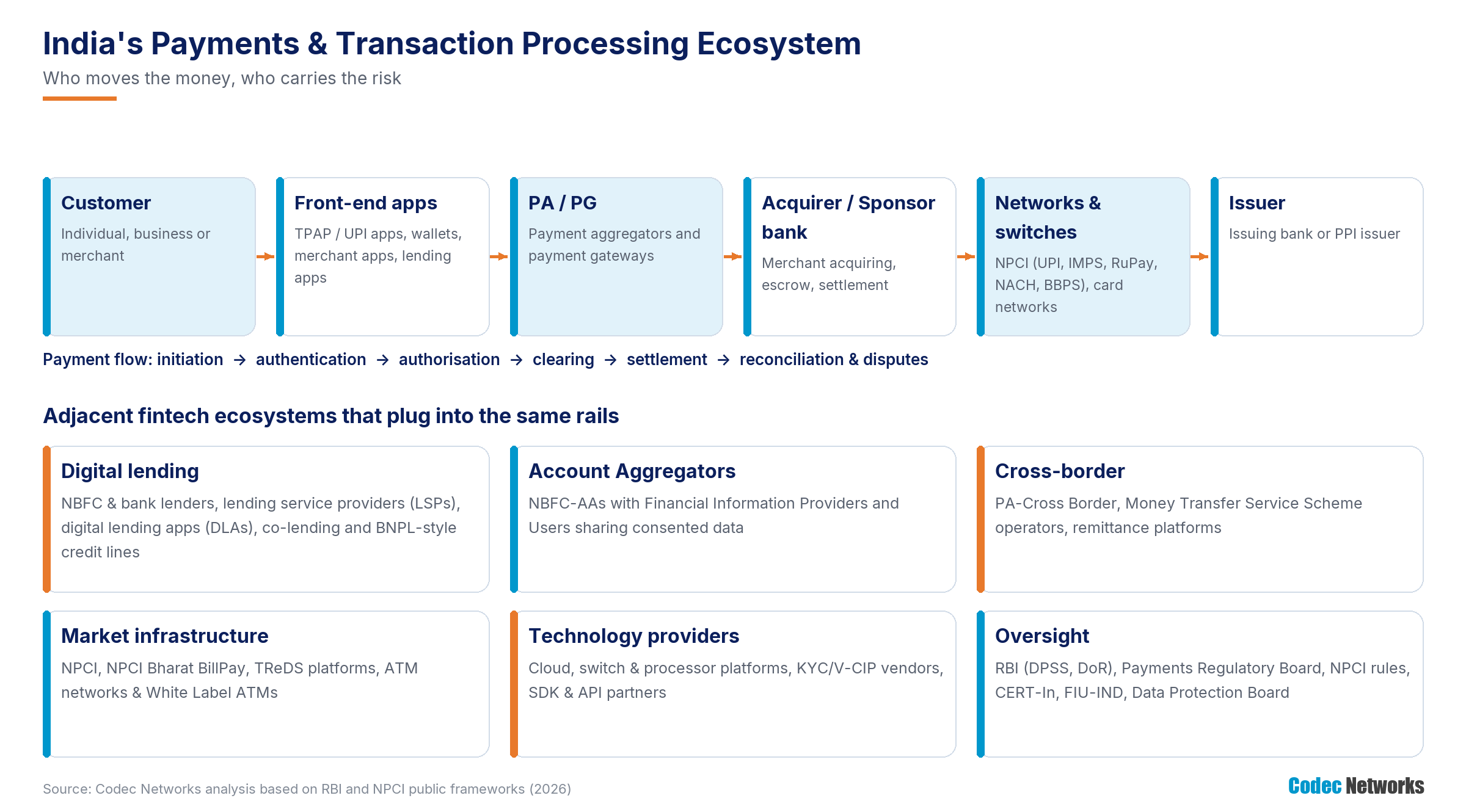
Figure 1: The Indian payments and transaction processing ecosystem — the payment chain and the adjacent fintech ecosystems that share its rails.
Because the chain is shared, security responsibilities are shared too. RBI's 2024 cyber resilience directions explicitly ask non-bank PSOs to extend security expectations to the unregulated entities in their ecosystem—such as payment gateways, third-party service providers and vendors—through Board-approved policy and mutual agreement.
3. Industry player categories
The sector can be organised into ten categories of industry players. The table below explains who they are, how they are typically owned and the primary regulatory basis under which they operate.
|
Player category |
Who they are |
Typical ownership |
Primary regulatory basis |
|
Payment system operators (market infrastructure) |
Retail and wholesale payment infrastructure: NPCI (UPI, IMPS, RuPay, NACH, AePS, NETC), NPCI Bharat BillPay, CCIL, card payment networks, ATM networks and White Label ATM operators, TReDS platforms |
Bank-promoted not-for-profit companies, bank consortia, private and international network companies |
Authorisation under the Payment and Settlement Systems Act, 2007; RBI oversight; RBI cyber resilience directions for non-bank PSOs (2024) |
|
Payment aggregators (PA-O, PA-P, PA-CB) |
Companies that aggregate payments for merchants online, at physical points of sale or across borders, and settle to merchants through escrow accounts |
Private fintechs, listed payment companies, subsidiaries of banks and large groups; banks may also act as PAs |
RBI Master Direction on Regulation of Payment Aggregators, 15 September 2025 |
|
Payment gateways |
Technology providers that route online transactions; they do not handle funds |
Private technology companies |
Outside the PA authorisation regime, but encouraged by RBI to follow the baseline technology recommendations |
|
PPI issuers and wallets |
Issuers of wallets, prepaid cards, gift cards and transit cards |
Banks and authorised non-bank companies |
RBI Master Directions on Prepaid Payment Instruments (27 August 2021, as updated; a 2026 draft replacement is under consultation) |
|
UPI apps and third-party application providers (TPAPs) |
Consumer and merchant UPI apps that work with sponsor PSP banks |
Private fintechs and big-tech companies |
NPCI UPI procedural guidelines and circulars; sponsor-bank due diligence |
|
Bill payment operating units (BBPOUs) |
Operators that collect bills through the Bharat Bill Payment System |
Banks and authorised non-banks |
PSS Act authorisation; NPCI Bharat BillPay rules |
|
Cross-border payment and remittance players |
PA-Cross Border entities, Money Transfer Service Scheme (MTSS) operators and remittance fintechs |
Private companies, often with international parents |
PA Master Direction (PA-CB); MTSS directions; FEMA; PMLA/FIU-IND reporting |
|
Digital lending platforms |
Regulated lenders (banks, NBFCs) and their lending service providers (LSPs) and digital lending apps (DLAs), including multi-lender marketplaces |
NBFCs, bank-fintech partnerships, private platforms |
RBI (Digital Lending) Directions, 2025; DLA reporting on RBI's CIMS portal |
|
Account Aggregators and financial data platforms |
NBFC-Account Aggregators and the Financial Information Providers and Users that exchange consented financial data |
Private NBFC-AAs; banks, NBFCs, insurers and securities entities as FIPs/FIUs |
RBI Master Direction for NBFC-Account Aggregators; sector regulators for FIPs/FIUs |
|
Technology and processing service providers |
Card processors, switch vendors, core platform vendors, KYC and V-CIP vendors, SDK and API partners, cloud and hosting providers |
Private Indian and international technology companies |
Not directly authorised; governed through contracts, outsourcing rules and the security requirements of their regulated clients |
|
Bank-versus-non-bank distinction Banks participate in almost every category—as issuers, acquirers, sponsor banks, escrow banks and PAs. This document focuses on the non-bank and fintech side of the market. Bank-specific obligations are covered in the Codec Networks Banking industry fact file. |
4. Corporate, enterprise, government and public-sector participants
4.1 Corporate and enterprise players
The commercial core of the sector is private. It ranges from listed payment and fintech companies and subsidiaries of large conglomerates to venture-funded scale-ups and early-stage startups. Their security needs scale with their regulatory category, transaction volume and number of partner banks and merchants.
|
Segment |
Characteristics |
Typical cybersecurity priorities |
|
Large and listed fintechs |
Multiple licences (PA, PPI, lending, broking), large merchant bases, public disclosure obligations |
Group-wide security governance, Board reporting, 24x7 SOC, regulatory audits across licences, investor and IPO diligence |
|
Conglomerate and big-tech subsidiaries |
Payments embedded in a wider consumer or commerce ecosystem |
Data segregation between group entities, shared-platform risk, privacy, third-party risk |
|
Mid-sized authorised entities |
Single licence (e.g., PA or PPI), growing transaction volumes, lean security teams |
Meeting RBI timelines, half-yearly VAPT, CERT-In empanelled audits, managed SOC instead of building in-house |
|
Startups and technology providers |
Unregulated or applying for authorisation; depend on bank and PA partners |
Partner due diligence questionnaires, PCI DSS for card data, ISO 27001 or SOC 2 readiness, secure SDLC |
4.2 Government, semi-government and public-sector participants
The public sector shapes the industry as owner, operator, regulator and large-scale user of payment systems:
- Public-sector banks and India Post Payments Bank act as issuers, acquirers, sponsor banks and escrow banks across UPI, cards, wallets and bill payments.
- NPCI, an umbrella organisation for retail payments set up as an initiative of the RBI and the Indian Banks' Association, operates national rails such as UPI, IMPS, RuPay, NACH and AePS.
- Government payment platforms—for example treasury, tax, subsidy and procurement payment systems—connect to aggregators, gateways and banks for collections and disbursements.
- Transit and urban bodies use prepaid and contactless payments, such as National Common Mobility Card (NCMC)-based transit cards issued through banks.
- Regulators and statutory bodies—RBI and its Payments Regulatory Board, CERT-In, FIU-IND, MeitY and the Data Protection Board of India—set the obligations that drive security demand.
|
Self-regulation In August 2024 the RBI recognised the Fintech Association for Consumer Empowerment (FACE) as the first Self-Regulatory Organisation for the FinTech sector (SRO-FT). Industry bodies such as the Payments Council of India and the Digital Lenders Association of India also publish codes that influence member security practices. |
5. Who buys cybersecurity inside these organisations
Cybersecurity decisions in payments and transaction processing are rarely made by one person. RBI's 2024 directions require the Board—or a Board sub-committee that meets at least once a quarter—to oversee information security, and require a senior executive such as a CISO to be accountable for implementation.
|
Stakeholder |
What they care about |
What they buy |
|
Board and IT/Risk sub-committee |
Regulatory standing, material cyber risk, incident readiness |
Board-level advisory, risk dashboards, cyber crisis exercises |
|
CEO / Business heads |
Uptime, partner and merchant trust, licence continuity, growth |
Assurance programmes that unblock partnerships and audits |
|
CISO / Head of Information Security |
Control effectiveness, monitoring, vulnerability closure |
VAPT, managed SOC, cloud and API security, red teaming |
|
CTO / Engineering |
Release velocity, platform stability, secure architecture |
DevSecOps, secure code review, API testing, architecture reviews |
|
Chief Risk Officer / Fraud head |
Fraud losses, mule accounts, chargebacks |
Fraud-scenario testing, mule-merchant analytics, forensic investigations |
|
Compliance head / Principal Officer |
RBI, NPCI, FIU-IND and CERT-In obligations |
Regulatory cyber audits, system audits, evidence management |
|
Data Protection Officer / Privacy lead |
DPDP Act and Rules readiness, consent, breach handling |
Privacy programme, data mapping, DPIA, breach playbooks |
|
Procurement / Partnerships |
Third-party and bank-partner due diligence |
Vendor assessments, security questionnaires, SOC 2 / ISO evidence |
6. Why each player type needs a different security approach
The same threat lands differently on each player. A mule account is a fraud problem for a wallet issuer, an onboarding problem for an aggregator and a monitoring problem for a network operator. Security programmes should therefore start from the player's role, licence and technology exposure.
|
Player type |
Highest-consequence risk |
Starting point for assurance |
|
Payment aggregator |
Fraudulent or mule merchants, e-skimming at checkout, settlement and escrow integrity |
Merchant onboarding controls review, payment-page security, annual CERT-In empanelled cyber audit, half-yearly VAPT |
|
PPI issuer / wallet |
Account takeover, social-engineering fraud, KYC abuse |
Mobile app security testing, device binding and authentication review, fraud-monitoring assessment |
|
PSO / network / switch |
Availability attacks, systemic outage, privileged-access compromise |
Resilience and DR testing, SOC maturity review, privileged-access audit |
|
Digital lending platform |
API data exposure, unauthorised data collection, fake lending apps |
API security testing, DPDP privacy review, brand and rogue-app monitoring |
|
Account Aggregator / data platform |
Consent bypass and data leakage across FIPs and FIUs |
API and consent-flow testing, encryption and key management review |
|
Cross-border player |
Money laundering through mule flows, sanctions exposure, partner compromise |
Transaction-monitoring controls review, third-party assessment, logging assurance |
|
Technology service provider |
Supply-chain compromise affecting many regulated clients |
Secure SDLC, SOC 2 / ISO 27001 readiness, client-ready assurance evidence |
7. How Codec Networks works with this sector
Codec Networks is a CERT-In empanelled information security auditing organisation certified to ISO 9001:2015, ISO/IEC 27001:2022 and ISO/IEC 20000-1:2018. For payments and transaction processing companies, our work typically combines three strands:
- Payment security: application, API, mobile and payment-page testing; PCI DSS readiness; fraud-scenario and business-logic testing; managed SOC with fraud-signal correlation.
- Regulatory audits: cyber security and system audits required under RBI directions, payment data storage audits, CERT-In readiness and evidence management across multiple licences.
- API and cloud assurance: cloud posture reviews, API gateway and microservice security, secrets management, secure SDLC and third-party risk management.
The remaining documents in this set examine the sector's products and services, market and regulatory drivers, threat landscape, applicable Codec Networks services and bundles, frequently asked questions and new case studies, followed by a brochure, sales presentation and marketing pamphlet.
Talk to Codec Networks
|
Contact Codec Networks Pvt. Ltd. New Delhi: 507, 5th Floor, New Delhi House, Barakhamba Road, Connaught Place, New Delhi – 110001 Gurugram: 707, 7th Floor, Silverton Tower, Golf Course Extension Road, Sector 50, Gurugram – 122018, Haryana Landline: 011 430 496 96 | 011 437 522 99 Mobile: +91 99716 76124 | +91 88007 88220 | +91 88003 31124 Email: mktg@codecnetworks.com Web: www.codecnetworks.com |
Note: This document is general industry guidance based on public information available as of October 2026, including RBI, NPCI, CERT-In and MeitY publications. Regulatory applicability depends on each entity's licence, category and activities; confirm requirements against the current official instruments before making compliance decisions. Market statistics are as published by the cited sources.