

Resources Categories
INDUSTRY FACT FILE · PAYMENTS & TRANSACTION PROCESSING
Threat Landscape: Top Cyber Threats Facing Payments and Transaction Processing
The 18 most relevant cyber threats, attacks and industry challenges for payments and transaction processing companies in India, and the impact each one has on industry players.
|
In this document 1. The threat picture in numbers 2. Top 18 threats, attacks and challenges 3. Threat relevance by segment 4. Five priority threats in depth 5. Impact on industry players 6. How regulation turns incidents into business events 7. Questions every leadership team should ask |
1. The threat picture in numbers
Payments and fintech companies sit where criminals want to be: at the point where money moves. Public data shows the scale of cyber-enabled financial fraud in India and the response being built across the ecosystem.
|
₹22,849 cr Reported cyber-fraud losses in 2024 (I4C data) |
₹19,813 cr Reported cyber-fraud losses in 2025 (I4C data) |
29 banks Using RBIH's MuleHunter.AI (July 2026) |
6 hours To report incidents to RBI and CERT-In |
These figures, reported from Indian Cybercrime Coordination Centre (I4C) data, cover complaints across all channels, not only payment companies. They nonetheless show why regulators now expect payment entities to detect, report and respond to incidents within hours. The industry response includes RBI Innovation Hub's MuleHunter.AI tool for identifying mule accounts and the Digital Payments Intelligence Platform, which the Government told Parliament in July 2026 had seven banks onboarded in its pilot phase.
2. Top 18 threats, attacks and challenges
The following list is a practical assessment framework for the payments and transaction processing sector. It is not a statistical ranking; actual priority varies by business model, technology exposure and existing controls.
|
# |
Threat / attack / challenge |
Typical scenario |
Players most exposed |
Potential business impact |
|
1 |
Account takeover (ATO) |
SIM swap, OTP interception, credential stuffing or a malicious app gives an attacker control of a wallet, UPI app or lending account |
Wallets, UPI apps, lenders |
Direct customer losses, reimbursement claims, regulatory complaints |
|
2 |
Social engineering and authorised push-payment scams |
Fake customer-care numbers, investment and task scams, impersonation of officials; the victim authorises the payment |
UPI apps, wallets, PAs |
Customer harm, grievance load, reputational damage, pressure on liability frameworks |
|
3 |
Mule accounts and mule merchants |
Accounts and merchant IDs opened with borrowed or synthetic identities to receive and move scam proceeds |
PAs, wallets, cross-border players |
Regulatory scrutiny of onboarding, FIU-IND reporting failures, partner-bank exits |
|
4 |
API abuse and broken authorisation |
Attackers manipulate object IDs, tokens or parameters to read other customers' data or trigger unauthorised actions |
All API-first players, especially lenders and AAs |
Mass data exposure, transaction manipulation, DPDP liability |
|
5 |
E-skimming and malicious third-party scripts or SDKs |
Compromised analytics, chat or payment scripts on checkout pages copy card data; malicious SDKs in apps |
PAs, gateways, merchants |
Card-data compromise, network penalties, forensic and reissuance costs |
|
6 |
Business-logic abuse |
Exploiting refund, reversal, cashback, limit or retry logic to extract money without 'hacking' in the traditional sense |
PAs, wallets, UPI apps |
Silent financial leakage, reconciliation breaks |
|
7 |
QR-code and collect-request fraud |
Fake or overlaid QR codes, malicious collect requests and fake payment-confirmation screens |
UPI apps, merchants, PAs |
Merchant and customer losses, dispute volumes |
|
8 |
Fake, cloned and rogue apps |
Fake lending apps, cloned payment apps, screen-sharing and remote-access tools used to steal credentials |
Lenders, wallets, UPI apps |
Brand abuse, customer harm, regulatory action against unauthorised lending |
|
9 |
Synthetic identities and deepfake-assisted KYC |
Forged documents, AI-generated faces or voices used to defeat KYC and V-CIP checks |
Wallets, lenders, PAs |
Fraudulent onboarding at scale, credit losses, KYC compliance findings |
|
10 |
Cloud misconfiguration and secrets exposure |
Public storage buckets, over-privileged IAM roles, exposed API keys in code or logs |
Cloud-native fintechs, PSOs |
Data exposure, unauthorised access, 6-hour incident reporting obligations |
|
11 |
Third-party and technology service provider compromise |
A processor, KYC vendor, SDK provider or managed service is breached and used as a path into clients |
All players |
Downstream breaches across many entities, outsourcing-control findings |
|
12 |
Ransomware and data extortion |
Encryption of systems and theft of data, with threats to publish |
PSOs, processors, lenders |
Service outage, settlement delays, data disclosure, recovery costs |
|
13 |
DDoS and availability attacks |
Floods against payment APIs, checkout pages or switches, sometimes with extortion demands |
PAs, PSOs, networks |
Failed transactions, SLA breaches, lost merchant revenue |
|
14 |
Insider misuse and privileged-access abuse |
Employees, contractors or vendor staff misuse access to data, limits or settlement functions |
PSOs, PAs, processors |
Fraud, data theft, settlement manipulation |
|
15 |
Settlement, escrow and reconciliation tampering |
Altered settlement files, manipulated payout instructions or abuse of reconciliation gaps |
PAs, PSOs, cross-border players |
Direct loss of merchant funds, regulatory breach of escrow rules |
|
16 |
Leakage of personal and financial data |
Over-collection, weak access controls, logs and exports containing personal data |
Lenders, AAs, wallets |
DPDP obligations, customer complaints, partner and regulator action |
|
17 |
Weak detection and slow incident response |
Missing logs, untuned alerts and unclear escalation delay detection beyond regulatory reporting windows |
All players |
Missed 6-hour reporting, larger blast radius, weaker evidence |
|
18 |
AI-enabled attacks and AI-system abuse |
AI-written phishing, voice cloning of executives, prompt injection against AI chatbots and agents |
All players using AI in service or operations |
Fraudulent approvals, data leakage, unreliable automated decisions |
3. Threat relevance by segment
Different segments experience the same threat with different intensity. The matrix below is a qualitative guide for prioritising the first round of security reviews.
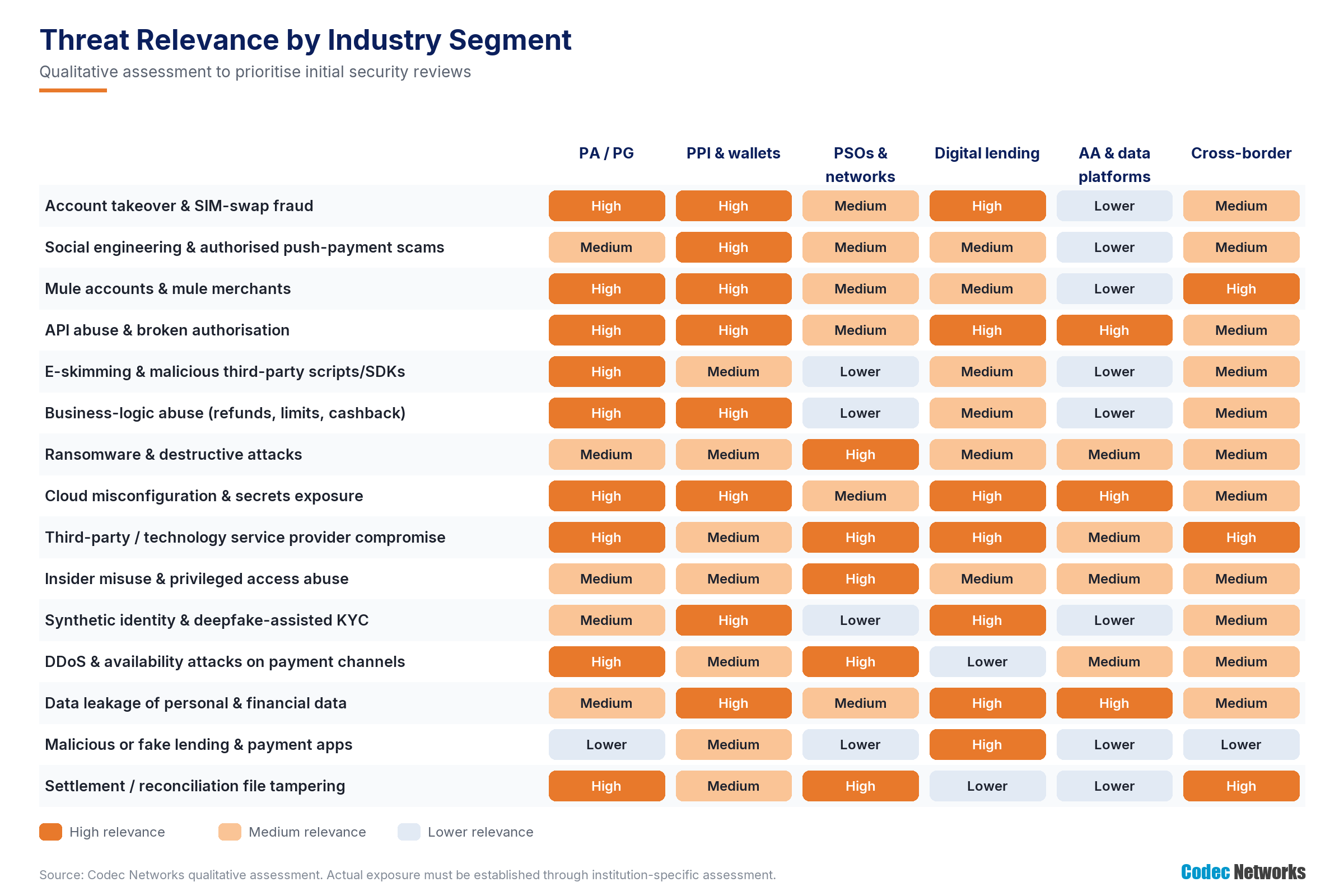
Figure 5: Qualitative threat relevance by industry segment (Codec Networks assessment).
4. Five priority threats in depth
4.1 Account takeover and authentication bypass
Account takeover combines technical and human weaknesses: SIM swaps, OTP sharing under pressure, malware or screen-sharing apps, reused passwords and weak device binding. RBI's 2024 directions for non-bank PSOs require device binding, session time-outs, lockouts after failed logins, blocking of transactions while remote-access apps are active and a 12-hour cooling period after a change of registered mobile number or e-mail. From 1 April 2026, the Authentication Directions require two factors, at least one of them dynamic.
- Questions to test: Can a new device be bound without a strong second factor? Are SIM-change and remote-access signals used in risk scoring? Do customer alerts reach the customer before the money leaves?
- Relevant services: mobile application security testing, authentication flow review, IAM & MFA bypass testing, fraud-scenario simulation, SOC fraud-signal monitoring.
4.2 Mule merchants and fraudulent onboarding
Scam proceeds need somewhere to land. Merchant IDs and accounts opened with borrowed, rented or synthetic identities give criminals a way to collect and move money. The 2025 PA Master Direction strengthens merchant due diligence: CKYCR-based retrieval, a simplified route for small merchants with Contact Point Verification, background checks and ongoing monitoring of transactions against the merchant's business profile.
- Questions to test: Do onboarding checks cross-verify PAN, GST, bank account and address? Are velocity limits and settlement holds applied to new merchants? Are suspicious patterns escalated to the Principal Officer for FIU-IND reporting?
- Relevant services: onboarding controls review, process-bypass testing, mule-merchant analytics, forensic investigations.
4.3 API abuse and broken authorisation
Payments and lending platforms are API-first, and APIs are where most serious data-exposure findings occur. Broken object-level authorisation—trusting an ID sent by the client—can expose every customer's records through a single flaw. Excessive data in API responses and missing rate limits compound the problem.
- Questions to test: Is every API tested for object- and function-level authorisation in each release? Are partner and internal APIs inventoried? Are tokens scoped and short-lived?
- Relevant services: API security testing (REST, GraphQL, SOAP), secure code review, API gateway assessment, DevSecOps integration.
4.4 E-skimming and the software supply chain
A checkout page often loads scripts from many third parties. If any one is altered, card data can be copied silently. PCI DSS v4.0.1 requirements 6.4.3 (inventory and authorisation of payment-page scripts) and 11.6.1 (detection of unauthorised changes to payment pages) became mandatory on 31 March 2025. Mobile SDKs raise the same issue inside apps.
- Questions to test: Is there an authorised inventory of every script on payment pages? Would a change be detected within days, not months? Are SDKs reviewed before integration?
- Relevant services: payment-page security assessment, PCI DSS readiness, supply-chain security testing, SOC monitoring of outbound connections.
4.5 Cloud misconfiguration and the 6-hour clock
Cloud-native fintechs move fast, and misconfigurations—public storage, wildcard IAM policies, keys in code repositories—are among the most common real-world causes of exposure. When an incident occurs, CERT-In's Directions and RBI's directions for non-bank PSOs both require reporting within six hours, which is only realistic if logging, ownership and playbooks are in place beforehand.
- Questions to test: Is cloud posture monitored continuously? Are ICT logs retained for 180 days in India and audit logs for at least five years where required? Has the 6-hour reporting process been rehearsed?
- Relevant services: cloud security posture assessment, secrets and IAM review, managed SOC, incident response retainer, tabletop exercises.
5. Impact on industry players
The consequences of a cyber incident in this sector extend well beyond IT. The table summarises the most consequential impacts for each player type.
|
Player type |
Threats to prioritise |
Main impact |
|
Payment aggregators |
Mule merchants, e-skimming, API abuse, settlement tampering, DDoS |
Merchant and partner-bank trust, escrow integrity, authorisation standing |
|
PPI issuers and wallets |
Account takeover, social engineering, synthetic KYC, rogue apps |
Customer losses and complaints, KYC findings, brand damage |
|
PSOs, networks and switches |
Ransomware, DDoS, insider misuse, third-party compromise |
Systemic outages, participant confidence, supervisory action |
|
Digital lending platforms |
API data exposure, fake lending apps, synthetic identities, data leakage |
Borrower harm, lender-partner exits, privacy liability |
|
Account Aggregators |
API abuse, consent bypass, data leakage |
Ecosystem trust, regulatory standing |
|
Cross-border players |
Mule flows, partner compromise, settlement tampering |
AML exposure, correspondent and AD-bank relationships |
|
Technology service providers |
Supply-chain compromise, cloud misconfiguration |
Simultaneous impact on many regulated clients, contract losses |
6. How regulation turns incidents into business events
For a payment entity, an incident immediately becomes a regulatory and partner event:
- Reporting clocks: unusual incidents to RBI within 6 hours of detection under the 2024 directions for non-bank PSOs; specified cyber incidents to CERT-In within 6 hours; payment aggregators also submit monthly cyber incident reports with root-cause analysis.
- Evidence expectations: ICT logs for a rolling 180 days in India (CERT-In) and audit logs retained for at least five years (RBI 2024 directions for non-bank PSOs).
- Customer liability: from 1 January 2027, RBI's revised framework for fraudulent electronic banking transactions places the burden of proving customer liability on banks—raising the stakes for fintech partners whose channels carry those transactions.
- Privacy obligations: once DPDP breach provisions commence (May 2027), personal data breaches must be intimated to the Data Protection Board, with a detailed report within 72 hours.
- Partner reactions: sponsor banks, escrow banks and networks may restrict or review the relationship after a material incident.
|
Insight The most damaging incidents in this sector are usually chains, not single failures: a weak onboarding control lets a mule merchant in, weak monitoring lets the money out, and a slow response turns a fraud case into a regulatory finding. Assessments should test the chain end to end. |
7. Questions every leadership team should ask
- Which of our products and partners would hurt us most if compromised, and when were they last tested?
- Can we detect, triage and report a material incident to RBI and CERT-In within six hours—today, at 2 a.m.?
- Do we know every third-party script, SDK and API partner that touches payment or customer data?
- How quickly would we spot a merchant or account behaving outside its declared profile?
- Are our cloud environments monitored continuously for exposure and misconfiguration?
- Is our Board sub-committee receiving risk indicators that show control effectiveness, not just activity?
Talk to Codec Networks
|
Contact Codec Networks Pvt. Ltd. New Delhi: 507, 5th Floor, New Delhi House, Barakhamba Road, Connaught Place, New Delhi – 110001 Gurugram: 707, 7th Floor, Silverton Tower, Golf Course Extension Road, Sector 50, Gurugram – 122018, Haryana Landline: 011 430 496 96 | 011 437 522 99 Mobile: +91 99716 76124 | +91 88007 88220 | +91 88003 31124 Email: mktg@codecnetworks.com Web: www.codecnetworks.com |
Note: Threat descriptions and relevance ratings are general guidance, not findings about any specific organisation. Loss and complaint figures are as reported from I4C data in public reports and cover all channels. Regulatory obligations summarised here depend on the entity's authorisation and category; confirm against official instruments.