

Resources Categories
INDUSTRY FACT FILE · POWER & ELECTRICITY
Main Products and Services in the Power Sector
What power sector organisations deliver, the operational and IT systems behind each service and where they create cybersecurity and compliance exposure.
|
In this document 1. How power organisations earn their money 2. Services by organisation type 3. Operational technology 4. Metering, billing, markets and corporate IT 5. The systems behind the products and services 6. Trends that change the attack surface 7. Mapping operations to Codec Networks engagements |
1. How power organisations earn their money
|
Revenue stream |
How it works |
Security relevance |
|
Generation tariffs |
Payments for power generated and capacity |
Plant availability depends on OT |
|
Transmission charges |
Charges for carrying power across networks |
Substation and network reliability |
|
Distribution and retail |
Consumer bills for electricity supplied |
Metering and billing integrity |
|
Trading margins |
Buying and selling power in markets |
Platform availability and integrity |
|
Grid services |
System operation and ancillary services |
Control system trust |
2. Services by organisation type
|
Organisation type |
Main services |
Key systems |
|
Generators |
Power generation and ancillary services |
DCS, turbine controls, historians, plant networks |
|
Transmission utilities |
Power transmission |
Substation automation, protection relays, RTUs, telecom |
|
Grid operators |
Scheduling, dispatch and balancing |
SCADA/EMS, communication networks |
|
DISCOMs |
Distribution, metering, billing, consumer service |
Distribution SCADA, smart meters, head-end, billing |
|
Traders and exchanges |
Power trading |
Trading and settlement platforms |
3. Operational technology
Operational technology includes plant distributed control systems, substation automation and protection relays, and SCADA and energy management systems at load dispatch centres. Much of it uses legacy protocols and long-lived equipment, and vendors often maintain systems remotely.
4. Metering, billing, markets and corporate IT
DISCOMs are rolling out smart meters connected to head-end systems that can read meters and connect or disconnect supply remotely. Billing, consumer portals, trading platforms and corporate IT run on conventional IT—where ransomware and phishing usually begin.
|
Highest-risk moments IT-to-OT pathways, permanent vendor remote access, protection relay settings and smart meter head-end commands are where power sector incidents can have the greatest physical impact. |
5. The systems behind the products and services
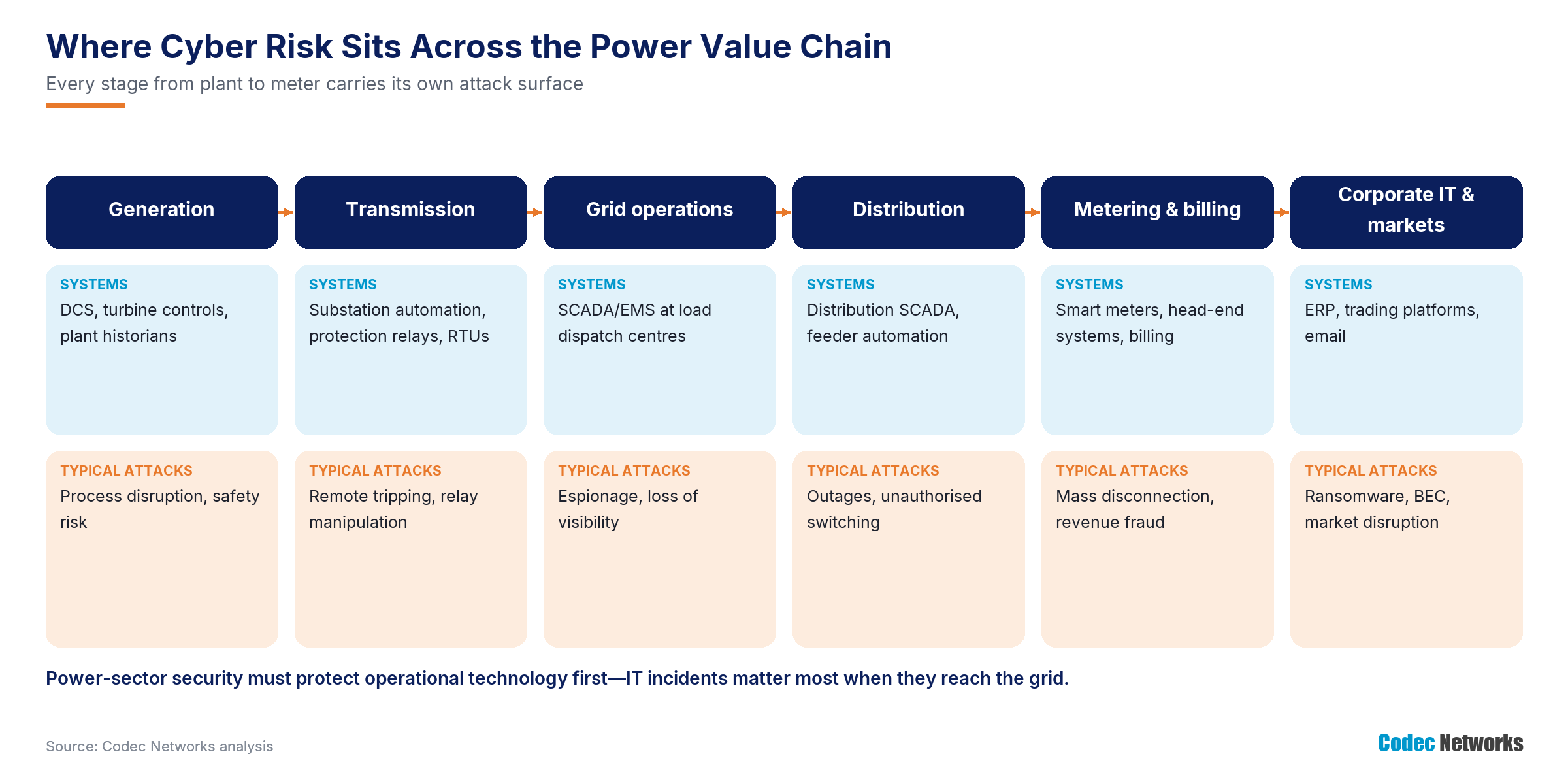
Figure 2: Where cyber risk sits across the power value chain.
|
Product / service |
Systems that deliver it |
Key cyber and compliance touchpoints |
|
Generation |
DCS, controllers, historians |
Segmentation, OT monitoring, change control |
|
Transmission |
Substation automation, relays, RTUs |
Remote access control, configuration integrity |
|
Grid operations |
SCADA/EMS, ICCP links |
Separation from IT, monitoring, hunting |
|
Distribution |
Distribution SCADA, feeder automation |
Access control, segmentation |
|
Smart metering |
Meters, head-end, MDM |
Command approvals, testing, monitoring |
|
Corporate IT and markets |
ERP, billing, portals, trading |
VAPT, EDR, backups, DDoS defence |
6. Trends that change the attack surface
|
Trend |
What is changing |
Security implication |
|
Smart metering roll-out |
Millions of connected meters |
Head-end systems become critical |
|
Renewable integration |
More inverter-based resources on the grid |
New connected assets and vendors |
|
Digital substations |
IEC 61850-based automation |
More networked protection systems |
|
Binding cyber regulations |
CEA Regulations in force from April 2027 |
Governance, audits and reporting become mandatory |
|
Remote operations |
Remote monitoring and vendor support |
Remote access as a primary risk |
7. Mapping operations to Codec Networks engagements
|
If the organisation operates… |
Recommended starting engagement |
|
Generating stations |
Plant IT/OT segmentation and DCS assessment |
|
Substations |
Substation automation, relay and remote access review |
|
Load dispatch centres |
SCADA/EMS assessment, OT monitoring, threat hunting |
|
Smart metering |
Head-end and metering security testing |
|
Any covered entity under the CEA Regulations |
Gap assessment, policy, crisis plan and annual audit |
Talk to Codec Networks
|
Contact Codec Networks Pvt. Ltd. New Delhi: 507, 5th Floor, New Delhi House, Barakhamba Road, Connaught Place, New Delhi – 110001 Gurugram: 707, 7th Floor, Silverton Tower, Golf Course Extension Road, Sector 50, Gurugram – 122018, Haryana Landline: 011 430 496 96 | 011 437 522 99 Mobile: +91 99716 76124 | +91 88007 88220 | +91 88003 31124 Email: mktg@codecnetworks.com Web: www.codecnetworks.com |
Note: Descriptions are general and based on public information available as of October 2026.