

Resources Categories

INDUSTRY FACT FILE · PROFESSIONAL & BUSINESS SERVICES
Threat Landscape: Top Cyber Threats Facing Professional and Business Services
The 18 most relevant cyber threats, attacks and industry challenges for law, accounting, consulting, recruitment, staffing, payroll and shared-services firms, and the impact each one has on clients, people and trust.
|
In this document 1. The threat picture in numbers 2. Top 18 threats, attacks and challenges 3. Threat relevance by professional services segment 4. Five priority threats in depth 5. Impact on firms, clients, employees and candidates 6. How regulation turns incidents into business events 7. Questions every leadership team should ask |
1. The threat picture in numbers
|
US$3.05bn BEC losses reported to the FBI IC3 in 2025 |
6.6m People affected by Capita's 2023 breach (UK ICO) |
~6m People affected by the Infosys McCamish attack (2023) |
6 hours To report incidents to CERT-In |
Professional and business services attract attackers because they concentrate value. One law firm holds the deal documents of dozens of companies; one audit firm holds the unpublished numbers of its clients; one payroll provider holds the salary and bank details of employees at hundreds of employers; one shared-services centre holds privileged access to a bank's payment systems. Fraudsters target the payment instructions that pass through every mandate; ransomware and extortion groups know that firms cannot let client files appear on a leak site; state-linked actors and competitors want deal and litigation intelligence; insiders and departing staff take files with them; and scammers borrow the brands of well-known recruiters and firms to defraud job seekers and clients.
Recent events show the pattern. Mossack Fonseca's leak of about 11.5 million documents in 2016 ended the firm; NotPetya disrupted DLA Piper's email and systems for days in 2017; Deloitte's email system was accessed through an administrator account in 2017; the Clop group exploited MOVEit in 2023, exposing staff data held by payroll provider Zellis for several employers; LockBit hit Infosys McCamish Systems in November 2023, affecting about six million people, and claimed an attack on Allen & Overy the same month; and the UK Information Commissioner fined Capita £14 million in October 2025, noting that an infected device had not been quarantined for 58 hours. In India, security researchers have repeatedly reported exposed or leaked job-seeker databases, including about 29 million records reported by Cyble in 2020 from a CV aggregation service.
2. Top 18 threats, attacks and challenges
The list below is a practical assessment framework, not a statistical ranking. Priority varies by business model, technology exposure and existing controls.
|
# |
Threat / attack / challenge |
Typical scenario |
Most exposed |
Potential impact |
|
1 |
Business email compromise and payment diversion |
Hijacked or spoofed mailboxes send clients, employers or finance teams new bank details |
Law, CA, payroll and shared-services firms |
Direct financial loss, client disputes, liability claims |
|
2 |
Ransomware on practice and delivery systems |
Document, audit, payroll or ERP systems encrypted during peak periods |
CA, law, payroll and BPO firms |
Missed deadlines, halted payroll, lost billable time |
|
3 |
Data theft and extortion via leak sites |
Client files copied and threatened with publication |
Law, audit and consulting firms |
Client loss, privilege and confidentiality breaches |
|
4 |
Mailbox and cloud identity takeover |
MFA fatigue, token theft or phishing used to seize Microsoft 365 or Workspace accounts |
All firms, especially partners and finance |
Silent access to client threads and documents |
|
5 |
Confidential document leaks |
Matter folders, working papers or Board papers shared beyond need |
Law, audit and consulting firms |
Professional misconduct exposure, insider trading risk |
|
6 |
File-transfer and SaaS supply chain compromise |
Zero-days in transfer tools or breaches at payroll, HR and document vendors |
Payroll, HR outsourcing and shared services |
Many clients exposed at once |
|
7 |
Payroll and bank-detail fraud |
Employee or vendor bank details changed through self-service or help desks |
Payroll, staffing and shared services |
Salaries and payments diverted |
|
8 |
Candidate and employee data exposure |
Open databases, ATS flaws or scraping of CVs and ID documents |
Recruitment, staffing and payroll firms |
DPDP consequences, identity fraud, brand damage |
|
9 |
Cloud storage and data-room misconfiguration |
Public links, open buckets and over-shared folders |
Staffing, consulting and audit firms |
Mass data exposure without any intrusion |
|
10 |
Insider exfiltration by leavers |
Departing partners and staff copy client files and contacts |
Law, consulting, recruitment and audit firms |
Lost clients, litigation, confidentiality breaches |
|
11 |
Impersonation and fake recruiter scams |
Fake job offers, recruiter profiles and lookalike domains using the firm's brand |
Recruitment and staffing firms, large employers |
Candidate fraud, complaints, reputational harm |
|
12 |
Deal and M&A espionage |
Targeted intrusion to obtain price-sensitive or litigation information |
Law, audit and consulting firms |
Insider trading, lost mandates, regulatory scrutiny |
|
13 |
Help-desk social engineering |
Callers impersonate staff to reset passwords and MFA |
Shared services, BPO and GCCs |
Privileged access to client systems |
|
14 |
Client portal and application vulnerabilities |
Broken authorisation in tax, payroll, HR and client portals |
Payroll, tax, HR and corporate services firms |
Cross-client data exposure |
|
15 |
Remote access and VPN compromise |
Unpatched gateways and passwords without MFA |
Audit, law and BPO firms |
Initial access for ransomware and theft |
|
16 |
Generative AI data leakage |
Client material pasted into public AI tools or uncontrolled plug-ins |
Consulting, law and audit firms |
Confidentiality breaches, contract violations |
|
17 |
Weak detection and response |
No monitoring of mailboxes, identities, cloud or vendor activity |
Most firms |
Late discovery; missed 6-hour reporting |
|
18 |
Backup and recovery failure |
Backups online, untested or encrypted with file servers |
CA, law and payroll firms |
Lost archives, extended outages |
3. Threat relevance by professional services segment
The matrix is a qualitative guide for prioritising the first round of security reviews.
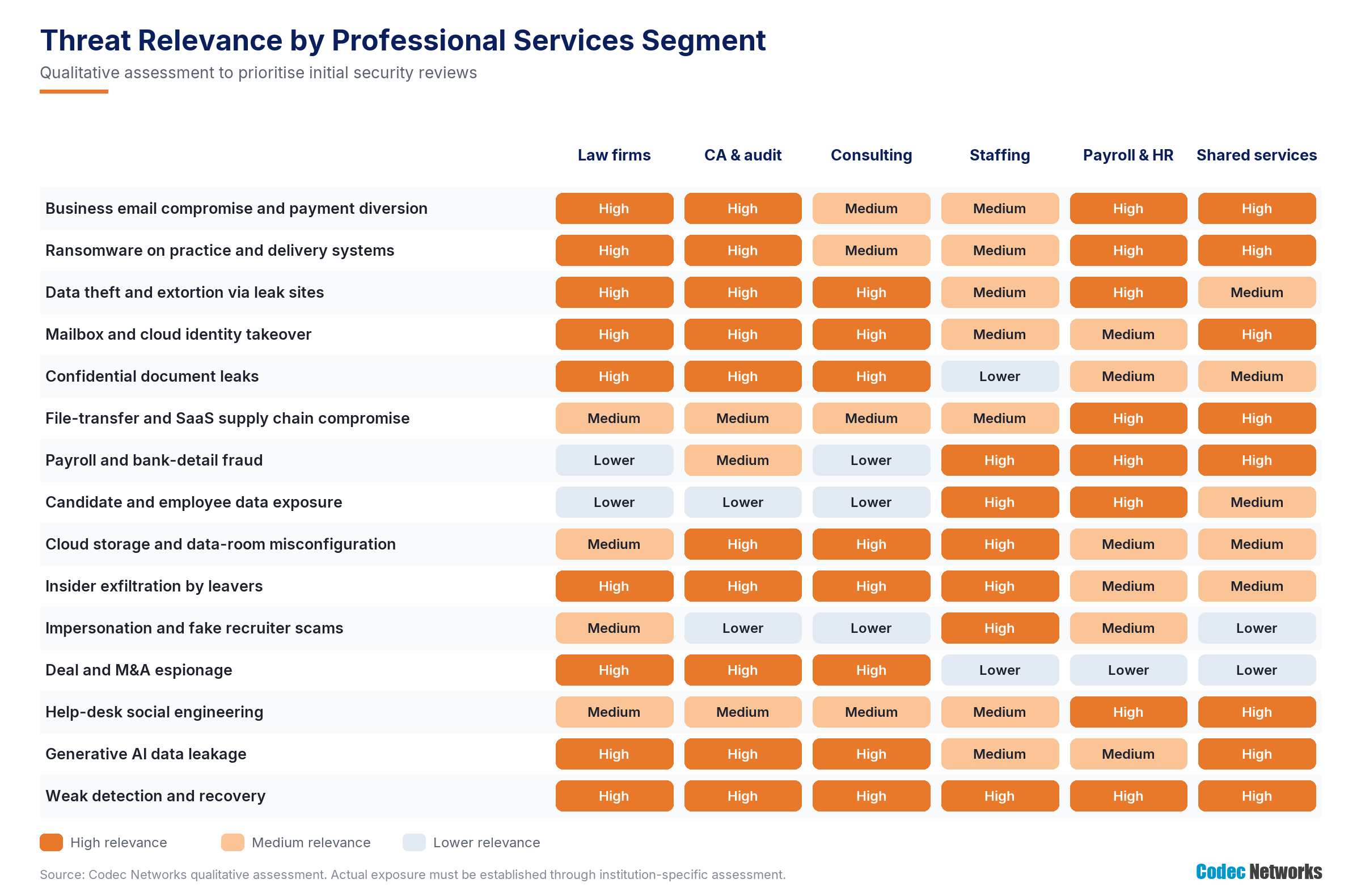
Figure 5: Qualitative threat relevance by professional services segment (Codec Networks assessment).
4. Five priority threats in depth
4.1 Business email compromise and payment diversion
Every transaction, settlement, fee invoice and payroll run includes a payment instruction, and most still travel by email. Attackers take over a partner's or finance user's mailbox through MFA fatigue, token theft or phishing, watch the thread, set hidden forwarding rules and then send new bank details at the moment of payment, often from a lookalike domain. Losses reported to the FBI from BEC reached about US$3.05 billion in 2025, and recovery depends on how fast the bank is told.
- Questions to test: Are partner and finance mailboxes protected by phishing-resistant MFA and conditional access? Would we see a new forwarding rule or an impossible-travel sign-in within minutes? Is every bank-detail change verified by a call to a known number? Do clients know we never change bank details by email?
- Relevant services: Microsoft 365 or Workspace security review, phishing-resistant MFA, mailbox-rule monitoring in a managed SOC, call-back controls, BEC awareness and a fraud investigation retainer.
4.2 Data theft and extortion of client files
Ransomware groups now steal before they encrypt, because a professional firm's greatest fear is its clients' files appearing on a leak site. Entry usually comes through a VPN or remote-access gateway without MFA, an unpatched internet-facing system or a phished account, followed by quiet copying of document and audit repositories over days or weeks. LockBit's claims against Allen & Overy and Infosys McCamish in 2023 show that size and reputation are no protection.
- Questions to test: Is every remote-access path protected by MFA and patched quickly? Are document and audit repositories segmented and access limited to the matter team? Would the SOC see gigabytes leaving the network? Are backups offline and tested, and do we have a rehearsed extortion response that includes clients?
- Relevant services: external and remote-access assessment, segmentation and access reviews, data loss prevention, EDR and managed SOC, backup testing and ransomware response exercises.
4.3 Supply chain compromise through payroll, file-transfer and SaaS vendors
Payroll providers, HR platforms and shared-services firms exchange files with many clients, so one weakness exposes them all. The Clop group's mass exploitation of MOVEit in 2023 reached employers through payroll provider Zellis; the Capita attack of 2023 affected about 6.6 million people and led to a £14 million fine. Under DPDP, the employer remains the data fiduciary and the provider the processor, so both must show safeguards.
- Questions to test: Which vendors hold our or our clients' people data, and how do they exchange files? Are internet-facing transfer tools monitored and patched within days? Are payroll files encrypted and minimised? Do our contracts set processor safeguards, breach notification and audit rights?
- Relevant services: third-party risk assessments, file-transfer and application testing, encryption and minimisation review, DPDP processor contract review, exposure monitoring and managed SOC.
4.4 Exposure of candidate and employee data
Recruitment and staffing firms collect CVs, phone numbers, salary history and identity documents from people who have not yet joined anyone, and keep them for years. Databases are left in open cloud storage, applicant-tracking APIs leak records and scrapers harvest profiles; the stolen data then fuels fake-job scams in the firm's name. Security researchers have reported exposures of Indian job-seeker data running to millions of records.
- Questions to test: Do we know where every candidate record lives and how long we keep it? Are cloud storage and ATS APIs tested? Are ID documents encrypted and deleted when no longer needed? Do we monitor for fake recruiters and lookalike domains using our name?
- Relevant services: cloud posture and ATS application testing, DPDP programme with retention and minimisation, brand monitoring and takedown support, candidate awareness.
4.5 Detection, reporting and the 6-hour clock
CERT-In requires reporting within six hours of noticing an incident, DPDP will require breach intimation, regulated clients expect prompt notification under their contracts, and listed firms disclose quarterly. Many firms monitor only their firewall and antivirus, so mailbox takeovers, cloud sign-ins and bulk downloads go unseen until a client calls about a missing payment or a leak.
- Questions to test: Are mailboxes, identities, cloud tenants, endpoints and vendor sessions monitored 24x7? Do we see forwarding rules, MFA resets and bulk downloads? Is there a playbook covering containment, client and bank communication, CERT-In reporting and DPDP intimation?
- Relevant services: managed SOC, playbooks, incident records, tabletop exercises with partners, finance, HR and client-service leaders.
5. Impact on firms, clients, employees and candidates
|
Player type |
Threats to prioritise |
Main impact |
|
Law firms |
BEC, data extortion, deal espionage, leaver exfiltration |
Client loss, privilege disputes, professional liability |
|
CA and audit firms |
Ransomware, data theft, remote-access compromise |
Missed filings and audits, confidentiality exposure, NFRA and ICAI scrutiny |
|
Consulting firms |
Document leaks, AI data leakage, insider risk |
Lost mandates, contract breaches, reputational harm |
|
Recruitment and staffing firms |
Candidate data exposure, fake recruiter scams, payroll fraud |
DPDP consequences, complaints, brand damage |
|
Payroll, HR outsourcing and shared services |
Supply chain compromise, help-desk social engineering, payment fraud |
Multi-client exposure, contract termination, client audits |
|
Clients, employees and candidates |
Diverted payments, identity fraud, exposed personal data |
Financial loss, harassment, loss of trust in the firm |
6. How regulation turns incidents into business events
- CERT-In: incidents reported within six hours of noticing them; logs available for investigation.
- DPDP: breaches of staff, candidate or client personal data trigger intimation to affected persons and the Data Protection Board once provisions commence in May 2027; processors must support the fiduciary.
- Professional bodies: unauthorised disclosure of client information can raise misconduct questions under the Chartered Accountants Act and Bar Council rules.
- Regulated clients: banks, insurers and SEBI-regulated entities invoke notification, audit and termination clauses under their outsourcing and vendor frameworks.
- SEBI LODR: listed firms and listed clients disclose cyber incidents in the quarterly corporate governance report.
- Insurers and courts: cyber and professional indemnity claims, client litigation and police complaints require preserved evidence.
|
Insight The most damaging professional services incidents cross the boundary between firm and client: a hijacked partner mailbox becomes a client's lost payment, a payroll vendor's flaw becomes every employer's breach, a leaver's download becomes a competitor's advantage. Hardened identities, controlled documents, assessed vendors and monitored mailboxes are the best defence. |
7. Questions every leadership team should ask
- Could a hijacked partner or finance mailbox redirect a client payment without anyone noticing?
- Who can access each client's files, and would we see them being copied out tonight?
- Which vendors hold our clients' and employees' data, and how would we know if one were breached?
- Could we pass our largest regulated client's security audit this quarter?
- Are backups of documents, audit files and payroll immutable, tested and separate?
- Could we detect, contain and report an incident within six hours while keeping clients informed?
Talk to Codec Networks
|
Contact Codec Networks Pvt. Ltd. New Delhi: 507, 5th Floor, New Delhi House, Barakhamba Road, Connaught Place, New Delhi – 110001 Gurugram: 707, 7th Floor, Silverton Tower, Golf Course Extension Road, Sector 50, Gurugram – 122018, Haryana Landline: 011 430 496 96 | 011 437 522 99 Mobile: +91 99716 76124 | +91 88007 88220 | +91 88003 31124 Email: mktg@codecnetworks.com Web: www.codecnetworks.com |
Note: Threat descriptions and relevance ratings are general guidance, not findings about any specific organisation. Public incident references are summarised from widely reported events, company statements and official sources.