

Resources Categories
INDUSTRY FACT FILE · RAILWAYS, METRO & SURFACE TRANSPORT
Threat Landscape: Top Cyber Threats Facing Railways, Metro and Surface Transport
The 18 most relevant cyber threats, attacks and industry challenges for Indian Railways and its PSUs, metro corporations, state transport, tolling and transit technology companies, and the impact each one has on safety, services, revenue and trust.
|
In this document 1. The threat picture in numbers 2. Top 18 threats, attacks and challenges 3. Threat relevance by transport segment 4. Five priority threats in depth 5. Impact on transport operators, passengers and partners 6. How regulation turns incidents into business events 7. Questions every leadership team should ask |
1. The threat picture in numbers
|
Oct 2022 Trains across Denmark stopped for hours after an attack on supplier Supeo |
£29 m Reported cost of the 2024 Transport for London intrusion |
~2,000 Systems locked by ransomware at San Francisco's Muni (2016) |
6 hours To report incidents to CERT-In |
Transport operators attract ransomware groups because services cannot stop without immediate public impact; state-backed and hacktivist actors because railways and metros are critical infrastructure and symbols; fraudsters because ticketing and tolling move enormous volumes of small payments; and bots and scalpers because popular trains sell out in seconds. The attack surface spans legacy and modern signalling, operations control centres, supplier-hosted apps, station networks, passenger information systems, national-scale ticketing APIs and roadside toll equipment.
Landmark incidents show the pattern. San Francisco's Muni (2016) had around 2,000 systems locked and opened its gates. Iran's railways (July 2021) saw false delay and cancellation notices on station displays. Denmark's DSB (October 2022) stopped trains for hours when supplier Supeo took its servers offline after an attack. Poland (August 2023) saw unauthorised radio-stop signals halt trains. Transport for London (2024) spent about £29 million recovering from an intrusion that exposed Oyster refund data. Pittsburgh Regional Transit (December 2024) lost light rail service for a day to ransomware. In India, a December 2022 data leak at the RailYatri platform led to suspension of its booking facility and a penalty, as the government told Parliament.
2. Top 18 threats, attacks and challenges
The list below is a practical assessment framework, not a statistical ranking. Priority varies by business model, technology exposure and existing controls.
|
# |
Threat / attack / challenge |
Typical scenario |
Most exposed |
Potential impact |
|
1 |
Ransomware halting operations |
Station, depot, ticketing or back-office systems encrypted |
All operators |
Service stoppage, free travel, recovery costs |
|
2 |
Signalling and control intrusion |
Unauthorised access to interlocking, Kavach, CBTC, OCC or SCADA |
Indian Railways, metros |
Safety risk, line closures, inquiries |
|
3 |
Supplier and OEM remote access abuse |
Standing connections and shared vendor accounts hijacked |
All operators |
Direct path to OT and operations |
|
4 |
Supplier-hosted app outages |
Driver, crew or fare apps unavailable after a supplier incident |
Operators dependent on vendor platforms |
Services stop under safety rules |
|
5 |
Ticketing bots and scalping |
Automated booking at launch time; resale by fraudulent agents |
Railways, PSUs, ticketing platforms |
Passenger anger, revenue leakage, regulatory questions |
|
6 |
API and mobile app vulnerabilities |
Broken authorisation, data leakage, weak rate limits |
Ticketing, AFC, toll and bus apps |
Data breach, fraud, outages |
|
7 |
Payment and tokenisation attacks |
Card data theft, refund fraud, settlement manipulation |
Ticketing, metros, tolling |
Financial loss, scheme penalties |
|
8 |
Passenger data breaches |
Identity documents, contact and travel data exposed |
PSUs, platforms, metros |
DPDP exposure, trust loss |
|
9 |
False passenger information |
Displays, PA or apps used to spread fake messages |
Railways, metros, airports-style hubs |
Crowd events, panic, injuries |
|
10 |
Radio, GPS and telecom interference |
Radio-stop abuse, GPS spoofing, telecom outages |
Railways, metros, fleets |
Service stoppage, tracking loss |
|
11 |
Phishing and credential theft |
Staff, contractors and vendor accounts targeted |
All operators |
Initial access |
|
12 |
Business email compromise |
Fraudulent changes to settlement or supplier bank details |
Tolling, PSUs, corporations |
Direct financial loss |
|
13 |
Flat IT/OT and station networks |
No separation between office IT, station systems and OT |
Older stations and depots |
Office malware reaching control systems |
|
14 |
Legacy signalling and SCADA |
Unpatched controllers, old protocols, maintenance ports |
Railways, older metro lines |
Easy exploitation, no vendor fixes |
|
15 |
Fleet telematics and IoT exposure |
AIS 140 devices, ticketing machines and chargers reachable |
State transport, bus operators |
Tracking manipulation, outages |
|
16 |
Hacktivism and state-backed sabotage |
Defacement, DDoS and disruption of symbolic networks |
Railways, metros |
Service and reputational damage |
|
17 |
Insider misuse |
Employees, agents or contractors abuse access to tickets or data |
All operators |
Fraud, data theft |
|
18 |
Weak detection and recovery |
No visibility into stations, OT or suppliers; untested backups |
Most operators |
Long dwell time; missed 6-hour reporting |
3. Threat relevance by transport segment
The matrix is a qualitative guide for prioritising the first round of security reviews.
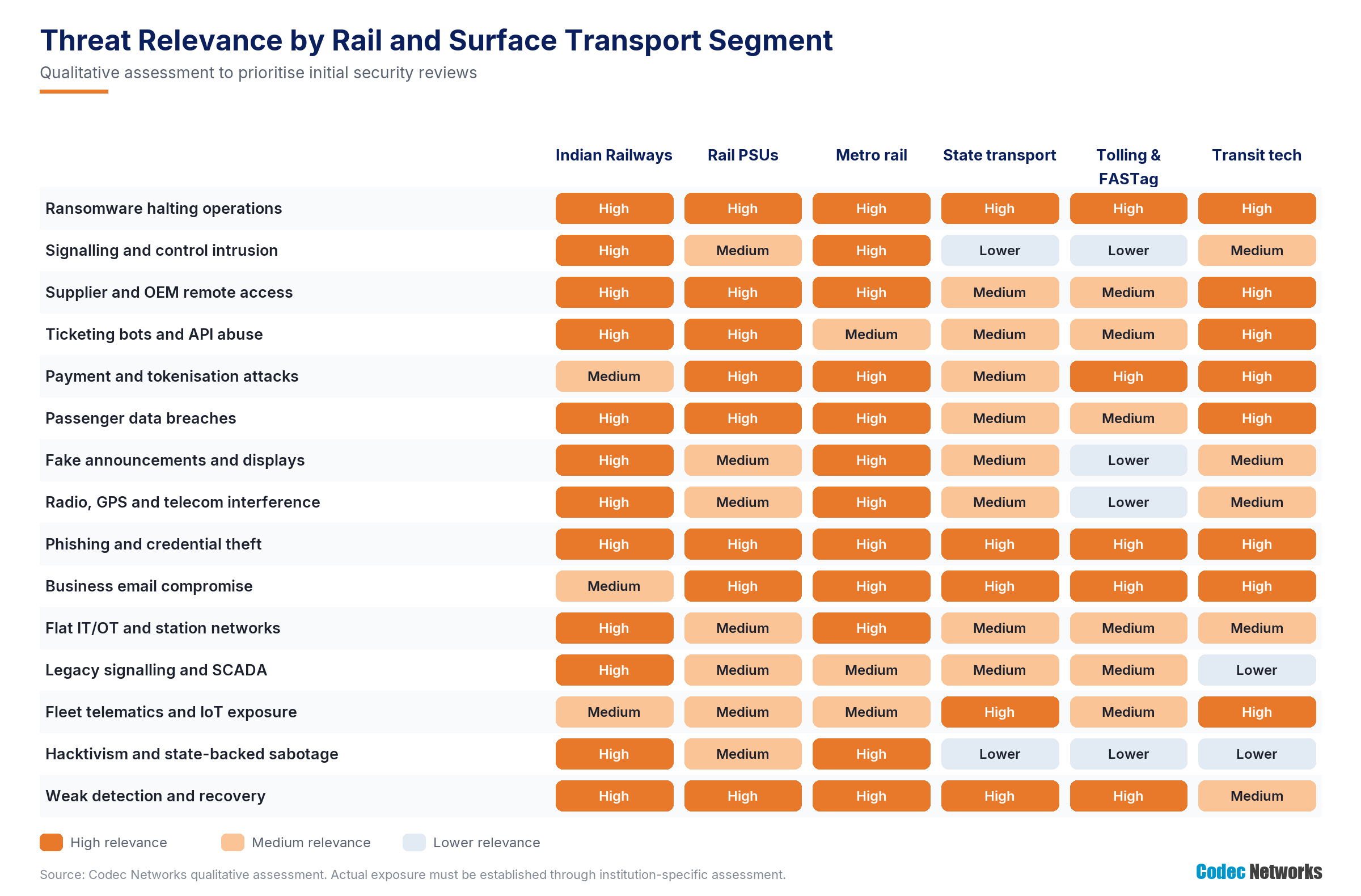
Figure 5: Qualitative threat relevance by transport segment (Codec Networks assessment).
4. Five priority threats in depth
4.1 Signalling, control and safety systems
Kavach, electronic interlocking, CBTC and operations control centres are being networked, maintained by OEMs and connected to diagnostics. Poland's radio-stop incidents and research on rail protocols show that cheap tools can disrupt trains, while a compromised maintenance laptop can reach the relay room.
- Questions to test: Are signalling and control networks isolated from station IT? Are OEM sessions brokered and recorded? Are maintenance ports and laptops controlled? Is cyber risk inside the safety case and the CRS/CMRS process?
- Relevant services: OT architecture assessment, segmentation, OEM access brokering, OT monitoring, cyber in safety management.
4.2 Supplier-hosted operations
DSB's trains stopped because one supplier's driver app went down. Operators increasingly run crew apps, fare systems and telecom through vendors whose incidents become the operator's outage.
- Questions to test: Which supplier systems can operations not run without? Do contracts carry recovery objectives? Are offline fallbacks defined and rehearsed? Is supplier health monitored?
- Relevant services: supplier criticality mapping, third-party programme, contractual recovery objectives, joint exercises.
4.3 Ticketing platforms at national scale
With around 89 per cent of reserved tickets online and launch-time demand concentrated into seconds, bots, scalpers and API abuse translate directly into public anger and fraud. Breaches at ticketing partners have already drawn government action in India.
- Questions to test: Are APIs authenticated, rate-limited and tested for authorisation flaws? Is bot management in place? Are payment flows tokenised and PCI DSS-aligned? Are booking patterns monitored for fraud?
- Relevant services: API and mobile testing, bot and fraud resistance, PCI DSS readiness, SOC fraud analytics.
4.4 Passenger information and crowd safety
Displays, PA and apps are the operator's voice. Iran's 2021 incident showed how false messages create chaos; at an Indian interchange in peak hour, a false evacuation message is a safety event.
- Questions to test: Are passenger information systems segregated from office IT? Is content approval enforced? Can stations override quickly? Is there a crisis communication playbook?
- Relevant services: communications and station network review, content and access controls, crisis communication exercises.
4.5 Detection, reporting and the 6-hour clock
CERT-In requires reporting within six hours; NCIIPC expects protected-system owners to report; listed PSUs disclose quarterly. Stations, OT and suppliers are usually unmonitored.
- Questions to test: Are stations, OCCs and enterprise IT monitored 24x7? Do we see supplier sessions? Is there a playbook combining safety decisions, degraded-mode operation, CERT-In reporting and public communication?
- Relevant services: IT/OT SOC, playbooks, joint drills with operations, suppliers and communications teams.
5. Impact on transport operators, passengers and partners
|
Player type |
Threats to prioritise |
Main impact |
|
Indian Railways and PSUs |
Signalling intrusion, ransomware, ticketing abuse, data breaches |
Service stoppage, safety inquiries, public and parliamentary scrutiny |
|
Metro and RRTS corporations |
CBTC/OCC intrusion, AFC and payment attacks, false information |
Line closures, crowd events, revenue loss |
|
State transport undertakings |
Ransomware, fleet IoT exposure, ticketing outages |
Buses idle, revenue loss, passenger safety |
|
Toll concessionaires and issuers |
BEC, settlement manipulation, plaza outages |
Revenue diversion, lender and NHAI reporting |
|
Passengers and partners |
Data exposure, fraud, false information |
Financial loss, personal harm, loss of trust |
6. How regulation turns incidents into business events
- CERT-In: incidents reported within six hours of noticing them.
- NCIIPC: incidents affecting notified protected systems require coordination and reporting by the CISO.
- Commission of Railway Safety and CMRS: incidents affecting signalling, control or safe operation trigger investigation and may affect certification.
- RBI, NPCI and card schemes: payment incidents engage scheme rules, tokenisation requirements and PCI DSS obligations.
- SEBI LODR: listed PSUs disclose cyber incidents quarterly.
- DPDP and contracts: passenger and employee data incidents trigger breach intimation from May 2027; operator and partner contracts require notification.
|
Insight The most dangerous transport incidents cross boundaries—from a supplier into operations, from station IT into signalling, and from a ticketing API into the public conversation. Strong boundaries, mapped suppliers, tested platforms and plant-floor visibility are the best defence. |
7. Questions every leadership team should ask
- Could a supplier's outage or compromised account stop our trains or buses?
- Are signalling, Kavach, CBTC and control centre networks isolated and their maintenance access controlled?
- Would our ticketing or toll platform survive a bot attack at launch time?
- Could someone push a false message to our displays and PA?
- Do we have offline fallbacks and tested backups for operations and ticketing?
- Could we detect, contain and report an incident within six hours while keeping passengers safe and informed?
Talk to Codec Networks
|
Contact Codec Networks Pvt. Ltd. New Delhi: 507, 5th Floor, New Delhi House, Barakhamba Road, Connaught Place, New Delhi – 110001 Gurugram: 707, 7th Floor, Silverton Tower, Golf Course Extension Road, Sector 50, Gurugram – 122018, Haryana Landline: 011 430 496 96 | 011 437 522 99 Mobile: +91 99716 76124 | +91 88007 88220 | +91 88003 31124 Email: mktg@codecnetworks.com Web: www.codecnetworks.com |
Note: Threat descriptions and relevance ratings are general guidance, not findings about any specific organisation. Public incident references are summarised from widely reported events and official statements.