

Resources Categories
INDUSTRY FACT FILE · REAL ESTATE, CONSTRUCTION & FACILITIES
Threat Landscape: Top Cyber Threats Facing Real Estate, Construction and Facilities
The 18 most relevant cyber threats, attacks and industry challenges for developers, contractors, property groups, co-working operators and facility managers, and the impact each one has on buildings, deals, tenants and buyers.
|
In this document 1. The threat picture in numbers 2. Top 18 threats, attacks and challenges 3. Threat relevance by real estate and facilities segment 4. Five priority threats in depth 5. Impact on property companies, their occupiers and their vendors 6. How regulation turns incidents into business events 7. Questions every leadership team should ask |
1. The threat picture in numbers
|
Mar 2021 Verkada breach: about 150,000 camera feeds reached through a support account |
2013 Target breach began with an HVAC contractor's credentials |
Jan 2020 Maze ransomware took Bouygues Construction's systems offline |
6 hours To report incidents to CERT-In |
Property, construction and facilities companies attract ransomware groups because launches, billing cycles and tenant services cannot pause without visible loss; fraudsters because the sector moves large payments to many contractors, brokers and buyers; and opportunists because buildings expose cameras, doors and controllers to the internet with default settings. The attack surface is unusually public: a compromised BMS or lift controller fails in front of tenants, an exposed camera streams a lobby to the world, and a stolen buyer database fuels fraud against the developer's own customers.
Landmark incidents show the pattern. The 2021 Verkada breach reached about 150,000 live camera feeds through one support account; Target's 2013 breach of 40 million cards began with its HVAC contractor; a 2016 denial-of-service attack left apartment blocks in Lappeenranta without heating; Bouygues Construction (January 2020) and ISS World (February 2020) shut down global IT after ransomware and malware attacks; First American Financial exposed about 885 million title and mortgage records in 2019 through a website flaw. In India, Ansal Housing disclosed repeated ransomware attacks in 2021, and the FBI's IC3 reported US$2.77 billion in business email compromise losses in 2024—a crime that targets property transactions and contractor payments worldwide.
2. Top 18 threats, attacks and challenges
The list below is a practical assessment framework, not a statistical ranking. Priority varies by business model, technology exposure and existing controls.
|
# |
Threat / attack / challenge |
Typical scenario |
Most exposed |
Potential impact |
|
1 |
Ransomware halting ERP, CRM and projects |
Project, booking and billing systems encrypted at launch or billing time |
All companies |
Lost sales, stalled billing, disclosure |
|
2 |
Building management system compromise |
BMS, HVAC, lifts or energy systems reached and manipulated |
Commercial, smart buildings, FM |
Outages, evacuations, tenant claims |
|
3 |
CCTV and video platform exposure |
Cameras, VMS or cloud video reached with weak or shared credentials |
FM, commercial, co-working |
Privacy breach, surveillance of tenants |
|
4 |
Access control and visitor system abuse |
Door schedules, credentials or visitor kiosks manipulated |
Commercial, co-working, residential |
Unauthorised entry, safety risk |
|
5 |
Vendor and integrator remote access abuse |
Standing tunnels and shared OEM accounts hijacked |
All buildings |
Direct path to building systems |
|
6 |
Flat building and tenant networks |
BMS, CCTV, corporate IT and tenants on one network |
Co-working, commercial |
Lateral movement between tenants and systems |
|
7 |
Payment diversion and BEC |
Fake bank-detail changes on contractor bills and buyer payments |
Construction, developers |
Direct financial loss, stopped work |
|
8 |
Buyer, tenant and visitor data theft |
KYC, PAN, bank and visitor records exfiltrated |
Developers, co-working, FM |
Fraud against customers, DPDP exposure |
|
9 |
Phishing and credential theft |
Staff, brokers, site teams and vendor accounts targeted |
All companies |
Initial access |
|
10 |
Insider, broker and contractor misuse |
Leads, buyer lists or site data copied or sold |
Developers, contractors |
Lost deals, fraud, reputation |
|
11 |
Legacy and unpatched building controllers |
Decades-old BMS, lift and fire controllers with known flaws |
All buildings |
Easy exploitation, no vendor fixes |
|
12 |
BIM, design and tender data theft |
Models, drawings and bids copied from CDEs and file shares |
Construction, consultants |
Lost bids, client confidentiality breach |
|
13 |
Co-working and shared network exposure |
A member device scanning and attacking other members and systems |
Co-working, managed offices |
Client data loss, lost enterprise clients |
|
14 |
IoT, sensor and smart-metering exposure |
Internet-facing gateways with default credentials |
Smart buildings, residential |
Bridge from internet to building |
|
15 |
Cloud and proptech misconfiguration |
Exposed storage, weak identity and over-privileged APIs |
Platforms, portfolios |
Portfolio-wide data exposure |
|
16 |
Web, mobile and API vulnerabilities |
Booking portals, tenant and member apps exploited |
Developers, co-working, platforms |
Account takeover, data theft, door control |
|
17 |
Weak detection and response |
No visibility into building systems or vendor sessions |
Most buildings |
Long dwell time; missed 6-hour reporting |
|
18 |
Backup and recovery failure |
Backups encrypted, untested or missing building configurations |
All companies |
Weeks of disruption |
3. Threat relevance by real estate and facilities segment
The matrix is a qualitative guide for prioritising the first round of security reviews.
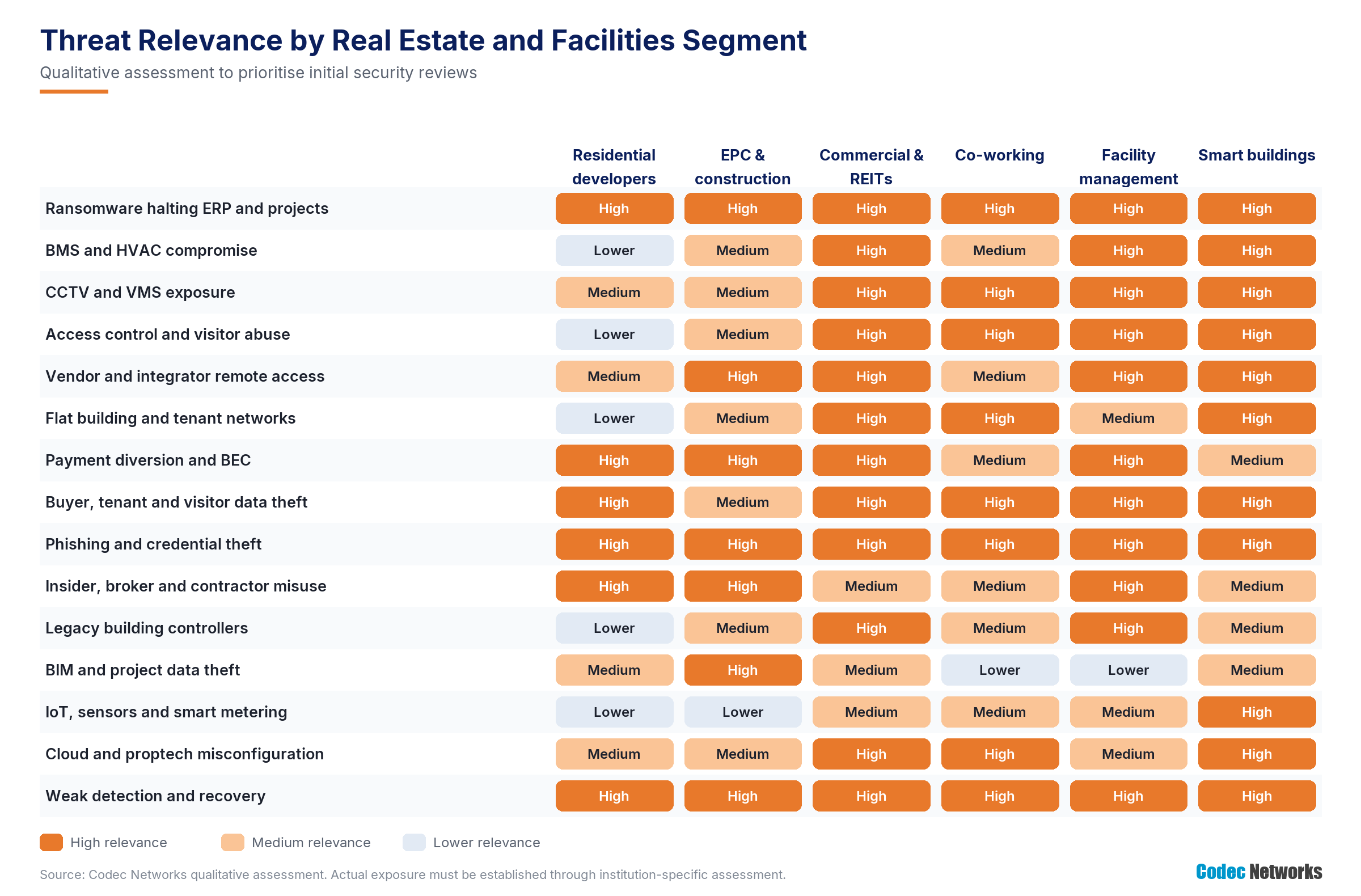
Figure 5: Qualitative threat relevance by real estate and facilities segment (Codec Networks assessment).
4. Five priority threats in depth
4.1 Building systems reachable from outside
BMS, lift, fire and energy systems are installed by integrators, left with default credentials and maintained through standing remote access. The Lappeenranta heating outage and the Verkada breach show how a single exposed system or account affects every occupant at once.
- Questions to test: Which building systems are reachable from the internet or tenant networks? Which vendors hold remote access and is it brokered and recorded? Are building, security, corporate and tenant networks separated?
- Relevant services: building system assessment, segmentation design, remote access brokering, OT monitoring.
4.2 Cameras, doors and privacy
CCTV and access control are safety systems and personal-data systems at once. Cloud platforms concentrate risk across sites, and since April 2025 cameras sold in India must meet MeitY's essential requirements.
- Questions to test: Who can view live and recorded video? Are platform accounts named, with MFA and rotation? How long is footage retained and under what notice? Do our cameras and procurement meet MeitY requirements?
- Relevant services: CCTV and access control testing, identity controls, surveillance privacy review, MeitY ER evidence.
4.3 Payment diversion on contractor and buyer payments
Construction and property move large payments on predictable cycles to hundreds of counterparties. Attackers watch invoice threads and send convincing bank-detail changes; the FBI counted US$2.77 billion of BEC losses in 2024.
- Questions to test: Are bank-detail changes verified by call-back and dual approval? Are vendor master-data changes monitored? Are finance, site and sales teams trained with simulations? Do we monitor look-alike domains?
- Relevant services: payment control review, master-data monitoring, BEC simulation, email security.
4.4 Buyer, tenant and visitor data
Developers hold KYC, PAN and bank details for every buyer; co-working operators and FM companies hold member and visitor records and video. Stolen data is used to defraud the company's own customers, and DPDP breach intimation arrives in May 2027.
- Questions to test: Where is buyer, tenant and visitor data stored and who can export it? Are portals and apps tested? Do brokers and channel partners handle data under controls? Is there a breach playbook?
- Relevant services: DPDP programme, data classification and DLP, portal and app testing, breach playbooks.
4.5 Detection, reporting and the 6-hour clock
CERT-In requires reporting within six hours of noticing an incident; listed companies disclose quarterly. Building systems and vendor sessions are usually unmonitored, so intrusions are found late—often by tenants.
- Questions to test: Are IT, building systems and security platforms monitored 24x7? Do we see vendor sessions and configuration changes? Is there a playbook covering tenant safety, containment, CERT-In reporting and disclosure?
- Relevant services: building SOC, playbooks, incident records, joint drills with FM and security teams.
5. Impact on property companies, their occupiers and their vendors
|
Player type |
Threats to prioritise |
Main impact |
|
Developers |
Ransomware at launch, buyer data theft, collection fraud |
Lost sales, fraud against buyers, RERA and disclosure consequences |
|
Commercial owners and REITs |
Building system takeover, CCTV exposure, occupier audits |
Tenant claims, lost leases, investor disclosure |
|
EPC and construction companies |
Payment diversion, site ERP ransomware, BIM theft |
Direct financial loss, stopped work, lost bids |
|
Co-working and FM companies |
Shared network and platform compromise across sites |
Client data loss, SLA breaches, lost contracts |
|
Tenants, buyers and visitors |
Outages, surveillance exposure, data misuse |
Safety, privacy and financial harm |
6. How regulation turns incidents into business events
- CERT-In: incidents reported within six hours of noticing them; logs available for investigation.
- SEBI LODR and REIT rules: listed developers, contractors and REIT managers disclose cyber incidents in the quarterly corporate governance report.
- RERA: incidents that disrupt collections, escrow or buyer communications can affect filings and timelines.
- DPDP: incidents involving buyer, tenant, visitor or employee data, including footage, trigger breach intimation once provisions commence in May 2027.
- Occupiers and lenders: lease and loan agreements increasingly require incident notification and evidence of controls.
- Insurers: policies require prompt notification and evidence that warranted controls were in place.
|
Insight The most damaging property incidents cross boundaries—from a vendor into the BMS, from a cloud platform into every site, from a phished inbox into a payment run, from a portal into a buyer database. Strong boundaries, verified payments and building-floor visibility are the best defence. |
7. Questions every leadership team should ask
- Which building systems can be reached from the internet, and who has remote access to them?
- Could a fake bank-detail change divert a contractor or buyer payment without anyone noticing?
- Who can view our cameras and change our door schedules, and would we know?
- If ERP and CRM went dark on launch weekend, could we book, receipt and communicate?
- Where is buyer, tenant and visitor data, and are we ready for DPDP breach intimation?
- Could we detect, contain and report an incident within six hours while keeping tenants safe?
Talk to Codec Networks
|
Contact Codec Networks Pvt. Ltd. New Delhi: 507, 5th Floor, New Delhi House, Barakhamba Road, Connaught Place, New Delhi – 110001 Gurugram: 707, 7th Floor, Silverton Tower, Golf Course Extension Road, Sector 50, Gurugram – 122018, Haryana Landline: 011 430 496 96 | 011 437 522 99 Mobile: +91 99716 76124 | +91 88007 88220 | +91 88003 31124 Email: mktg@codecnetworks.com Web: www.codecnetworks.com |
Note: Threat descriptions and relevance ratings are general guidance, not findings about any specific organisation. Public incident references are summarised from widely reported events, regulator statements and company disclosures.