

Resources Categories

INDUSTRY FACT FILE · RETAIL & E-COMMERCE
Main Products and Services in Retail and E-commerce
What India's retailers, marketplaces, D2C brands and quick-commerce platforms sell and deliver, the storefront, payment, fulfilment and data systems behind each activity, and where those systems create cybersecurity and compliance exposure.
|
In this document 1. How retailers and platforms earn their money 2. Products and services by retailer type 3. The storefront layer: web, apps, APIs and checkout 4. The operations and data layer: OMS, WMS, POS, loyalty and CRM 5. The systems behind the products and services 6. Trends that change the attack surface 7. Mapping operations to Codec Networks engagements |
1. How retailers and platforms earn their money
|
Revenue stream |
How it works |
Security relevance |
|
Merchandise sales |
Goods sold in stores, on apps and through marketplaces at a margin |
Checkout availability; pricing and promotion integrity; payment data |
|
Marketplace commissions and fees |
Commission, listing, fulfilment and advertising fees from sellers |
Seller portals and APIs; catalogue integrity; seller data |
|
Quick-commerce delivery and platform fees |
Delivery, handling and small-basket fees on rapid orders |
Dark-store WMS, rider apps and dispatch availability |
|
Advertising and retail media |
Sponsored listings, banners and data-driven advertising |
Customer data use, consent and ad-platform integrations |
|
Loyalty, subscriptions and financial services |
Memberships, points, co-branded cards, BNPL and insurance attach |
Stored value, account security, partner integrations |
|
Private labels and D2C margins |
Own brands sold at higher margins through owned channels |
Storefront platform security; supplier and brand data |
2. Products and services by retailer type
|
Retailer type |
Main products and services |
Key systems |
|
Retail chains and supermarkets |
Grocery, general merchandise, apparel and home products in stores and online |
POS, ERP, store networks, loyalty, supply chain and e-commerce platforms |
|
Online marketplaces |
Multi-category catalogues from third-party sellers, fulfilment and ads |
Web and app storefronts, search, pricing and cart APIs, seller portals, OMS |
|
D2C brands |
Own-brand products through owned storefronts and marketplaces |
Hosted commerce platforms, plugins, CRM, marketing automation, 3PL integrations |
|
Quick commerce |
Groceries and essentials delivered in minutes from dark stores |
Consumer app, dark-store WMS, rider app, dispatch and routing, partner APIs |
|
Omnichannel and fashion retailers |
Apparel, footwear and lifestyle across stores and digital channels |
Unified commerce, OMS, click-and-collect, returns, loyalty, franchise systems |
|
Payments, loyalty and gift cards |
Wallets, points, stored value, co-branded cards and offers |
Payment integrations, token vaults, loyalty engines, gift card platforms |
3. The storefront layer: web, apps, APIs and checkout
A retailer's storefront is a web application, one or more mobile apps and a set of APIs that search catalogues, price items, manage carts, apply coupons and complete orders. Behind them sit a content delivery network, a web application firewall, identity and OTP services, and the payment page—usually a hosted or embedded checkout from an RBI-authorised payment aggregator that routes UPI, cards, net banking, wallets and BNPL. Since October 2022 saved cards are tokens, not card numbers, and the retailer's own systems should never see a primary account number.
This layer changes constantly. Engineering teams release daily, marketing adds tags, chat widgets and analytics scripts, and third-party plugins extend hosted platforms. Every script on the payment page can read what the shopper types, which is why PCI DSS v4.0.1 now expects an inventory of payment page scripts and tamper detection. Public APIs built for the app are also reachable by bots that scrape prices, hoard inventory, test stolen cards and replay leaked credentials; without rate limits and bot management, the festive sale is as open to scalpers as it is to shoppers.
4. The operations and data layer: OMS, WMS, POS, loyalty and CRM
Behind the storefront, the order management system allocates orders to stores, warehouses or dark stores; the warehouse management system and rider apps pick, pack and deliver; point-of-sale terminals and store networks sell in person; and ERP, finance and HR run the business. Loyalty engines, gift card platforms and wallets hold stored value that is effectively cash. CRM, customer data platforms and analytics warehouses hold names, phone numbers, addresses, purchase histories and sometimes identity documents—exactly the data that the DPDP Act will govern and that appeared for sale after the BigBasket, Domino's India and boAt incidents.
Much of this estate is operated by partners. Commerce SaaS, POS vendors, payment aggregators, couriers, 3PLs, dark-store franchisees and marketing agencies all hold credentials, API keys or VPN access. The Target breach of 2013 began with an HVAC vendor's credentials and the Marks & Spencer attack of 2025 reportedly began through a contractor; in retail, third-party access is the most common unmonitored path to the platform.
|
Highest-risk moments Festive and flash sales when traffic, bots and change windows peak; new scripts, plugins or payment methods added to the checkout; app releases that expose new APIs; cloud exports of customer data for analytics; onboarding of franchisees, couriers and agencies with access; and loyalty or gift card promotions that create stored value are where retail incidents typically begin or escalate. |
5. The systems behind the products and services
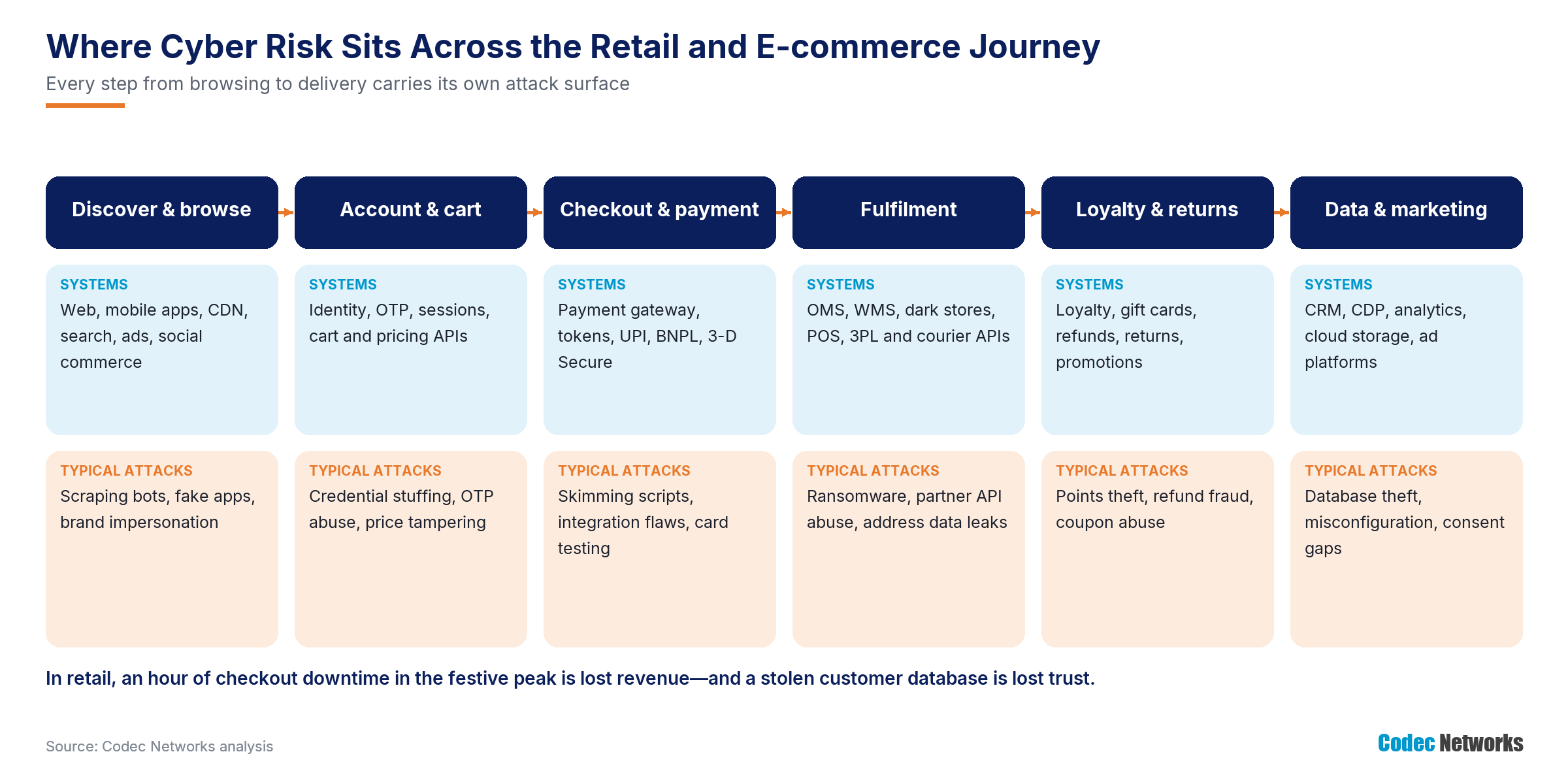
Figure 2: Where cyber risk sits across the retail and e-commerce journey.
|
Product / service |
Systems that deliver it |
Key cyber and compliance touchpoints |
|
Discover and browse |
Web and app storefronts, CDN, search, ads, social commerce |
Scraping and bot management, fake-app and domain monitoring, WAF tuning |
|
Account and cart |
Identity, OTP and session services, cart, pricing and coupon APIs |
ATO and credential-stuffing tests, business-logic testing, rate limits |
|
Checkout and payment |
Payment aggregator integration, hosted fields, tokens, UPI, BNPL, 3-D Secure |
Payment page script controls, integration review, PCI DSS scoping, RBI rules |
|
Fulfilment |
OMS, WMS, dark-store systems, POS, courier and 3PL APIs |
Segmentation, partner access controls, backups, store and POS assessments |
|
Loyalty and returns |
Loyalty engine, gift cards, refund and returns workflows, promotions |
Redemption and refund controls, velocity checks, fraud signal monitoring |
|
Data and marketing |
CRM, CDP, analytics warehouse, cloud storage, ad platforms |
Cloud posture, secrets management, DPDP consent and retention, DLP |
6. Trends that change the attack surface
|
Trend |
What is changing |
Security implication |
|
Quick commerce and dark stores |
Hundreds of micro-warehouses, rider fleets and franchise partners |
Many more sites, devices and partner identities to secure |
|
Mobile-first and API-first platforms |
Apps and public APIs replace the website as the primary channel |
API security, mobile app hardening and bot management become core |
|
Tokenisation and new payment methods |
Card-on-file tokens, UPI variants, BNPL and credit on UPI |
Integration security and payment page controls replace card storage controls |
|
ONDC and open commerce |
Buyer and seller apps interoperating over an open network |
New API trust boundaries and participant assurance |
|
AI personalisation and agentic shopping |
Recommendation engines, chatbots and AI agents that buy on behalf of users |
Prompt injection, data leakage and automated abuse join the threat list |
|
Regulatory formalisation |
CERT-In audits, PA Directions 2025, dark-pattern rules, DPDP |
Evidence-based assurance and privacy engineering replace informal practice |
7. Mapping operations to Codec Networks engagements
|
If the company operates… |
Recommended starting engagement |
|
A website, mobile app or public APIs |
Web, mobile and API VAPT with business-logic testing and pre-season retests |
|
A checkout with gateway, UPI, BNPL or saved cards |
Payment integration review, payment page script controls, PCI DSS v4.0.1 and RBI readiness |
|
Loyalty, gift cards, wallets or refunds at scale |
Account takeover testing, redemption and refund control review, fraud signal monitoring |
|
Stores, dark stores, WMS or franchisees |
Store, POS and WMS assessments; zero-trust partner access; backups and segmentation |
|
CRM, CDP or cloud analytics with customer data |
Cloud posture review, DPDP programme, data minimisation and DLP |
|
Festive or flash sales |
Load, API and DDoS resilience testing, bot management design, war-room exercises and SOC watch |
Talk to Codec Networks
|
Contact Codec Networks Pvt. Ltd. New Delhi: 507, 5th Floor, New Delhi House, Barakhamba Road, Connaught Place, New Delhi – 110001 Gurugram: 707, 7th Floor, Silverton Tower, Golf Course Extension Road, Sector 50, Gurugram – 122018, Haryana Landline: 011 430 496 96 | 011 437 522 99 Mobile: +91 99716 76124 | +91 88007 88220 | +91 88003 31124 Email: mktg@codecnetworks.com Web: www.codecnetworks.com |
Note: Descriptions are general and based on public information available as of October 2026. Systems and exposures differ by retailer and platform.