

Resources Categories
INDUSTRY FACT FILE · RETAIL & E-COMMERCE
Threat Landscape: Top Cyber Threats Facing Retail and E-commerce
The 18 most relevant cyber threats, attacks and industry challenges for retail chains, marketplaces, D2C brands, quick-commerce platforms and loyalty programmes, and the impact each one has on revenue, customers and partners.
|
In this document 1. The threat picture in numbers 2. Top 18 threats, attacks and challenges 3. Threat relevance by retail segment 4. Five priority threats in depth 5. Impact on retailers, platforms, partners and customers 6. How regulation turns incidents into business events 7. Questions every leadership team should ask |
1. The threat picture in numbers
|
59% Of retail web traffic is malicious bots (Imperva, 2025) |
£20 m ICO fine after Magecart skimming at British Airways (2018) |
US$18.5 m Target's multistate settlement for its vendor-led 2013 breach |
6 hours To report incidents to CERT-In |
Retailers attract three kinds of attacker. Fraudsters want what converts to money fastest: cards at the checkout, loyalty points, gift cards, refunds and accounts with saved payment methods. Data brokers want customer databases—names, phones, addresses and order histories—that fuel phishing and resale. Ransomware groups want leverage, and nothing creates leverage like a retailer whose stores, warehouses and apps stop in the festive season. The attack surface is unusually public: storefronts and APIs are open to anyone, third-party scripts run inside the checkout, and partners from couriers to franchisees hold access.
Landmark incidents show the pattern. Target (2013) lost about 40 million card records through an HVAC vendor's credentials and paid an US$18.5 million multistate settlement; British Airways (2018) was fined £20 million after Magecart skimming code harvested more than 400,000 customers' details; Marks & Spencer (2025) estimated a £300 million profit impact after ransomware entered through a contractor. In India, BigBasket (2020), Juspay (2020), Domino's India (2021) and boAt (2024) each saw millions of customer records offered online; Verizon's 2025 DBIR found third-party involvement in 30% of breaches and ransomware in 44%, and Imperva measured bad bots at 59% of retail traffic.
2. Top 18 threats, attacks and challenges
The list below is a practical assessment framework, not a statistical ranking. Priority varies by business model, technology exposure and existing controls.
|
# |
Threat / attack / challenge |
Typical scenario |
Most exposed |
Potential impact |
|
1 |
Web, mobile and API vulnerabilities |
Injection, broken access control, IDOR and logic flaws in storefronts and apps |
All online retailers |
Data theft, fraud, outage |
|
2 |
Payment page skimming (Magecart) |
Malicious scripts on checkout pages copy card details as they are typed |
Any site with card entry |
Card fraud, fines, PCI consequences |
|
3 |
Account takeover and credential stuffing |
Leaked passwords replayed against login and OTP flows |
Apps with saved cards or points |
Fraud, refunds, churn |
|
4 |
Malicious bots: scraping, scalping, hoarding |
Automated traffic scrapes prices, hoards stock and tests cards |
Marketplaces, electronics, quick commerce |
Lost sales, cost, unfair outcomes |
|
5 |
Loyalty, coupon, refund and return fraud |
Abuse of points, promo codes, refunds and return policies |
Chains, fashion, quick commerce |
Direct margin loss |
|
6 |
Festive-season DDoS and capacity attacks |
Volumetric and application-layer floods during sales |
Marketplaces, large retailers |
Checkout outage on peak days |
|
7 |
Customer database theft and leaks |
CRM, order and loyalty data exfiltrated or exposed |
All retailers |
DPDP exposure, phishing of customers, trust loss |
|
8 |
Third-party scripts, plugins and vendor compromise |
Tags, widgets, plugins and SaaS with access to the platform |
D2C brands, omnichannel |
Platform-wide compromise |
|
9 |
Ransomware across stores, warehouses and HQ |
Encryption of ERP, OMS, WMS, POS back-ends and file servers |
Chains, quick commerce |
Stores and deliveries stop |
|
10 |
POS, in-store network and kiosk attacks |
Flat store networks, legacy terminals, exposed kiosks |
Retail chains, omnichannel |
Card and store data theft |
|
11 |
Phishing, fake apps and brand impersonation |
Look-alike sites, apps and festive offers targeting customers and staff |
All retailers |
Customer fraud, credential theft |
|
12 |
Cloud and SaaS misconfiguration |
Open storage, leaked keys, excessive permissions |
Cloud-native retailers, D2C |
Mass data exposure |
|
13 |
Insider and privileged misuse |
Staff, agencies or support teams abuse access to data or refunds |
All retailers |
Theft, fraud, leaks |
|
14 |
Seller, delivery partner and franchisee exposure |
Partner portals, courier APIs and franchise access abused |
Marketplaces, quick commerce |
Data exposure, platform access |
|
15 |
Payment integration and tokenisation weaknesses |
Flawed gateway integration, token or webhook handling |
All online retailers |
Payment manipulation, card exposure |
|
16 |
Gift card and stored-value fraud |
Brute-forced or stolen gift cards and wallet balances |
Chains, loyalty operators |
Cash-equivalent loss |
|
17 |
Weak detection and slow incident reporting |
No visibility across platform, cloud, stores and partners |
Most retailers |
Long dwell time; missed 6-hour window |
|
18 |
Backup, recovery and continuity gaps |
Untested restores of OMS, WMS and POS systems |
All retailers |
Days of lost sales |
3. Threat relevance by retail segment
The matrix is a qualitative guide for prioritising the first round of security reviews.
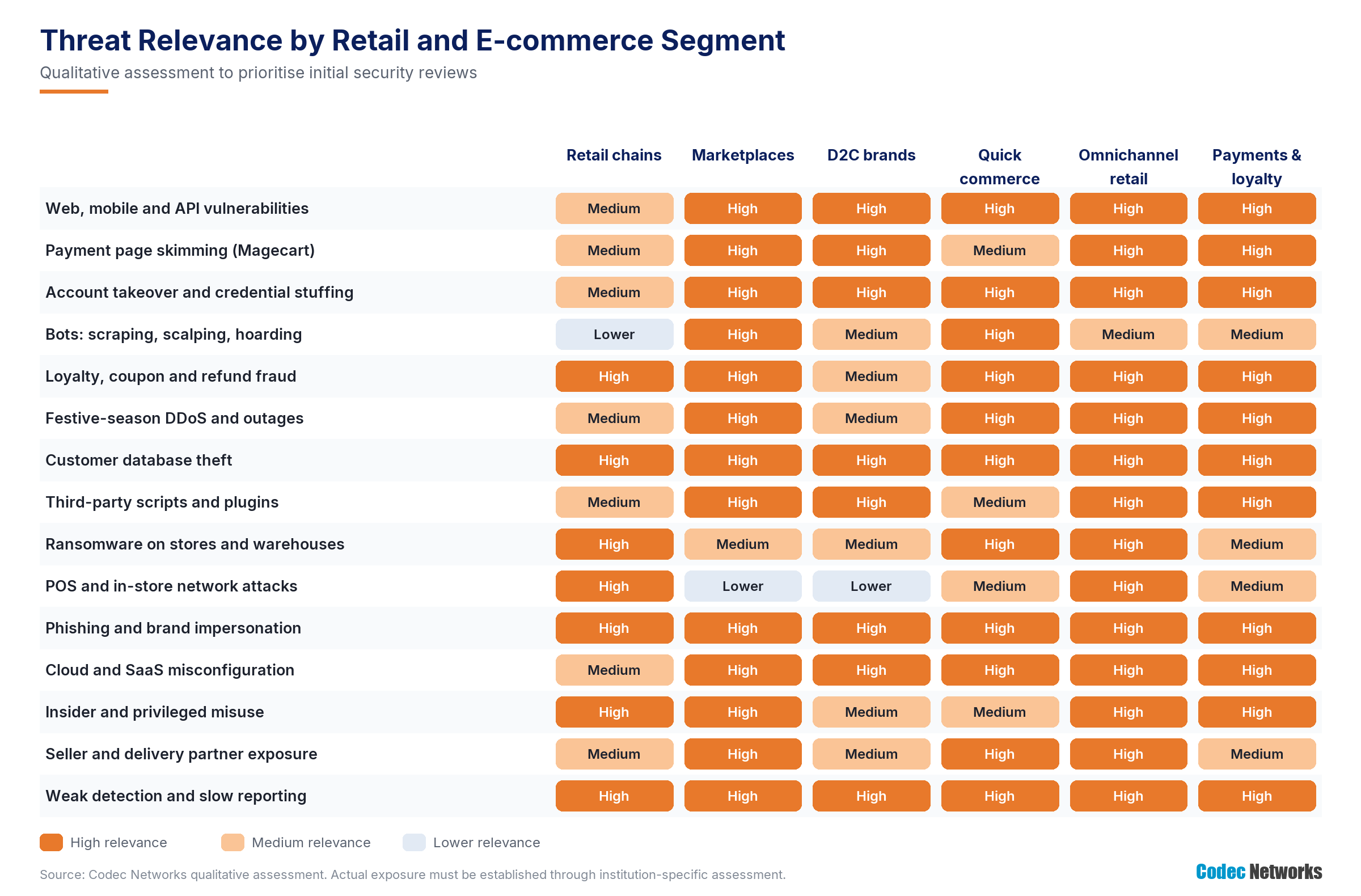
Figure 5: Qualitative threat relevance by retail segment (Codec Networks assessment).
4. Five priority threats in depth
4.1 Payment page skimming and the third-party script problem
Magecart-style attacks do not break the gateway; they compromise a script already trusted by the checkout—an analytics tag, a chat widget, a plugin—and copy card details before tokenisation happens. British Airways' 2018 breach ran for just over two weeks and cost a £20 million fine; PCI DSS v4.0.1 now expects an inventory of payment page scripts and tamper detection.
- Questions to test: Which scripts load on our payment page and who can change them? Are card fields isolated in hosted or tokenised components? Would we detect a modified script? Does each script vendor meet our security requirements?
- Relevant services: payment page script review, tamper detection design, payment integration testing, third-party script risk assessment.
4.2 Account takeover, bots and the festive peak
Leaked passwords and automated tools make account takeover industrial. Bots that hoard stock, test stolen cards and scrape prices are 59% of retail traffic, and DDoS-for-hire attacks are timed for sale days when every minute of checkout downtime is lost revenue.
- Questions to test: Do login and OTP flows resist credential stuffing? Are cart and checkout APIs rate-limited and bot-managed? Have we load- and DDoS-tested at peak volumes? Who is in the war room on sale day?
- Relevant services: ATO and credential-stuffing testing, bot management design, load and DDoS resilience testing, festive-season SOC watch and drills.
4.3 Customer data and the DPDP clock
Retailers hold more personal data than most banks—every address, phone number and purchase. The BigBasket, Domino's India and boAt leaks show how quickly that data reaches forums and feeds phishing. From May 2027 the DPDP Rules add consent, retention and breach-intimation duties on top of CERT-In's six-hour reporting.
- Questions to test: Where does customer data live—CRM, CDP, cloud exports, agencies? Who can reach it? Is it minimised and encrypted? Could we detect and report a leak in six hours and intimate affected customers?
- Relevant services: data mapping, cloud posture and secrets review, DPDP programme, DLP and monitoring, breach workflow.
4.4 Ransomware and partner access across stores and dark stores
Retail estates are distributed: hundreds of stores, dark stores and franchisees connected to central OMS, WMS and POS back-ends. Target's HVAC vendor and Marks & Spencer's contractor show that a partner's credentials are the easiest way in, and a ransomware event at the centre stops every site at once.
- Questions to test: Which partners, franchisees and vendors can reach our core systems? Is access brokered with MFA and least privilege? Are WMS, OMS and POS back-ends segmented? Are backups immutable and restores tested?
- Relevant services: zero-trust partner access design, segmentation review, backup and restore testing, third-party risk programme, EDR and SOC.
4.5 Loyalty, refunds and stored value
Points, gift cards, wallets and refund workflows are cash equivalents sitting behind consumer-grade authentication. Attackers take over accounts, redeem points to gift cards and resell them within hours; organised refund fraud exploits generous return policies and support processes.
- Questions to test: Can points and gift cards be redeemed without step-up authentication? Are redemption and refund velocities monitored? Are support agents able to override controls? Do fraud and security teams share signals?
- Relevant services: business-logic testing of loyalty and refund flows, redemption controls, fraud signal integration into SOC, insider and agent access review.
5. Impact on retailers, platforms, partners and customers
|
Player type |
Threats to prioritise |
Main impact |
|
Marketplaces and quick-commerce platforms |
API abuse, bots, DDoS, partner compromise, data leaks |
Peak-day outages, seller and customer churn, disclosure |
|
Retail chains and omnichannel retailers |
Ransomware, POS attacks, loyalty fraud, data theft |
Store and delivery stoppage, fraud losses, SEBI disclosure |
|
D2C brands |
Plugin and script compromise, cloud exposure, impersonation |
Customer data leaks, card fraud, investor concern |
|
Payment, loyalty and gift card operators |
Stored-value fraud, integration flaws, card data exposure |
Direct financial loss, partner and RBI consequences |
|
Customers, sellers and partners |
Phishing with real order data, account takeover, fake offers |
Financial loss, loss of trust in the brand |
6. How regulation turns incidents into business events
- CERT-In: incidents reported within six hours of noticing them; logs available for investigation.
- RBI and payment partners: card data incidents trigger aggregator, acquirer and card-network processes, forensic investigation and potential penalties.
- PCI DSS: a breach involving cardholder data leads to a PCI forensic investigation and re-validation.
- Consumer protection: complaints about fraud, failed refunds or deceptive interfaces reach grievance officers and the CCPA.
- SEBI LODR: listed retailers disclose cyber incidents and data loss in the quarterly corporate governance report.
- DPDP: incidents involving customer personal data trigger breach intimation to the Data Protection Board and affected individuals once provisions commence in May 2027.
|
Insight The most damaging retail incidents start outside the retailer's own code—in a third-party script, a partner's credentials, a leaked password list or an open cloud bucket. Visibility over scripts, partners, identities and data, tested before every peak, is the best defence. |
7. Questions every leadership team should ask
- Which scripts run on our payment page, and who approved them?
- Would our checkout survive sale day under a bot and DDoS attack?
- If leaked passwords were replayed against our app tonight, how many accounts would fall?
- Where is every copy of our customer database, and who can reach it?
- Which partner or franchisee could bring ransomware into our core systems?
- Could we detect, contain and report an incident within six hours while keeping stores and deliveries running?
Talk to Codec Networks
|
Contact Codec Networks Pvt. Ltd. New Delhi: 507, 5th Floor, New Delhi House, Barakhamba Road, Connaught Place, New Delhi – 110001 Gurugram: 707, 7th Floor, Silverton Tower, Golf Course Extension Road, Sector 50, Gurugram – 122018, Haryana Landline: 011 430 496 96 | 011 437 522 99 Mobile: +91 99716 76124 | +91 88007 88220 | +91 88003 31124 Email: mktg@codecnetworks.com Web: www.codecnetworks.com |
Note: Threat descriptions and relevance ratings are general guidance, not findings about any specific organisation. Public incident references are summarised from widely reported events and company disclosures.