

Resources Categories
INDUSTRY FACT FILE · SAAS & ENTERPRISE SOFTWARE
Threat Landscape: Top Cyber Threats Facing SaaS and Enterprise Software Vendors
The 18 most relevant cyber threats, attacks and industry challenges for ERP, CRM, HRMS, collaboration, cybersecurity and business application vendors.
|
In this document 1. The threat picture in numbers 2. Top 18 threats, attacks and challenges 3. Threat relevance by SaaS segment 4. Five priority threats in depth 5. Impact on SaaS vendors and their customers 6. How regulation turns incidents into business events 7. Questions every leadership team should ask |
1. The threat picture in numbers
|
6 hours To report incidents to CERT-In |
2024 Stolen credentials hit customer accounts without MFA on a major data platform |
2025 Stolen OAuth tokens from an integration exported many firms' CRM data |
May 2027 Most DPDP obligations take effect |
Attackers target SaaS platforms because one weakness can expose many customers. They probe tenant isolation and APIs, steal OAuth tokens from integrations, use info-stealer logs to take over accounts and support sessions, and exploit vulnerable dependencies.
Widely reported incidents—credential-based access to customer accounts on a major cloud data platform (2024), a breach of a large identity provider's support system (2023) and OAuth token theft from a third-party chat integration used to export CRM data (2025)—show how trust paths around the product become attack paths.
2. Top 18 threats, attacks and challenges
The list below is a practical assessment framework, not a statistical ranking. Priority varies by business model, technology exposure and existing controls.
|
# |
Threat / attack / challenge |
Typical scenario |
Most exposed |
Potential impact |
|
1 |
Tenant isolation flaws |
One tenant can read or change another's data |
All multi-tenant platforms |
Mass customer exposure |
|
2 |
Broken API authorisation |
APIs return objects without ownership checks |
API-heavy products |
Data exposure at scale |
|
3 |
Customer account takeover |
Credential stuffing and info-stealer logs |
Platforms without default MFA |
Data theft and extortion |
|
4 |
OAuth and integration token theft |
Breached integrations reuse tokens |
CRM and collaboration |
Bulk exports |
|
5 |
Support-tool and admin abuse |
Stolen support sessions or insider misuse |
Vendors with impersonation features |
Multi-tenant breaches |
|
6 |
Vulnerable dependencies |
Exploitable open-source components |
All vendors |
Compromise and emergency patching |
|
7 |
Build and supply-chain compromise |
Tampered builds or updates |
Software and security vendors |
Malicious releases |
|
8 |
Cloud misconfiguration |
Public storage, over-broad IAM |
Cloud-native vendors |
Data exposure |
|
9 |
Secrets in code and pipelines |
Keys exposed in repositories or logs |
All vendors |
Infrastructure takeover |
|
10 |
Ransomware on hosting estate |
Encryption of production or backups |
Vendors with self-managed infrastructure |
Outages for all customers |
|
11 |
Business-logic abuse |
Workflow flaws, e.g. payroll or approval bypass |
ERP and HRMS |
Fraud |
|
12 |
AI feature data leakage |
Prompt injection or cross-tenant retrieval |
Products with AI assistants |
Confidentiality breaches |
|
13 |
DDoS and availability attacks |
Floods against apps and APIs |
High-visibility platforms |
SLA breaches |
|
14 |
Insider access to customer data |
Staff misuse production access |
All vendors |
Trust loss |
|
15 |
Insecure webhooks and events |
Unsigned or replayable callbacks |
Integration platforms |
Data tampering |
|
16 |
Weak customer-facing logging |
Customers cannot investigate incidents |
Smaller vendors |
Slow joint response |
|
17 |
Weak detection and response |
Limited production monitoring |
Early-stage vendors |
Missed 6-hour reporting |
|
18 |
Backup and recovery failure |
Untested restores or shared backups |
All vendors |
Data loss |
3. Threat relevance by SaaS segment
The matrix is a qualitative guide for prioritising the first round of security reviews.
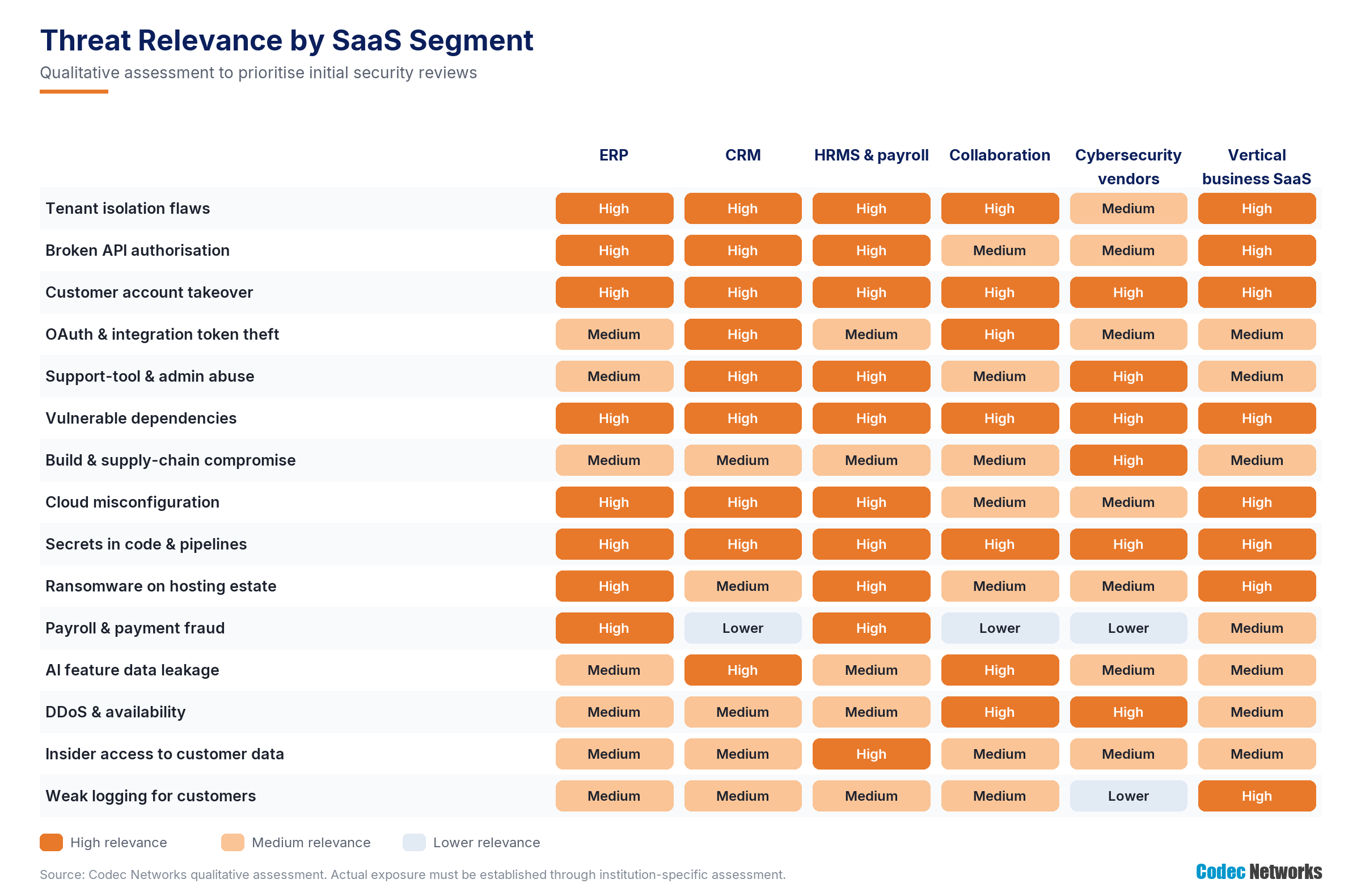
Figure 5: Qualitative threat relevance by SaaS segment (Codec Networks assessment).
4. Five priority threats in depth
4.1 Tenant isolation
Multi-tenant products often pass a tenant or object ID in requests. If the server trusts it instead of binding the tenant from the session, any customer admin can read others' data.
- Questions to test: Is the tenant bound server-side on every endpoint, cache, export and background job? Are isolation tests automated in CI?
- Relevant services: tenant isolation testing, secure code review, CI authorisation tests.
4.2 Integration and OAuth tokens
Integrations hold long-lived tokens to many customers' tenants. Breaching one integration vendor can expose all of them.
- Questions to test: Are scopes minimal and tokens short-lived? Are bulk exports by integrations monitored? Can tokens be revoked quickly?
- Relevant services: OAuth and API reviews, integration vendor assessments, export monitoring.
4.3 Account takeover and support sessions
Info-stealer malware harvests passwords and session cookies. Without default MFA and session binding, attackers log in as customers—or as support staff with access to many tenants.
- Questions to test: Is MFA on by default for admins? Are support sessions just-in-time and customer-approved? Are sessions bound to devices?
- Relevant services: identity and session testing, support-tool reviews, SOC use cases.
4.4 Dependencies and SBOMs
Most products include hundreds of open-source components. When a critical vulnerability is published, vendors without an SBOM struggle to know if they are affected.
- Questions to test: Is there an SBOM per release? Are dependencies scanned continuously? Are patch SLAs defined?
- Relevant services: SCA and SBOM programme, vulnerability disclosure process.
4.5 Detection and the 6-hour clock
CERT-In requires reporting within six hours of noticing an incident, and customers expect prompt notice and logs to investigate their own exposure.
- Questions to test: Are production, identity and API logs monitored 24x7? Can customers access audit logs? Is there a customer-notification playbook?
- Relevant services: managed SOC, playbooks, tabletop exercises, IR retainer.
5. Impact on SaaS vendors and their customers
|
Player type |
Threats to prioritise |
Main impact |
|
ERP and HRMS vendors |
Tenant isolation, business-logic abuse |
Financial and employee data exposure |
|
CRM vendors |
Integration token theft, bulk exports |
Customer data breaches |
|
Collaboration platforms |
Account takeover, external sharing |
Confidential communications exposed |
|
Cybersecurity vendors |
Supply-chain and update compromise |
Privileged access to customer estates |
|
Customers |
Inherited product weaknesses |
Breaches, outages and regulatory exposure |
6. How regulation turns incidents into business events
- CERT-In: incidents reported within six hours of noticing them.
- Customers: contracts require prompt notification, logs and cooperation, and may trigger audits, credits or termination.
- Customer regulators: BFSI customers may need to report vendor-caused incidents to RBI, SEBI or IRDAI.
- Privacy: customers as data fiduciaries must intimate personal data breaches to the Data Protection Board once DPDP breach provisions commence in May 2027; EU customers may have GDPR duties.
- Certifications: incidents are examined in SOC 2 and ISO 27001 audits.
|
Insight In SaaS, the most dangerous paths are the trusted ones: support tools, integrations and admin features. Test them as thoroughly as the customer-facing application. |
7. Questions every leadership team should ask
- Could one tenant read another tenant's data through any endpoint, export or job?
- Which integrations hold tokens to our customers, and with what scopes?
- Is MFA on by default for customer admins and support staff?
- Do we have an SBOM for every release we support?
- Could we report an incident to CERT-In within six hours and notify every affected customer?
- Can we hand customers current test reports and SOC 2 or ISO 27001 evidence?
Talk to Codec Networks
|
Contact Codec Networks Pvt. Ltd. New Delhi: 507, 5th Floor, New Delhi House, Barakhamba Road, Connaught Place, New Delhi – 110001 Gurugram: 707, 7th Floor, Silverton Tower, Golf Course Extension Road, Sector 50, Gurugram – 122018, Haryana Landline: 011 430 496 96 | 011 437 522 99 Mobile: +91 99716 76124 | +91 88007 88220 | +91 88003 31124 Email: mktg@codecnetworks.com Web: www.codecnetworks.com |
Note: Threat descriptions and relevance ratings are general guidance, not findings about any specific organisation. Public incident references are summarised from widely reported events.