

Resources Categories
INDUSTRY FACT FILE · SPACE, SATELLITE & GEOSPATIAL SERVICES
Main Products and Services in Space, Satellite and Geospatial Services
What India's satellite makers and operators, launch start-ups, ground station and teleport operators, satcom providers, earth observation and geospatial platforms and navigation vendors deliver, the systems behind each, and where those systems create cyber and compliance exposure.
|
In this document 1. How space and geospatial businesses create value 2. Products and services by organisation type 3. The space and ground layers: satellites, launch, ground stations and mission control 4. The service layer: satcom, earth observation, geospatial and location 5. The systems behind the products and services 6. Trends that change the attack surface 7. Mapping operations to Codec Networks engagements |
1. How space and geospatial businesses create value
|
Revenue stream |
How it works |
Security relevance |
|
Satellite and component sales |
Satellites, buses, payloads and subsystems sold to government, commercial and export customers |
Design IP, supplier integrity, flight software security |
|
Launch services |
Dedicated and rideshare launches sold per mission or per kilogram |
Engineering IT, range and test facility OT, customer data |
|
Ground station services |
Antenna time, TT&C and data downlink sold per pass or by subscription |
Shared infrastructure, vendor access, scheduling integrity |
|
Satellite communication services |
Capacity, VSAT, broadband, maritime and aero connectivity sold to enterprises and government |
NMS and terminal security, licence conditions, availability |
|
Earth observation and geospatial data |
Imagery, analytics, maps and digital twins sold by licence, subscription or project |
API security, data handling, sensitive attributes |
|
Navigation and location solutions |
Receivers, telematics, location SDKs and APIs sold per device or per call |
Location privacy, signal resilience, API abuse |
2. Products and services by organisation type
|
Organisation type |
Main products and services |
Key systems |
|
Satellite manufacturers |
Small satellites, buses, payloads, integration and testing, in-orbit support |
CAD and PLM, flight software repositories, test benches, cleanroom OT |
|
Component and subsystem suppliers |
Onboard computers, radios, star trackers, propulsion, solar arrays |
Embedded firmware, build systems, supplier portals |
|
Satellite operators |
Satellite capacity, EO data collection, constellation services |
Mission control, TT&C, key management, flight dynamics tools |
|
Launch service start-ups |
Small launch vehicles, engines, launch campaigns |
Engineering IT, test stands, range networks, telemetry systems |
|
Ground station and teleport operators |
Antenna access, TT&C, downlink, ground-station-as-a-service |
Antenna control units, modems, baseband, scheduling, cloud links |
|
Satcom providers |
VSAT, broadband, backhaul, maritime, aero and mobile satellite services |
Hubs, gateways, NMS, terminal update servers, customer portals |
|
EO, geospatial and location platforms |
Imagery, tasking, analytics, maps, GIS, telematics and location APIs |
Cloud platforms, data archives, APIs, SDKs, identity |
3. The space and ground layers: satellites, launch, ground stations and mission control
A satellite mission begins in engineering. Satellite makers and component suppliers hold designs in CAD and product lifecycle management systems, write flight software and firmware in repositories and build pipelines, and test hardware on benches and in cleanrooms whose equipment is itself networked. Launch start-ups run engine test stands, telemetry systems and range networks alongside ordinary business IT. These environments hold valuable intellectual property, and they are where the integrity of everything that flies is decided: a tampered component, a backdoored library or a compromised build server can travel into orbit, where it is very hard to fix. Because suppliers often deliver software and firmware as finished images, makers need ways to verify what they receive and to keep test benches isolated and monitored.
Once in orbit, a satellite is operated from mission control through telemetry, tracking and command links, usually via a network of ground stations. Ground stations and teleports run antenna control units, modems and baseband equipment, scheduling systems that allocate passes and links to mission control and to cloud platforms that receive data. More of this is shared: one teleport may serve several operators, and ground-station-as-a-service models let operators book antenna time through a web portal and receive data directly in the cloud. That efficiency concentrates risk. Vendor remote access to antennas and modems, flat networks between customers, and portals that control scheduling are attractive targets, and the security of command paths and the custody of command and encryption keys decide whether an intruder can only disrupt a pass or can interfere with the spacecraft itself. Radio frequency links can also be jammed or interfered with, and testing their resilience is legitimate only when authorised and carried out in controlled conditions under the applicable licences.
4. The service layer: satcom, earth observation, geospatial and location
Satellite communication providers run hubs and gateways that connect satellites to terrestrial networks, network management systems that configure capacity and terminals, and fleets of user terminals at bank branches, mines, ships, aircraft, telecom towers and homes. Terminals receive firmware and configuration updates from management servers, which makes the management plane the most powerful part of the network. The 2022 KA-SAT attack showed what happens when that plane is breached: a misconfigured VPN gave attackers access, and a destructive update disabled tens of thousands of modems at once. In India, satcom services are licensed by the Department of Telecommunications under conditions that include security, interception and monitoring requirements, and licensees fall under the Telecom Cyber Security Rules 2024, so the security of hubs, NMS and update servers is both an operational and a licence question.
Earth observation, geospatial and location businesses deliver their products as data. EO platforms take tasking requests, schedule collections, process imagery and deliver it through portals and APIs; geospatial firms build maps, GIS layers, survey products and digital twins for government, infrastructure, agriculture and insurance clients; and location vendors provide GNSS and NavIC receivers, fleet telematics, mobile SDKs and location APIs. Their main attack surface is the cloud platform and the API. A broken authorisation check can reveal another customer's orders or imagery, an exposed storage bucket can publish an archive, and an old, unauthenticated API version can leak months of precise movement histories. The Geospatial Data Guidelines' list of sensitive attributes, customer confidentiality terms and the DPDP Act, which applies to the location data of identifiable people, make data handling as important as uptime. Location services also need to cope with GNSS interference, which Indian airports reported in 2025.
|
Highest-risk moments Integrating a new supplier's subsystem or software, launch campaigns and final integration, commissioning a new ground station or opening one to new customers, granting vendor remote access to antennas or hubs, pushing a terminal firmware update across the network, launching a new tasking or location API version, migrating ground systems to the cloud, onboarding foreign partners or investors, applying for IN-SPACe authorisation or a telecom licence, and staff exits from mission or engineering roles are where space and geospatial incidents typically begin or escalate. |
5. The systems behind the products and services
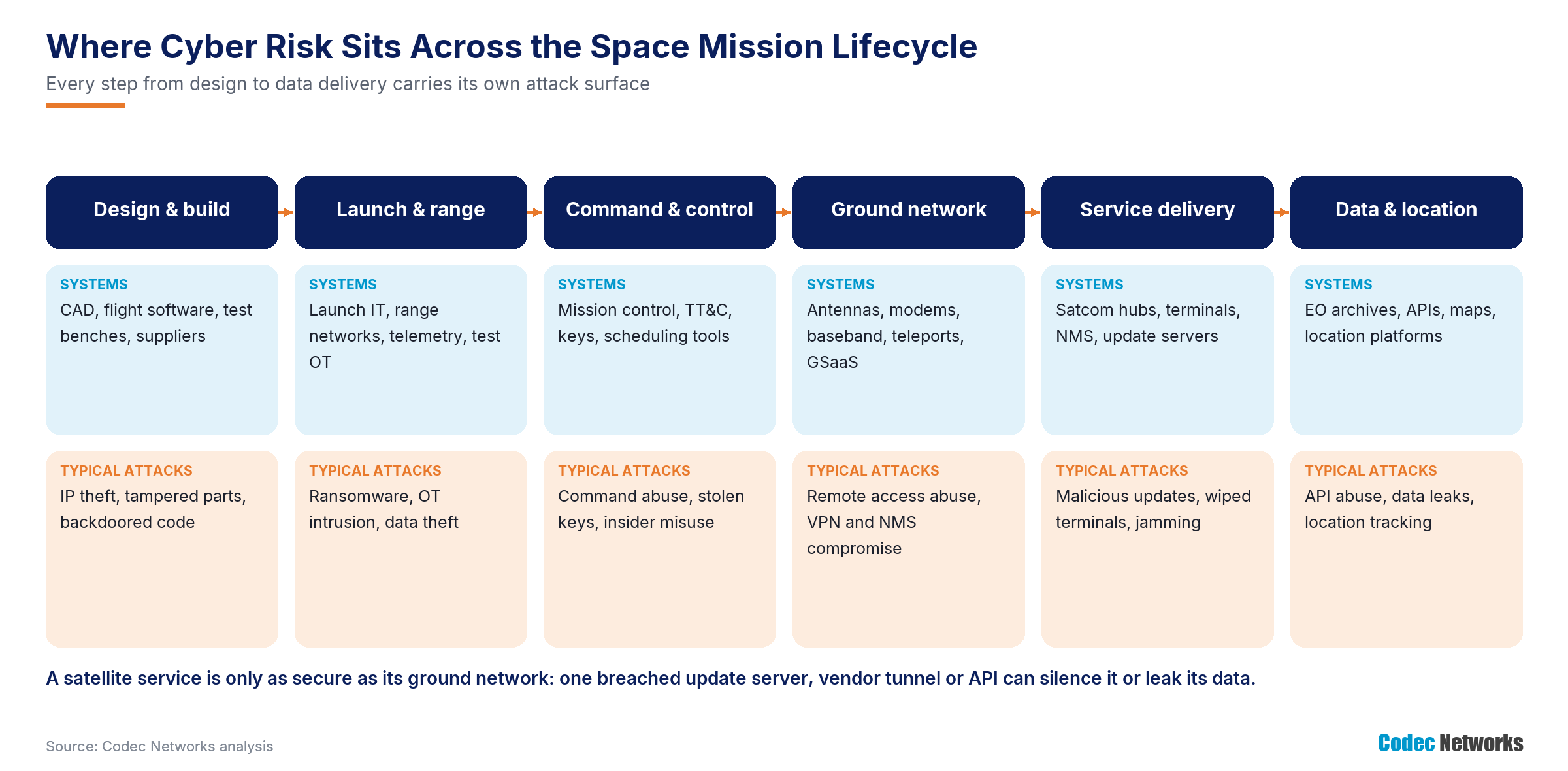
Figure 2: Where cyber risk sits across the space mission lifecycle.
|
Product / service |
Systems that deliver it |
Key cyber and compliance touchpoints |
|
Design and build |
CAD and PLM, flight software repositories, build servers, test benches, suppliers |
Secure SDLC, software integrity, SBOMs, supplier assurance, IP protection |
|
Launch and range |
Engineering IT, test stands, range networks, telemetry systems |
OT segmentation, ransomware readiness, recovery testing |
|
Command and control |
Mission control, TT&C software, flight dynamics, command and encryption keys |
Privileged access, key custody, command authorisation, monitoring |
|
Ground network |
Antenna control, modems, baseband, scheduling, GSaaS portals |
Segmentation, vendor access control, VAPT, logging |
|
Service delivery |
Satcom hubs, gateways, NMS, terminal update servers |
MFA on management planes, signed updates, staged roll-outs, SOC |
|
Data and location |
EO archives, tasking and delivery APIs, maps, location SDKs |
API authorisation, tenant isolation, DPDP minimisation, sensitive attributes |
6. Trends that change the attack surface
|
Trend |
What is changing |
Security implication |
|
Private launch and satellite growth |
Start-ups build and operate satellites and launch vehicles under IN-SPACe authorisation |
Young firms hold valuable IP and safety-critical systems with lean security teams |
|
Shared and cloud ground segments |
Ground-station-as-a-service and cloud delivery of satellite data |
Tenant isolation, portal security and cloud configuration become critical |
|
Low-earth-orbit broadband |
LEO constellations and new satcom licensees serve Indian users |
Terminal fleets, gateways and licence security conditions grow |
|
Foreign capital and partners |
FDI liberalisation and international collaboration |
Due diligence, ownership and data flow questions in every deal |
|
Geospatial liberalisation |
Self-certification for most mapping and data products since 2021 |
Data handling, sensitive attributes and API security carry the risk |
|
Space cyber regulation abroad |
The proposed EU Space Act and NIS2 cover space operators and ground assets |
Testing, risk management and incident reporting expectations rise |
7. Mapping operations to Codec Networks engagements
|
If the organisation operates… |
Recommended starting engagement |
|
A satellite or component manufacturing business |
Engineering IT and IP protection review, supplier and software integrity assessment, test bench segmentation review |
|
Satellite operations and mission control |
Mission control and TT&C review, privileged access and command key custody review, SOC monitoring |
|
A launch vehicle programme |
Range and test facility OT assessment, engineering IT VAPT, ransomware readiness and recovery testing |
|
Ground stations, teleports or GSaaS |
Ground network VAPT, vendor access and segmentation review, portal and cloud testing |
|
Satcom networks and terminals |
Hub, NMS and update server assessment, management VPN review, licence security condition support |
|
EO, geospatial or location platforms |
API and multi-tenant VAPT, cloud review, DPDP and sensitive attribute data handling review |
Talk to Codec Networks
|
Contact Codec Networks Pvt. Ltd. New Delhi: 507, 5th Floor, New Delhi House, Barakhamba Road, Connaught Place, New Delhi – 110001 Gurugram: 707, 7th Floor, Silverton Tower, Golf Course Extension Road, Sector 50, Gurugram – 122018, Haryana Landline: 011 430 496 96 | 011 437 522 99 Mobile: +91 99716 76124 | +91 88007 88220 | +91 88003 31124 Email: mktg@codecnetworks.com Web: www.codecnetworks.com |
Note: Descriptions are general and based on public information available as of October 2026. Systems and exposures differ by organisation, mission, authorisation, licence and agreements in force. Radio frequency and link testing is described only as authorised testing in controlled environments, coordinated with the customer and any required licences and permissions.