

Resources Categories
INDUSTRY FACT FILE · SPACE, SATELLITE & GEOSPATIAL SERVICES
Threat Landscape: Top Cyber Threats Facing Space and Satellite Businesses
The 18 most relevant cyber threats, attacks and industry challenges for satellite makers and operators, launch start-ups, ground station and teleport operators, satcom providers, earth observation and geospatial platforms and navigation vendors, and the impact each has.
|
In this document 1. The threat picture in numbers 2. Top 18 threats, attacks and challenges 3. Threat relevance by space, satellite and geospatial segment 4. Five priority threats in depth 5. Impact on space and geospatial businesses and their customers 6. How regulation turns incidents into business events 7. Questions every leadership team should ask |
1. The threat picture in numbers
|
100+ Cyber attacks a day on ISRO, per its chairman (2023) |
~30,000 Modems Viasat shipped after the AcidRain attack |
~5,800 Wind turbines cut off from remote control (2022) |
6 hours To report incidents to CERT-In |
Space and geospatial businesses face attackers with very different aims. State-linked groups seek designs, mission data and access to satellite services that matter in a crisis, and the KA-SAT attack of February 2022 showed that a satellite service can be disabled at the moment it is most needed. Criminal groups use ransomware against manufacturers, launch firms, teleports and platform providers because downtime during integration, a launch campaign or a satellite pass creates pressure to pay. Opportunistic attackers scan the internet for exposed antenna controllers, modems, management interfaces, remote desktop services and storage buckets. Researchers and curious customers find flaws in APIs and terminals, which become public quickly. Insiders and contractors with shared operator or vendor accounts can misuse access to command systems and data, and suppliers deep in the chain can introduce weaknesses without anyone noticing.
Public reporting shows how these risks are moving. On 24 February 2022 attackers used the management network of the KA-SAT service to deliver the AcidRain wiper to modems; Viasat said tens of thousands of terminals were disabled, Enercon reported that about 5,800 wind turbines lost remote monitoring, and the EU, UK and US attributed the attack to Russia in May 2022. CISA and the FBI followed with an advisory to satcom providers and customers. ISRO's chairman said in October 2023 that the agency faces more than 100 cyber attacks a day, and he spoke of building onboard cyber defences for spacecraft. GNSS interference reports near Indian airports in 2025 show that location services cannot assume a clean signal. Regulators are responding: India's Telecom Cyber Security Rules of November 2024 reach satcom licensees, and the proposed EU Space Act would require cyber risk management, testing and incident reporting from space operators, including for ground infrastructure.
2. Top 18 threats, attacks and challenges
The list below is a practical assessment framework, not a statistical ranking. Priority varies by business model, technology exposure and existing controls.
|
# |
Threat / attack / challenge |
Typical scenario |
Most exposed |
Potential impact |
|
1 |
Ground station and teleport network intrusion |
Attackers reach antenna controllers, modems, baseband or scheduling systems through exposed services or flat networks |
Ground stations, teleports, GSaaS providers |
Missed passes, lost downlinks, multi-customer outages |
|
2 |
Mission control and command (TT&C) compromise |
Misuse of mission control access or command keys to send unauthorised commands |
Satellite operators, mission control teams |
Loss of control, damaged spacecraft, mission loss |
|
3 |
Link jamming, spoofing and interception |
Intentional interference with uplinks and downlinks, or interception of unencrypted links |
Satcom providers, EO operators, ground stations |
Service disruption, exposed traffic and data |
|
4 |
User terminal and modem firmware attacks |
Malicious or destructive firmware pushed to user terminals and modems |
Satcom providers and their enterprise users |
Mass terminal outage, costly replacement |
|
5 |
Network management plane and VPN misconfiguration |
Weak VPN accounts or misconfiguration expose the network management plane |
Satcom providers, ground station operators |
Network-wide compromise and malicious updates |
|
6 |
Earth observation and geospatial API flaws |
Broken authorisation in tasking, ordering and delivery APIs exposes other clients' data |
EO and geospatial platforms |
Client data exposure, lost government contracts |
|
7 |
Cloud ground segment and GSaaS misconfiguration |
Misconfigured cloud accounts, storage and portals in cloud-delivered ground systems |
GSaaS providers, EO platforms, operators |
Data leaks, portal takeover, scheduling abuse |
|
8 |
Privileged access and shared operator accounts |
Shared logins and standing privileges on mission, ground and cloud systems |
Operators, ground stations, start-ups |
Untraceable actions, insider misuse |
|
9 |
Component and software supply chain compromise |
Tampered components, subsystem software or libraries from suppliers |
Satellite makers, integrators, operators |
Hidden functions in orbit, recalls, delays |
|
10 |
Flight software and onboard update integrity |
Unverified flight software builds or in-orbit updates |
Satellite makers and operators |
Malfunction or loss of control in orbit |
|
11 |
Theft of designs, payload data and mission IP |
Theft of designs, test data, payload data and proposals by outsiders or leavers |
Makers, launch start-ups, EO firms |
Lost advantage, export control exposure |
|
12 |
Ransomware on engineering, production and business IT |
Encryption of CAD, PLM, ERP and production systems |
Makers, launch start-ups, suppliers |
Missed launch windows and delivery dates |
|
13 |
GNSS and NavIC interference affecting location services |
Jamming or spoofing degrades positions used by receivers and location apps |
Navigation vendors, telematics and fleet users |
Wrong positions, service failures, safety risk |
|
14 |
Location data privacy and tracking exposure |
Precise movement histories of people exposed through SDKs, APIs or storage |
Location platforms, telematics vendors |
DPDP exposure, client and public distrust |
|
15 |
Mishandling of sensitive geospatial attributes |
Sensitive attributes or client-restricted areas published in maps and datasets |
Geospatial and mapping firms |
Regulatory scrutiny, client sanctions |
|
16 |
Launch range, test facility and OT network attacks |
Intrusion into test stand, cleanroom, range and telemetry networks |
Launch start-ups, satellite makers |
Test failures, safety incidents, delays |
|
17 |
Vendor, integrator and remote support access |
Always-on vendor tunnels and shared support accounts into ground and hub systems |
Ground stations, satcom providers, operators |
Unmonitored access, supply chain intrusion |
|
18 |
Weak logs, monitoring and 6-hour reporting |
No ground network, NMS, cloud and API logging or 24x7 monitoring |
Start-ups, smaller operators, platforms |
Missed reporting, unprovable timelines |
3. Threat relevance by space, satellite and geospatial segment
The matrix is a qualitative guide for prioritising the first round of security reviews.
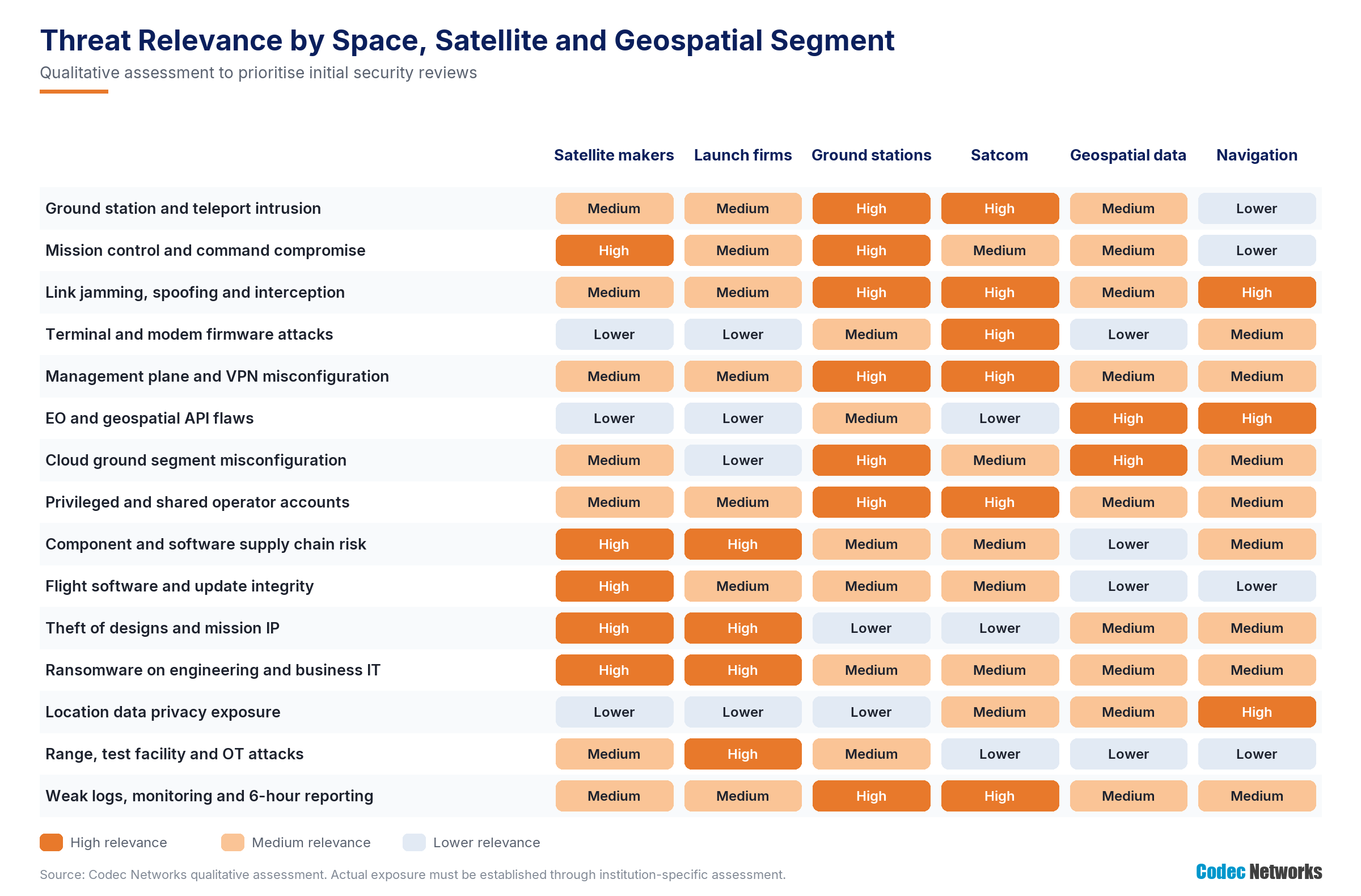
Figure 5: Qualitative threat relevance by space, satellite and geospatial segment (Codec Networks assessment).
4. Five priority threats in depth
4.1 Ground stations and the management plane
Most attacks on space services land on the ground. Antenna controllers, modems, baseband equipment and scheduling systems are often reachable from vendor tunnels or corporate networks, and satcom network management systems and update servers control thousands of terminals. The KA-SAT attack began with a misconfigured VPN into the management network and ended with destructive updates to tens of thousands of modems. Shared teleports and ground-station-as-a-service models add a further risk: one compromised customer or portal can affect others.
- Questions to test: Can anyone reach our antenna control, baseband or NMS from the internet or office network? Is every management and vendor account named and protected with MFA? Are update servers segmented and monitored? Do terminals reject unsigned or downgraded firmware? Are customers isolated from each other?
- Relevant services: ground network and teleport VAPT, NMS and update server assessment, segmentation design, vendor access review and managed SOC monitoring of management planes.
4.2 Command paths and key custody
Whoever can send authenticated commands controls a satellite. Mission control software, TT&C systems, flight dynamics tools and the keys that authenticate and encrypt commands are the crown jewels, yet they are often reached through shared accounts, standing privileges and engineering laptops. Weak custody of keys, or command systems that trust any user on the mission network, can turn a stolen password into a mission-ending event.
- Questions to test: Who can send commands, and how is each command authorised and logged? Where are command and encryption keys held, and who can use them? Are mission networks isolated from corporate IT? Are privileged sessions recorded? Would we notice an unusual command or pass booking?
- Relevant services: mission control and TT&C reviews, privileged access and key custody assessments, segmentation reviews, and SOC use cases for command and scheduling anomalies.
4.3 APIs, cloud platforms and data delivery
Earth observation, geospatial and location businesses sell through cloud platforms and APIs. Broken object-level authorisation, where an API trusts an order or customer identifier sent by the client, is a common and serious flaw, and old API versions, exposed storage and weak tenant isolation can leak imagery of sensitive sites or movement histories of people. Government and enterprise buyers increasingly ask for evidence that these platforms have been tested.
- Questions to test: Does every API check that the caller may see the object requested? Are old API versions retired? Is tenant isolation tested in every release? Is storage private by default with expiring links? Would we notice bulk downloads or enumeration?
- Relevant services: API and multi-tenant VAPT, cloud configuration review, DevSecOps pipeline review, abuse monitoring and DPDP data handling reviews.
4.4 Supply chain and flight software integrity
Satellites integrate components and software from many suppliers, often delivered as finished images that are hard to inspect, and fixing a flaw after launch is difficult or impossible. A breached supplier build server, a malicious open-source library or a counterfeit part can introduce hidden functions that only surface in orbit. Buyers, investors and foreign partners increasingly ask makers to show how they assure what they integrate.
- Questions to test: Do we hold SBOMs for flight and ground software? Do we verify supplier images against hashes or signatures? Are integration test benches isolated and monitored? Do contracts require suppliers to notify us of incidents? Are critical suppliers assessed each year?
- Relevant services: supplier and component assurance, SBOM and software integrity reviews, secure SDLC reviews, test bench segmentation and incident response for supplier compromise.
4.5 Location services and navigation resilience
Navigation receivers, telematics and location apps depend on GNSS and NavIC signals that can be degraded by jamming or falsified by spoofing, and they collect precise location data that reveals where people live, work and travel. Designs need to detect unreliable positions, cross-check other sources and fail safely, and location data needs minimisation, short retention and strong API controls under the DPDP Act.
- Questions to test: Do our receivers and apps detect position jumps or integrity loss? Are fallbacks tested? How long do we keep precise location histories, and who can query them? Are SDKs collecting more than they need? Are location APIs authenticated and monitored?
- Relevant services: location platform and SDK testing, DPDP programmes for location data, authorised resilience testing in controlled environments under the applicable permissions, and API abuse monitoring.
5. Impact on space and geospatial businesses and their customers
|
Player type |
Threats to prioritise |
Main impact |
|
Satellite makers and suppliers |
Supply chain compromise, IP theft, ransomware, flight software integrity |
Delivery delays, lost contracts, export and partner scrutiny |
|
Satellite operators |
Command misuse, key compromise, ground network intrusion |
Loss of control, service outages, customer claims |
|
Launch start-ups |
Ransomware, OT intrusion at test and range sites, IP theft |
Missed launch windows, safety incidents, investor concern |
|
Ground stations and satcom providers |
Management plane compromise, vendor access abuse, terminal attacks |
Multi-customer outages, licence and SLA consequences |
|
EO, geospatial and location platforms |
API flaws, cloud misconfiguration, location data exposure |
Client data leaks, DPDP exposure, loss of government work |
|
Customers and the public |
Lost connectivity, exposed imagery and movement histories |
Disrupted operations, privacy harm, loss of confidence |
6. How regulation turns incidents into business events
- CERT-In: incidents reported within six hours of noticing them; logs kept for 180 days in India and available for investigation; CERT-In may issue directions and advisories.
- Telecom Cyber Security Rules 2024: telecom entities, including satcom licensees, report security incidents within six hours with details within 24 hours, and the government may order audits or public disclosure.
- IN-SPACe and the Department of Space: incidents affecting authorised space objects or ground systems can raise questions under the terms of authorisation.
- NCIIPC: where a service supports notified protected systems in critical sectors, incidents draw in the protected system owner and NCIIPC.
- DPDP Act: breach intimation and safeguards for personal and location data once provisions commence; SEBI LODR disclosure for listed firms.
- Customers and partners: government buyers, telecom operators and foreign partners can suspend contracts, demand audits or exercise security clauses after incidents.
|
Insight The most damaging space incidents have not needed attacks on satellites. They begin with a vendor VPN account, a flat ground network, a shared mission control login, an API that trusts the client or a supplier image nobody verified, and end as silenced terminals, missed passes or leaked data. Testing ground networks, command paths, APIs, access and suppliers together is the best defence. |
7. Questions every leadership team should ask
- If our management network were breached, could it push a malicious update to every terminal?
- Who can reach our antennas, mission control and command keys today, including vendors, and with what authentication?
- Does every API that sells imagery or location data check who is asking, every time?
- Can we verify the integrity of every component and software image we integrate?
- How long do we keep precise location data, and who can query it?
- Could we detect, contain and report a ground segment incident within six hours, including at night?
Talk to Codec Networks
|
Contact Codec Networks Pvt. Ltd. New Delhi: 507, 5th Floor, New Delhi House, Barakhamba Road, Connaught Place, New Delhi – 110001 Gurugram: 707, 7th Floor, Silverton Tower, Golf Course Extension Road, Sector 50, Gurugram – 122018, Haryana Landline: 011 430 496 96 | 011 437 522 99 Mobile: +91 99716 76124 | +91 88007 88220 | +91 88003 31124 Email: mktg@codecnetworks.com Web: www.codecnetworks.com |
Note: Threat descriptions and relevance ratings are general guidance, not findings about any specific organisation, satellite or service. Public incident references are summarised from official statements and widely reported events. Interference threats are described only at the level needed to explain defences, and testing is described only as authorised testing in controlled environments, coordinated with the customer and any required licences and permissions.