

Resources Categories

INDUSTRY FACT FILE · TEXTILES, APPAREL & CONSUMER MANUFACTURING
Threat Landscape: Top Cyber Threats Facing Textiles, Apparel and Consumer Manufacturing
The 18 most relevant cyber threats, attacks and industry challenges for mills, exporters, footwear and consumer goods manufacturers, brand owners and D2C arms, and the impact each one has on shipments, designs, payments and consumers.
|
In this document 1. The threat picture in numbers 2. Top 18 threats, attacks and challenges 3. Threat relevance by textiles, apparel and consumer manufacturing segment 4. Five priority threats in depth 5. Impact on manufacturers, brands, buyers and suppliers 6. How regulation turns incidents into business events 7. Questions every leadership team should ask |
1. The threat picture in numbers
|
35.5 mn Consumers affected in VF Corp's December 2023 incident |
US$100 m Net sales Hanesbrands lost to ransomware in Q2 2022 |
72,231 Levi's customers notified after credential stuffing, June 2024 |
6 hours To report incidents to CERT-In |
Textile, apparel and consumer manufacturers attract ransomware groups because a stopped shipment in season is expensive and visible; they attract fraudsters because export proceeds, supplier advances and buyer remittances move by email instruction across time zones; they attract competitors because designs, tech packs, lasts and costings are easy to copy and hard to protect; and brands and D2C arms attract credential-stuffing and skimming crews because they hold consumer accounts, loyalty value and card data. The attack surface spans flat plant networks, cloud ERP and PLM, buyer portals, email and consumer platforms built from third-party scripts.
Public incidents show the pattern. VF Corporation's December 2023 incident disrupted order fulfilment and exposed data on about 35.5 million consumers; Hanesbrands' May 2022 ransomware attack limited order fulfilment for about three weeks and cost roughly US$100 million in net sales; Levi Strauss notified 72,231 customers after a June 2024 credential-stuffing attack; and Adidas disclosed in May 2025 that consumer contact data had been taken from a third-party customer service provider. IBM X-Force ranks manufacturing the most attacked industry for the fifth consecutive year. Indian exporters, manufacturers and brands run the same platforms and face the same adversaries.
2. Top 18 threats, attacks and challenges
The list below is a practical assessment framework, not a statistical ranking. Priority varies by business model, technology exposure and existing controls.
|
# |
Threat / attack / challenge |
Typical scenario |
Most exposed |
Potential impact |
|
1 |
Ransomware halting mills and shipments |
ERP, cutting-room, document or plant systems encrypted in season |
All manufacturers |
Missed vessels, air freight, penalties |
|
2 |
ERP, invoicing and export document compromise |
Attackers alter or encrypt orders, e-invoices, packing lists and customs documents |
Exporters, mills |
Shipments stop; compliance failures |
|
3 |
E-commerce and D2C platform attacks |
Web skimming, injection and plug-in abuse on brand sites and apps |
Brand owners, D2C arms |
Card data theft, outages in sale events |
|
4 |
Credential stuffing and account takeover |
Leaked passwords replayed against consumer accounts and loyalty |
Brand owners, D2C arms |
Fraud, consumer complaints, breach duties |
|
5 |
Business email compromise |
Spoofed buyer, supplier or executive emails change bank details |
Exporters, all finance teams |
Loss of export proceeds and advances |
|
6 |
Theft of designs and tech packs |
Designs, lasts, costings and samples copied by insiders or contractors |
Exporters, footwear, brands |
Copied products, lost buyers |
|
7 |
Buyer and brand data exposure |
Purchase orders, pricing and compliance records leaked from portals or shares |
Exporters, contract manufacturers |
Contract breaches, lost programmes |
|
8 |
Job-worker and supplier compromise |
A processor or trim supplier's outage starves lines |
Exporters, consumer goods |
Delivery failures without being attacked |
|
9 |
Third-party service provider breaches |
Customer service, marketing or logistics providers leak data |
Brands, D2C arms |
Consumer breaches, regulatory exposure |
|
10 |
Phishing and credential theft |
Merchandisers, finance and IT staff targeted |
All companies |
Initial access |
|
11 |
Flat office and plant networks |
No separation between office IT and production machines |
Mills, factories |
Office malware reaching lines |
|
12 |
Legacy machine controllers |
Unsupported Windows on cutting, knitting and embroidery machines |
Mills, footwear, factories |
Easy exploitation, no vendor fixes |
|
13 |
OEM remote access to machines |
Standing vendor connections to automation |
Automated plants |
Unmonitored path into production |
|
14 |
Insider and contractor misuse |
Large, mobile workforces and contractors abuse access |
All companies |
Theft, fraud, data loss |
|
15 |
Counterfeits and brand abuse online |
Fake stores, domains and social accounts impersonate brands |
Brand owners, D2C arms |
Lost sales, consumer harm, reputation |
|
16 |
Cloud ERP, PLM and SaaS misconfiguration |
Exposed tenants, excessive sharing, weak identity |
Cloud-first companies |
Data exposure, outage |
|
17 |
Weak detection and incident response |
No monitoring across units, cloud and e-commerce |
Most companies |
Long dwell time; missed 6-hour reporting |
|
18 |
Backup and recovery failure |
Backups encrypted, untested or missing PLM and documents |
All companies |
Weeks of downtime |
3. Threat relevance by textiles, apparel and consumer manufacturing segment
The matrix is a qualitative guide for prioritising the first round of security reviews.
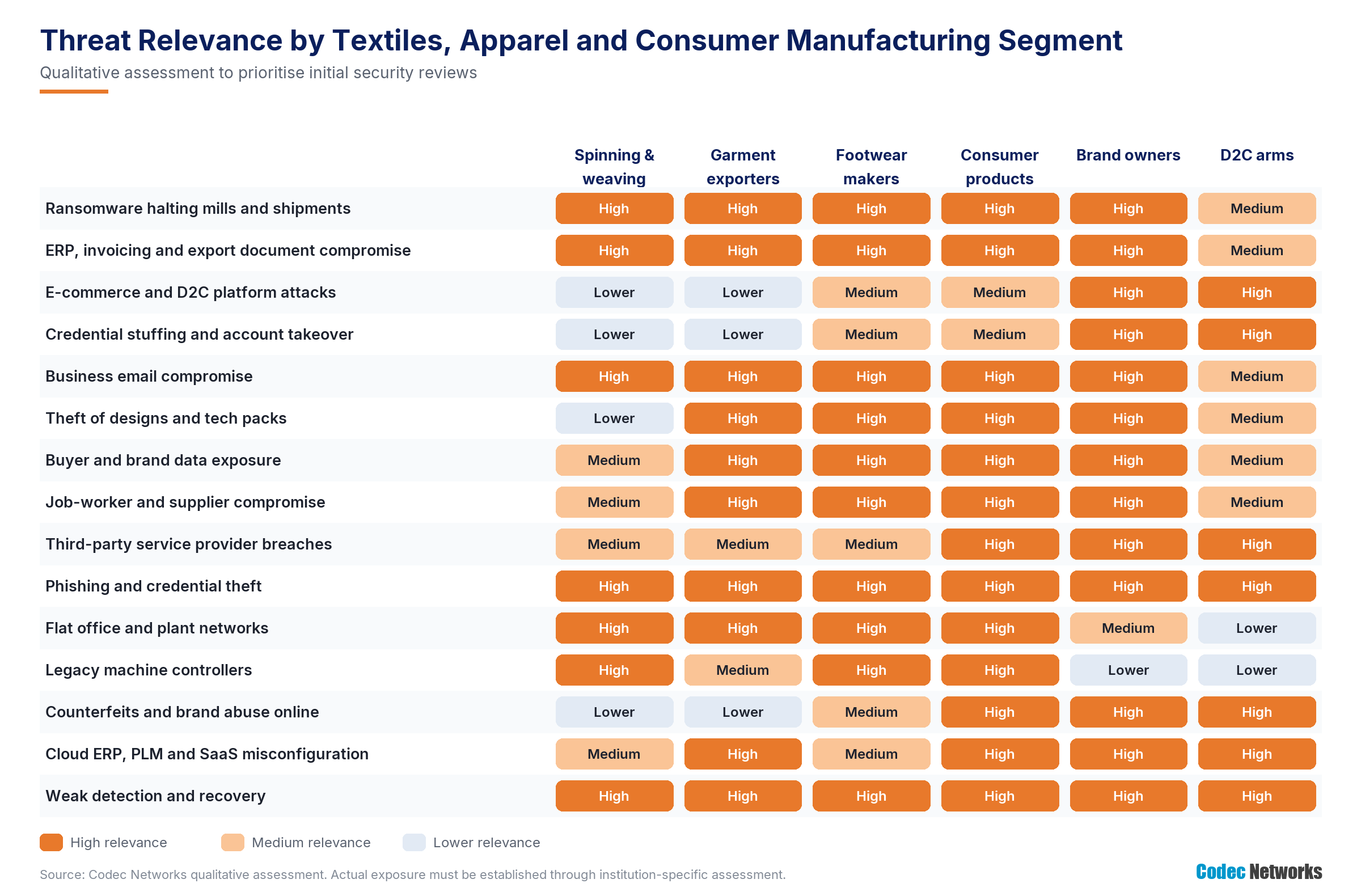
Figure 5: Qualitative threat relevance by textiles, apparel and consumer manufacturing segment (Codec Networks assessment).
4. Five priority threats in depth
4.1 Ransomware and the shipment calendar
Attackers rarely need to touch a sewing line to stop an exporter. Encrypting ERP, the cutting-room system and export documents removes the ability to plan, pack, invoice and clear goods; the vessel sails without the order, as Hanesbrands' three-week fulfilment disruption and VF Corp's replenishment delays illustrate.
- Questions to test: Which packing, invoicing, e-invoicing and customs processes depend on ERP? Can we ship manually and lawfully for a week? Are backups immutable and restores tested? Would EDR and the SOC catch the intrusion before encryption?
- Relevant services: dependency mapping, segmentation, backup and recovery testing, EDR validation, crisis exercises.
4.2 Business email compromise and export proceeds
Export trade runs on email: purchase orders, approvals, invoices and bank details. Attackers who read a merchandiser's mailbox learn the payment cycle and insert new bank details from a look-alike domain at the right moment; losses are rarely recovered and disputes damage buyer relationships.
- Questions to test: Is MFA enforced on every mailbox? Do buyers and suppliers verify bank-detail changes by an agreed second channel? Do we monitor look-alike domains and mailbox rules? Have finance and merchandising been tested with simulations?
- Relevant services: mailbox hardening, verification procedures, look-alike domain monitoring, BEC simulation, SOC.
4.3 Designs, tech packs and contractors
A season's value sits in tech packs, lasts, patterns and costings shared with designers, contractors and buyers in cloud folders. Access is rarely reviewed, downloads are not monitored and contractor accounts outlive projects—so copies appear on marketplaces before launch.
- Questions to test: Is design data classified and access-restricted by need? Are contractor and leaver accounts removed on the last day? Are bulk downloads monitored? Could we prove what was taken?
- Relevant services: data classification, DLP, access and contractor reviews, activity monitoring, forensic readiness.
4.4 D2C platforms, credential stuffing and skimming
Brand sites and apps hold consumer accounts, loyalty value and card data, and are built from SaaS and third-party scripts owned by marketing. Credential stuffing takes over accounts, skimming scripts steal cards at checkout and sale events amplify both—Levi's 72,231 affected accounts show the scale.
- Questions to test: Are sites, APIs and apps tested before launch and each release? Are bot management, rate limiting and MFA in place? Are third-party scripts controlled and checkout PCI DSS-aligned? Does the SOC see account takeover patterns?
- Relevant services: web, API and mobile testing, bot controls, script integrity, PCI DSS readiness, SOC fraud detection.
4.5 Suppliers, service providers and the 6-hour clock
Job-workers, trim suppliers, logistics partners and customer service providers hold your production and your data; their incidents become yours, as Adidas' provider breach shows. Few manufacturers monitor beyond the office, so incidents are found late and reported late against CERT-In's six-hour expectation.
- Questions to test: Which suppliers and providers could stop deliveries or leak consumer data? Have they been assessed and contracted for security and notification? Are units, cloud and e-commerce monitored 24x7? Is there a playbook covering CERT-In reporting, buyer notification and disclosure?
- Relevant services: supplier assurance programme, contract clauses, SOC, playbooks, joint exercises.
5. Impact on manufacturers, brands, buyers and suppliers
|
Player type |
Threats to prioritise |
Main impact |
|
Listed integrated groups |
Ransomware across units, D2C breaches, disclosure |
Multi-unit stoppage, market disclosure, lender scrutiny |
|
Exporters |
Shipment stoppage, BEC, buyer data leaks, design theft |
Missed seasons, lost proceeds, lost programmes |
|
Mills, processors and job-workers |
Ransomware, BEC, being the weak supplier |
Lost customers, financial loss |
|
Brand owners and D2C arms |
Account takeover, skimming, provider breaches, counterfeits |
Consumer harm, DPDP breach duties, reputation |
|
Buyers and consumers |
Supplier outages, leaked data, copied products |
Their own delays, fraud and privacy harm |
6. How regulation turns incidents into business events
- CERT-In: incidents reported within six hours of noticing them; logs available for investigation.
- SEBI LODR: listed companies disclose cyber incidents and data loss in the quarterly corporate governance report.
- DPDP: incidents involving consumer, loyalty, employee or worker personal data trigger breach intimation once provisions commence in May 2027.
- Buyers: vendor contracts require incident notification and can suspend programmes pending independent assessment.
- PCI DSS and payment partners: card data incidents trigger forensic investigation and acquirer obligations.
- EU CRA: manufacturers of connected consumer products sold in the EU report actively exploited vulnerabilities and severe incidents from September 2026.
|
Insight The most damaging incidents in this sector cross boundaries—from a mailbox into a buyer's payment, from a contractor's account into next season's designs, from a marketing plug-in into consumers' cards, from a job-worker into your lines. Strong identity, controlled sharing, tested recovery and visibility across units, cloud and channels are the best defence. |
7. Questions every leadership team should ask
- If ERP went dark tonight, would this week's shipment sail—and lawfully?
- Could a convincing email move our export proceeds or a supplier advance?
- Who can still download our designs, and would we know?
- Could our D2C site survive a sale-day credential-stuffing and skimming attack?
- Which job-worker or service provider could stop our deliveries or leak our consumers' data?
- Could we detect, contain and report an incident within six hours and tell our buyers what happened?
Talk to Codec Networks
|
Contact Codec Networks Pvt. Ltd. New Delhi: 507, 5th Floor, New Delhi House, Barakhamba Road, Connaught Place, New Delhi – 110001 Gurugram: 707, 7th Floor, Silverton Tower, Golf Course Extension Road, Sector 50, Gurugram – 122018, Haryana Landline: 011 430 496 96 | 011 437 522 99 Mobile: +91 99716 76124 | +91 88007 88220 | +91 88003 31124 Email: mktg@codecnetworks.com Web: www.codecnetworks.com |
Note: Threat descriptions and relevance ratings are general guidance, not findings about any specific organisation. Public incident references are summarised from widely reported events and company disclosures.